Module 02 · From Understanding to Preparation and From Modeling to Evaluation
Lesson Summary: From Modeling to Evaluation课程总结:从建模到评估
Congratulations! You have completed this lesson. At this point in the course, you know 恭喜!您已完成本课程。此时,您已了解
- The end goal of the Modeling stage is that the data model answers the business question.
建模阶段的目标是数据模型能够回答业务问题。 - The data modeling process uses a training data set. Data scientists test multiple algorithms on the training set data to determine whether the variables are required and whether the data supports answering the business question. The outcome of those models are either descriptive or predictive.
数据建模过程使用训练数据集。数据科学家在训练集数据上测试多种算法,以确定变量是否必要以及数据是否支持回答业务问题。这些模型的输出结果要么是描述性的,要么是预测性的。
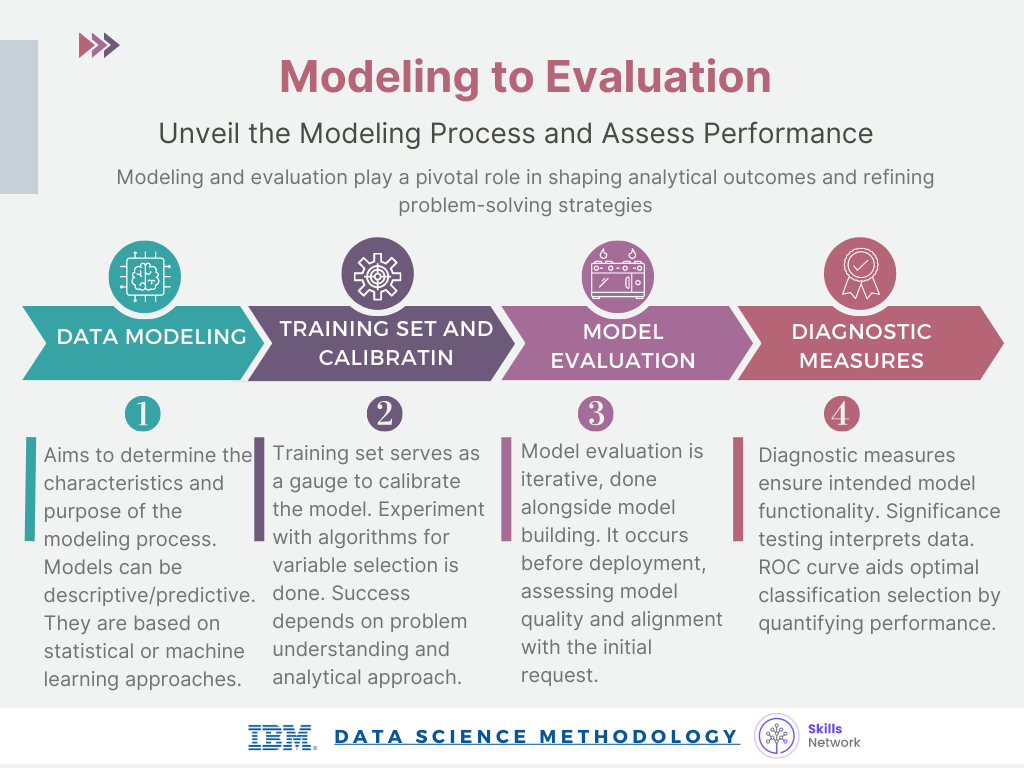
- The Evaluation phase consists of two stages, the diagnostic measures phase, and the statistical significance phase.
评估阶段包括两个阶段,即诊断度量阶段和统计显著性阶段。 - During the Evaluation stage, data scientists and others assess the quality of the model and determine if the modelanswers the initial Business Understanding question or if the data model needs adjustment.
在评估阶段,数据科学家和其他相关人员评估模型的质量,并确定模型是否回答了初始的业务理解问题,或者数据模型是否需要调整。 - The ROC curve, known as the receiver operating characteristic curve, is a useful diagnostic tool for determining the optimal classification model. This curve quantifies how well a binary classification model performs, declassifying the yes and no outcomes when some discrimination criterion is varied.
ROC曲线,即受试者工作特征曲线,是一种用于确定最佳分类模型的实用诊断工具。该曲线量化了二元分类模型的表现,当某些区分标准变化时,对"是"和"否"的结果进行去分类。