Module 02 · Biology of Skin
Types of Skin Cells皮肤细胞类型
Did you know that your skin is not just a cover but a bustling city of diverse cells, each with a unique job to do? Imagine a world where tiny workers toil day and night to protect, repair, and beautify the city you live in—that’s exactly what’s happening right under your skin! From the keratinocytes acting as the city’s robust walls to the melanocytes, which produce molecules akin to sun-protective umbrellas, each cell plays a vital role in keeping this city—your skin—vibrant and lively.
你知道你的皮肤不仅仅是一层保护层,而是一个充满各种细胞的繁忙城市,每个细胞都有其独特的功能吗?想象一个世界,微小的工人日夜不停地工作,保护、修复和美化你所居住的城市——这就是正在你皮肤下发生的事情!从作为城市坚固墙壁的角质形成细胞,到产生类似于防晒伞分子的黑色素细胞,每个细胞都在维持这个城市——你的皮肤——充满活力和生机中发挥着至关重要的作用。
These names are probably new to you but don’t worry, you’re not expected to recall the name of each cell type from memory. What we would like you to see is how each type has a specific job to do in supporting your skin’s overall health.
这些名称可能对你来说很陌生,但不用担心,你不需要记住每种细胞类型的名称。我们希望你能看到的是,每种类型都有其特定的功能,以支持你皮肤的整体健康。
| Type of Cell 细胞类型 | How They Help Your Skin 它们如何帮助你的皮肤 |
|---|---|
| Keratinocytes 角质形成细胞 | These are the main players in your skin’s outer layer. They make keratin, which keeps your skin strong and waterproof. Think of them as your skin’s shield against the world. 它们是皮肤外层的主要组成部分。它们产生角蛋白,使皮肤坚韧且防水。可以将它们视为皮肤抵御外界侵害的盾牌。 |
| Melanocytes 黑色素细胞 | Melanocytes make melanin, the stuff that gives your skin its color and helps provide some protection from the sun’s UV rays. 黑色素细胞产生黑色素,这种物质赋予皮肤颜色,并有助于提供对紫外线的一些保护。 |
| Langerhans Cells 朗格汉斯细胞 | These cells are like tiny sentinels in your skin, helping to identify unwanted chemical or particle intruders. They’re a key part of your skin’s defense team. 这些细胞如同皮肤中的微小哨兵,帮助识别不需要的化学物质或颗粒入侵者。它们是皮肤防御团队的关键组成部分。 |
| Merkel Cells 黑色素瘤细胞 | These cells live deep in your skin and are connected to your nerves. They help you feel things, like the softness of a kitten or the sun’s warmth. 这些细胞存在于您皮肤的深层,并与您的神经相连。它们帮助您感知事物,例如小猫的柔软或阳光的温暖。 |
| Fibroblasts 成纤维细胞 | Imagine these cells as your skin’s builders. They produce collagen and elastin, making your skin stay firm and bouncy. Without them, we’d all look a lot older! 想象这些细胞是您皮肤的建造者。它们产生胶原蛋白和弹性蛋白,使您的皮肤保持紧致和有弹性。没有它们,我们都会看起来老得多! |
| Adipocytes (Fat Cells) 脂肪细胞 | These cells are like your skin’s cushion. They store fat for energy and help keep your skin looking plump and smooth. They’re like the padding that keeps everything comfy and soft. 这些细胞就像皮肤里的垫子。它们储存脂肪以获取能量,并帮助保持皮肤丰满光滑。它们就像让一切舒适柔软的衬垫。 |
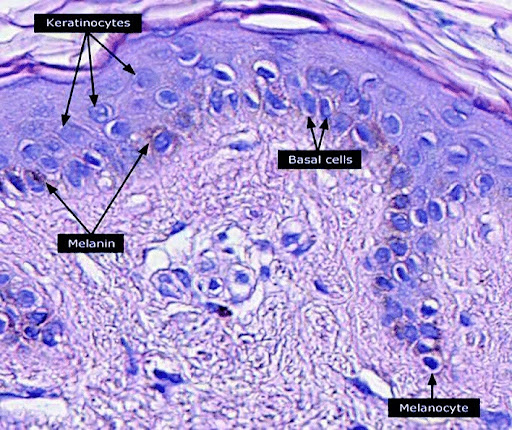
In this micrograph (Setijanti et al., 2019), you can see keratinocytes and melanocytes, two of the skin cell types we discussed here. If they look the same to you, don’t worry; this course does not expect you to be able to identify them from a micrograph, but you may be curious to see what they look like under a microscope.
在这张显微照片(Setijanti 等人,2019 年)中,你可以看到角质形成细胞和黑色素细胞,这是我们在这里讨论的两种皮肤细胞类型。如果你觉得它们看起来一样,不用担心;本课程不要求你能够从显微照片中识别它们,但你可能想看看它们在显微镜下的样子。
References: 参考文献:
- Setijanti, H.B., Rusmawati, E., Fitria, R., Erlina, T., Adriany, R., Murtiningsih. (2019). Development of the technique for the preparation and characterization of reconstructed human epidermis (RHE). In: H. Kojima, T. Seidle, H. Spielmann. (Eds),* Alternatives to animal testing*. Springer, Singapore. https://doi.org/10.1007/978-981-13-2447-5_3
Setijanti, H.B., Rusmawati, E., Fitria, R., Erlina, T., Adriany, R., Murtiningsih. (2019). 重建人表皮(RHE)制备和表征技术的开发。收录于 H. Kojima, T. Seidle, H. Spielmann. (编), 动物实验替代方法。新加坡斯普林格出版社。https://doi.org/10.1007/978-981-13-2447-5_3 - Goldsmith, L. A. (Ed.). (1991). Physiology, biochemistry, and molecular biology of the skin. Oxford University Press.
Goldsmith, L. A. (编). (1991). 皮肤的生理学、生物化学和分子生物学。牛津大学出版社。 - Venus, M., Waterman, J., & McNab, I. (2010). Basic physiology of the skin. *Surgery *(Oxford), 28(10), 469–472.
金星,M.,沃特曼,J.,& 麦克纳布,I. (2010)。皮肤的基本生理学。外科手术(牛津),28(10),469–472。 - Wickett, R. R., & Visscher, M. O. (2006). Structure and function of the epidermal barrier. American Journal of Infection Control, 34(10), S98–S110.
威克特,R. R.,& 维斯彻,M. O. (2006)。表皮屏障的结构与功能。美国感染控制杂志,34(10),S98–S110。