Module 01 · Categories and Distinctions类型与区别
Reading - Basic Legal Terms基本法律术语阅读
Suggested Reading 建议阅读
Introduction to Basic Legal Terms 法律术语简介
**Action: **Case, cause, suit or controversy disputed or contested before a court of justice.
诉讼:在司法机关争议或诉讼的案件、原因、诉讼或争议。
**Affirm: **To declare a judgement, decree or order is valid and must stand as rendered below.
维持原判:宣布一项裁决、法令或命令有效,必须维持下级法院的原判。
**A Fortiori: **Literally, with stronger reason. A logic term used to label an argument claiming that because one ascertained fact exists, therefore another, analogous fact must also exist.
A Fortiori:字面意思是“更有理由”。一个逻辑术语,用于标记一个论证,声称因为一个确定的事实存在,因此另一个类似的事实也必须存在。
Amicus Curiae: Literally, a friend of the court. A person with strong interest in or views on the subject matter of an action, but not a party to the action, may petition the court for permission to file a brief, ostensibly on behalf of a party but actually to suggest a rationale consistent with its own views.
法庭之友:字面意思是法庭的朋友。对诉讼标的具有强烈兴趣或观点的人,但不是诉讼当事人,可以请求法院许可提交简报,表面上代表一方当事人,实际上是为了提出与其自身观点一致的论据。
**Averment: **In a pleading, to allege or assert positively.
陈述:在诉状中,指明确地指控或主张。
**Cause: **A lawsuit, litigation, or action. Any question, civil or criminal, litigated or contested before a court of justice.
案件:诉讼、诉讼或诉讼行为。任何在司法机关提起的、涉及民事或刑事的、经诉讼或争议的问题。
**Cause of Action: **The facts that give rise to a lawsuit.
诉讼原因:引发诉讼的事实。
**Certiorari: **Literally, to be informed of. The loser of a case will often ask the appellate court to issue a writ of certiorari, which orders the lower court to convey the record of the case to the appellate court and to certify it as accurate and complete. If an appellate court grants a writ of certiorari, it agrees to take the appeal, often referred to as "granting cert."
Certiorari:字面意思是“被告知”。案件的败诉方通常会请求上诉法院签发一份 Certiorari 令状,该令状要求下级法院将案件记录转交给上诉法院,并证明其准确性和完整性。如果上诉法院批准签发 Certiorari 令状,它就同意受理上诉,通常被称为“签发 Certiorari”。
**Common Law: **Law arising from tradition and judicial decisions, as opposed to statutory law, passed by the legislature.
普通法:源于传统和司法判决的法律,与由立法机关通过的成文法相对。
**Declaratory Judgment: **A judgment that, without the need for enforcement, declares the rights of the parties or an interpretation of the law. A binding adjudication of the rights and status of litigants even though no actual, consequential relief is awarded. A party asks for a declaratory judgment if it feels the law is unclear, wants to be sure it is acting legally before acting, or wants to inform everyone that a certain action is legal or illegal. Such a judgment is conclusive in a subsequent action between the parties as to the matters declared. For example, a court may be asked to issue a declaratory judgment on the constitutionality of a statute. Compare with injunctions.
声明性判决:一种无需执行即可宣布当事人权利或对法律的解释的判决。即使没有实际或后果性的救济措施,也是对诉讼当事人权利和地位的具有约束力的裁决。如果一方认为法律不明确,希望在采取行动之前确保其行为合法,或者希望告知所有人某项行为是合法或非法的,则该方会请求声明性判决。此类判决对当事人之间后续行动中声明的事项具有结论性。例如,法院可能被要求就一项法律的合宪性发布声明性判决。与禁令进行比较。
Decree: The judgment of a court of equity or chancery, answering for most purposes to the judgment of a court of law. A decree in equity is a sentence or order of the court, pronounced on hearing and understanding all issues, and determining the rights of all the parties to the suit, according to the equity and good conscience. With the procedural merger of law and equity under the Rules of Civil Procedure, the term "judgment" has generally replaced "decree."
命令:衡平法院或大法官法院的判决,在大多数情况下相当于法院的判决。衡平法上的命令是法院在听取并理解所有问题后作出的判决或命令,根据公平和良心确定诉讼各方当事人的权利。在《民事诉讼法》下,法律与衡平的程序合并后,"判决"一词通常取代了"命令"。
**Demurrer: **A motion to dismiss a civil case because of the legal insufficiency of a complaint. An allegation that, even if the facts as stated are taken to be true, there is no violation of law or grounds for a civil damages.
抗辩:因诉状法律不足而驳回民事诉讼的动议。即使所陈述的事实被认定为真实,也没有违反法律或构成民事赔偿的依据。
**Dicta: **An observation or remark made by a judge in pronouncing an opinion upon a cause, concerning some rule, principle, or application of law, but not necessarily involved in the case or essential to its holding; any statement of the law enunciated by the court merely by way of illustration, argument, analogy, or suggestion, lacking the force of adjudication. Dicta does not have the force of law, as it is incidental to the main issue before the court.
附带意见:法官在就某一案件发表意见时所作的观察或评论,涉及某些规则、原则或法律的适用,但不一定与案件本身或其判决结果有关;法院仅以说明、论证、类比或建议的方式作出的法律陈述,缺乏裁决的效力。附带意见不具有法律效力,因为它只是法院面前主要问题的附带内容。
Directed Verdict: In a case in which the party with the burden of proof has failed to present a prima facie case for jury consideration, the trial judge may order the entry of a verdict without allowing the jury to consider it, because, as a matter of law, there can be only one such verdict. A directed verdict finding of not guilty may be appealed to a higher court, whereas a jury finding of not guilty cannot.
指导性判决:在证明责任方未能向陪审团提出初步证据的情况下,审判法官可以命令进入判决,而不允许陪审团考虑它,因为根据法律,只能有一个这样的判决。对无罪的指导性判决可以上诉至上级法院,而陪审团的无罪判决则不能上诉。
En Banc: All judges of a court sitting together. Appellate courts can consist of a dozen or more judges, but often they hear cases in panels of three judges. If a case is heard or re-heard by the full court, it is heard en banc.
全体法官:法院所有法官集体审理。上诉法院可以由十几个或更多法官组成,但通常他们以三人小组的形式审理案件。如果一个案件由整个法院审理或重新审理,则称为全体法官审理。
**Enjoin: **To require a person, by writ of injunction, to perform or to abstain from some specific act.
命令:通过禁令状要求某人执行或禁止某些特定行为。
Equity: A separate body of law developed in England in reaction to the inability of the common-law courts, in their strict adherence to rigid writs and forms of action, to consider or provide a remedy for every injury. The king therefore established the court of chancery or equity, to do justice between parties in cases where the common law would give inadequate redress. The principle of this jurisprudence is that equity will find a way to achieve a just result when legal procedure is inadequate. Equity and common-law courts are now merged in most jurisdictions.
衡平法:在英国发展起来的一套独立法律体系,作为对普通法法院在严格遵循僵化的令状和诉讼形式时,无法考虑或提供补救措施以应对每一项伤害的反应。因此,国王设立了衡平法院或公平法院,以在普通法无法提供充分救济的案件中,在当事人之间实现公正。这种法学的原则是,当法律程序不足时,衡平法将找到实现公正结果的方法。现在,在大多数司法管辖区,衡平法和普通法法院已合并。
Ex Contractu: A common-law action arising out of contract or a cause of action arising from a breach of promise.
基于合同的诉讼:源于合同或违反承诺而产生的普通法诉讼。
Ex Delicto: A common-law action arising out of tort or a cause of action arising from breach of duty growing out of contract.
从侵权行为产生的普通法诉讼或因违反合同产生的义务违反而产生的诉讼请求。
**Ex Ante: **Before the fact or event in question has occurred.
事前:在所讨论的事实或事件发生之前。
**Ex Post: **After the fact or event in question has occurred.
事后:在所讨论的事实或事件发生后。
**Finding: **Formal conclusion by a judge or regulatory agency on issues of fact; also, a conclusion by a jury regarding a fact. Usually findings of fact cannot be appealed once the lower court has made its determination.
事实认定:法官或监管机构对事实问题的正式结论;亦指陪审团对事实问题的结论。通常,一旦下级法院作出裁决,事实认定不能上诉。
**Holding: **The legal principle to be drawn from the opinion of the court; the answer to the question posed before the court.
判决要旨:从法院意见中得出的法律原则;法院面前提出问题的答案。
**Injunction: **A court order prohibiting someone from doing some specified act or commanding someone to undo some wrong or injury. Generally it is a preventive and protective remedy, aimed at future acts, and is not intended to redress part wrongs. Compare with declaratory judgment.
禁令:法院命令禁止某人进行某些特定行为或命令某人纠正某些错误或伤害。通常是一种预防和保护性救济措施,旨在防止未来的行为,并不旨在纠正部分错误。与判决宣告比较。
**Inter alia: **Literally, among other things. A term used in pleadings, especially in reciting statues, where the whole statute was not set forth at length.
此外:字面意思是“在其他事物之中”。在诉状中使用的术语,特别是在列举法规时,其中并未详细列出整个法规。
**Judgment: **The final disposition of a lawsuit.
判决:诉讼的最终处理。
Judgment n.o.v.: Literally, a judgment non obstante verdicto, which translates as judgment notwithstanding the verdict; it is a judge's decision to decide a case contrary to the verdict of the jury.
判决 n.o.v.:字面意思是“尽管有陪审团的裁决”,即“不顾陪审团裁决的判决”;这是法官决定与陪审团裁决相反地决定案件。
**Overrule: **To make void. A judicial decision is said to be overruled when a later decision, rendered by the same court or by a superior court in the same system, expresses a judgment upon the same question of law directly opposite to the earlier opinion, thereby depriving it of all authority as a precedent.
推翻:使无效。当后来的决定,由同一法院或同一系统中的上级法院作出,对同一法律问题作出与先前意见直接相反的判决时,称该司法决定被推翻,从而剥夺其作为先例的所有权威。
**Per Curiam Opinion: **An unsigned opinion of the court; an opinion of the whole court, as distinguished from an opinion written by any one judge. Sometimes it denotes an opinion written by the chief announcement of the disposition of a case by a court not accompanied by a written opinion.
全体法官意见:法院未署名的意见;整个法院的意见,与任何一位法官撰写的意见相区别。有时它表示法院对案件处理的首席公告意见,但不附带书面意见。
**Prima Facie Case: **Literally, on the face of it. A case that is sufficient - that is, has the minimum amount of evidence necessary to allow it to continue in the judicial process and the pass a motion for direct verdict. Such cases will prevail until contradicted and overcome by other evidence.
初步证据:字面上,从表面上看。一个足以证明的案例——即,拥有必要最低证据量的案例,允许其在司法程序中继续,并通过直接判决动议。此类案例将在被其他证据反驳和克服之前占上风。
**Remand: **To send a dispute back to the lower court where it was originally heard. Usually it is an appellate court that remands a case for proceedings in the trial court consistent with the appellate court's ruling.
发回重审:将争议案件发回最初审理的下级法院。通常情况下,是上诉法院将案件发回一审法院审理,以符合上诉法院的裁决。
**Res Judicata: **Literally, a thing decided. The rule that a final judgment rendered by a court constitutes an absolute bar to a subsequent action involving the same cause of action.
既判力:字面意思是“已决定的事物”。指法院作出的最终判决构成对同一诉讼请求的后续诉讼的绝对禁止。
**Reverse: **To make void a judgment of a lower court by an appellate court, or to change to a contrary or former condition.
上诉法院使下级法院的判决无效,或改变为相反或原状。
**Sine Qua Non: **Literally, without which not. An indispensable requisite or condition.
不可或缺:字面意思是“没有它就不行”。指必不可少的必需品或条件。
**Stare Decisis: **Akin to precedent, the doctrine that courts will follow principles of law laid down in previous cases.
stare decisis:类似于先例,指法院将遵循先前案件中确立的法律原则。
**Summary Judgment: **Disposition of a claim without trial when there is no dispute as to material fact, or if only a question of law is involved.
简易判决:在不存在关于事实材料有争议的情况下,或者在仅涉及法律问题时,不经过审判而处理索赔。
**Trespass: **A form of action brought to recover damages for any injury to one's person or property or relationship with another. Generally, trespass was understood to mean the redress of harm caused by the defendant's direct and immediate application of force against the person or property of the plaintiff. Compare with trespass on the case.
侵权:为恢复因对个人或财产或与他人关系造成的任何伤害而提起的一种诉讼形式。通常,侵权被理解为对被告直接且立即对原告的人身或财产施加力量所造成的损害进行救济。与侵权之诉相比较。
**Trespass on the Case: **In common law, the form of action adapted to the recovery of damages for some injury resulting to a party which is the indirect or secondary consequence of a defendant''s act. Such action is the ancestor of the present day action for negligence, otherwise known as "case."
侵权诉讼:在普通法中,适用于因被告行为导致的对一方当事人造成某些伤害的损害赔偿的诉讼形式。此类诉讼是当今过失诉讼的祖先,也称为“侵权诉讼”。
**Writ: **A handwritten judicial order to perform a specified act or to institute an action at common law. Historically, in order to commence most actions, plaintiffs had to obtain the appropriate kind of writ. Trespass and trespass on the case are the two writs that covered most of the harms actionable within the common-law system.
手令:指以手书形式发布的执行特定行为或提起普通法诉讼的司法命令。历史上,为了开始大多数诉讼,原告必须获得适当的命令。侵权和侵权诉讼是两种涵盖了普通法体系中大部分可诉损害的命令。
**Writ of Mandamus: **A writ issued by a court ordering a public official to perform an act.
法院命令状:法院签发的命令公职人员执行某项行为的文书。
**Writ of Replevin: **A writ issued by the court ordering recovery of a possession that has been wrongfully taken.
财产返还令:法院签发的命令,要求恢复被非法夺取的财产。
Other References: 其他参考文献:
http://www.nolo.com/dictionary
http://thelawdictionary.org/letter/m/
Basic Structure of the American Judiciary 美国司法体系的基本结构
Take from CHRISTOPHER G. WREN & JILL ROBINSON WREN, THE LEGAL RESEARCH MANUAL 6-!) (1986) 从克里斯托弗·G·雷恩与吉尔·罗宾逊·雷恩,《法律研究手册》6-!) (1986) 取材
Common Law. Court decisions are collected chronologically in volumes called case reporters, and summarized by subject matter in reference works called the case digests. Because the structure of the court system requires more detailed discussion (which follows shortly), case reporters and digests are treated more fully later in this chapter.
普通法。法院判决按时间顺序收集在称为案例报告的卷宗中,并在称为案例摘要的参考作品中按主题进行总结。由于法院体系的结构需要更详细的讨论(将在稍后进行),案例报告和摘要将在本章后面更全面地讨论。
A further refinement: the structure of the courts 进一步细化:法院的结构
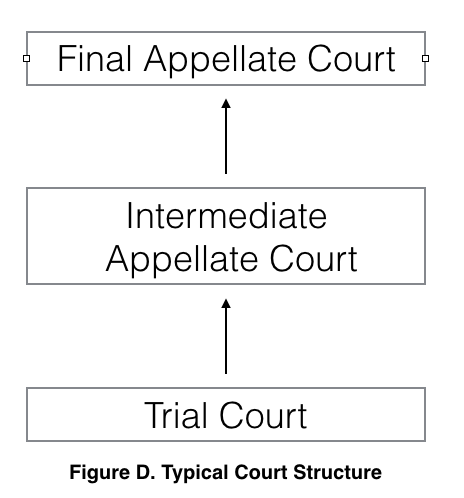
Effective legal research requires a further refinement of governmental structure with respect to the judiciary. Within the court systems there usually several levels, each of which performs a specific function. The federal courts have three levels, as do many state courts: a trial level, an intermediate appellate level, and a final appellate level. Figure D illustrates this arrangement.
有效的法律研究需要进一步细化政府结构,特别是关于司法机构。在法院系统中,通常有几个级别,每个级别都执行特定的功能。联邦法院有三个级别,许多州法院也是如此:一个审判级别、一个中级上诉级别和一个最终上诉级别。图 D 展示了这种安排。
At the federal level, the trial courts are called United States District Courts. Each state has within its boundaries at least one federal judicial district, and some states have several. The number of districts in a state is determined primarily by population and the geographic size of the state. For example, Massachusetts has only one federal judicial district, which covers the whole state and is called the United States District Court for the District of Massachusetts. California, on the other hand, has four federal judicial districts, each of which covers a discrete geographic region of the state. California's four districts are known as the U.S. District Court for the Northern District of California, U.S. District Court for the Central District of California, U.S. District Court for the Southern District of California, and U.S. District Court for the Eastern District of California.
在美国联邦层面,初审法院被称为美国地区法院。每个州在其边界内至少有一个联邦司法区,有些州有几个。一个州内的区数量主要由人口和该州的地域大小决定。例如,马萨诸塞州只有一个联邦司法区,覆盖整个州,被称为马萨诸塞州美国地区法院。另一方面,加利福尼亚州有四个联邦司法区,每个区都覆盖该州的一个独立地理区域。加利福尼亚州的四个区被称为美国加利福尼亚北部地区法院、美国加利福尼亚中部地区法院、美国加利福尼亚南部地区法院和美国加利福尼亚东部地区法院。
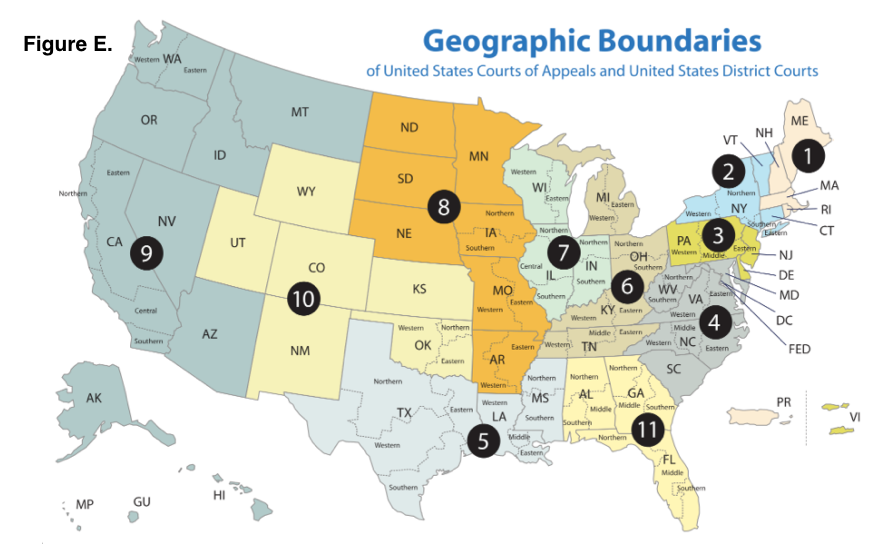
Federal intermediate appellate courts are known as United States Courts of Appeals. There are 13 federal Courts of Appeals, each of which covers a particular geographical area known as a "circuit." There are 11 numbered circuits (First Circuit, Second Circuit, etc.), a circuit for the District of Columbia, and a circuit known as the Federal Circuit. Except for the D.C. Circuit, each Court of Appeals circuit encompasses several states. For example, the Tenth Circuit embraces Colorado, Kansas, New Mexico, Oklahoma, Utah, and Wyoming. The Federal Circuit hears appeals from all U.S. District Courts in certain specialized kinds of cases. The map in Figure E shows the geographical organization of the United States Courts of Appeals.
联邦中级上诉法院被称为美国上诉法院。共有 13 个联邦上诉法院,每个法院负责一个特定的地理区域,称为“巡回区”。有 11 个编号的巡回区(第一巡回区、第二巡回区等),一个哥伦比亚特区的巡回区,以及一个称为联邦巡回区的巡回区。除了哥伦比亚特区巡回区外,每个上诉法院巡回区涵盖几个州。例如,第十巡回区包括科罗拉多州、堪萨斯州、新墨西哥州、俄克拉荷马州、犹他州和怀俄明州。联邦巡回区审理某些特定类型的案件的上诉。图 E 展示了美国上诉法院的地理组织结构。
When a party to a lawsuit in a U.S. District Court wants to appeal that court's decision, the appeal normally goes to the U.S. Court of Appeals covering that district. For example ( as Figure E Shows), if you were involved in a lawsuit in a U.S. District Court in California and you wanted to appeal the decision in your case, you would take you appeal to the U.S. Court of Appeals for the Ninth Circuit. Similarly, a party in a lawsuit in a U.S. District Court in Oklahoma would take an appeal to the U.S. Court of Appeals for the Tenth Circuit.
当美国地区法院诉讼的一方想要对该法院的决定提起上诉时,上诉通常提交给负责该地区的美国巡回上诉法院。例如(如图 E 所示),如果你在美国加利福尼亚州的一个美国地区法院参与诉讼并希望对你的案件提起上诉,你将上诉提交给美国第九巡回上诉法院。同样,在美国俄克拉荷马州地区法院诉讼的一方将上诉提交给美国第十巡回上诉法院。
The final appellate court in the federal court system is the Supreme Court of the United States. The U.S. Supreme Court hears appeals from the decisions of the U.S. Courts of Appeals; from the highest appellate court of each state (when a federal question is involved); and (on extremely rare occasions) directly from U.S. District Courts. In certain limited cases. the U.S. Supreme Court also has original jurisdiction and then acts as a trial court.
美国联邦法院系统的终审法院是美国最高法院。美国最高法院审理来自美国上诉法院的决定;来自各州最高上诉法院(当涉及联邦问题时);以及(在极其罕见的情况下)直接来自美国地区法院。在某些有限的案件中,美国最高法院也拥有初审管辖权,并充当审判法院。
*State court structures *vary from state to state. Many states have three levels, like the federal system although some have only two (a trial level and one appellate level). The names of the state courts differ among the various states, too. For example, the highest court in Massachusetts is called the "Supreme Judicial Court"; in New York, it's known as the "Court of Appeals"; and in California it's called the "Supreme Court."
各州的州法院结构各不相同。许多州设有三级法院,类似于联邦体系,尽管有些州只有两级(一个审判级别和一个上诉级别)。各州州法院的名称也各不相同。例如,马萨诸塞州最高法院被称为“最高司法法院”;在纽约,它被称为“上诉法院”;而在加利福尼亚州,它被称为“最高法院”。
Regardless of the courts' names, though, they perform essentially the same functions at both the state and federal levels. Trial courts decide what the facts in a given dispute are, and what those facts mean in terms of the law -- for example, whether they mean guilt or innocence, and if guilt, what the penalty should be. Appellate courts review to see if the trial judge correctly applied the relevant points of law to the facts determined at the trial level; except in rare cases. appellate courts do not re-evaluate or redetermine findings of fact made at the trial level.
无论法院名称如何,它们在州和联邦层面都执行基本相同的职能。审判法院决定特定争议中的事实是什么,以及这些事实在法律上的含义——例如,它们是否意味着有罪或无罪,如果有罪,应受到何种惩罚。上诉法院审查审判法官是否正确地将相关法律要点应用于审判阶段确定的事实;除非在罕见情况下,上诉法院不会重新评估或重新确定审判阶段作出的事实认定。
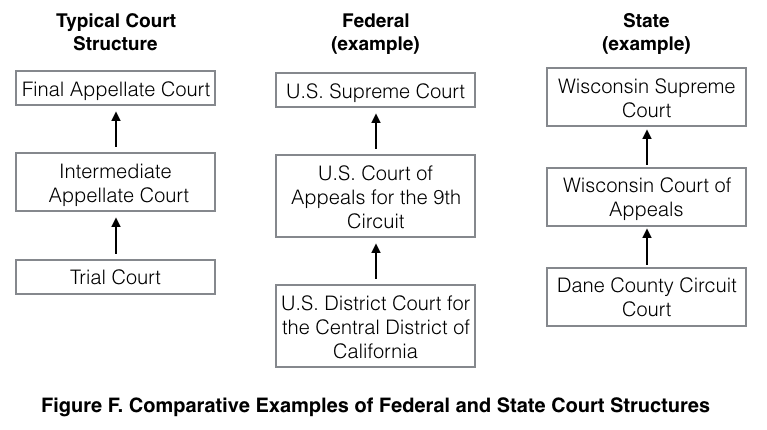
The structure of the federal court system and many state court systems is shown schematically in figure F.
联邦法院系统以及许多州法院系统的结构如图 F 所示。