Module 01 · Introduction to Abnormal Psychology
Module 2: Models of Abnormal Psychology模块 2:异常心理学模型
3rd edition as of July 2023
截至 2023 年 7 月的第三版
Module Overview 模块概述
In Module 2, we will discuss three models of abnormal behavior to include the biological, psychological, and sociocultural models. Each is unique in its own right and no single model can account for all aspects of abnormality. Hence, we advocate for a multi-dimensional and not a uni-dimensional model.
在模块 2 中,我们将讨论三种异常行为模型,包括生物、心理和社会文化模型。每种模型都有其独特之处,没有任何一个模型可以解释所有异常的方面。因此,我们主张采用多维而不是单维模型。
Module Outline 模块大纲
- 2.1. Uni- vs. Multi-Dimensional Models of Abnormality
2.1. 单维与多维异常模型 - 2.2. The Biological Model
2.2. 生物学模型 - 2.3. Psychological Perspectives 2.3. 心理学视角
- 2.4. The Sociocultural Model
2.4. 社会文化模型
Module Learning Outcomes 模块学习成果
- Differentiate uni- and multi-dimensional models of abnormality.
区分异常的单维和多维模型。 - Describe how the biological model explains mental illness.
描述生物模型如何解释精神疾病。 - Describe how psychological perspectives explain mental illness.
描述心理视角如何解释精神疾病。 - Describe how the sociocultural model explains mental illness.
描述社会文化模型如何解释精神疾病。
2.1. Uni- vs. Multi-Dimensional Models of Abnormality 2.1. 异常的单一维度与多维度模型
Section Learning Objectives 章节学习目标
- Define the uni-dimensional model.
定义一维模型。 - Explain the need for a multi-dimensional model of abnormality.
解释多维异常模型的需求。 - Define model. 定义模型。
- List and describe the models of abnormality.
列出并描述异常模型。
2.1.1. Uni-Dimensional 2.1.1. 单一维度
To effectively treat a mental disorder, we must understand its cause. This could be a single factor such as a chemical imbalance in the brain, relationship with a parent, socioeconomic status (SES), a fearful event encountered during middle childhood, or the way in which the individual copes with life’s stressors. This single factor explanation is called a uni-dimensional model. The problem with this approach is that mental disorders are not typically caused by a solitary factor, but multiple causes. Admittedly, single factors do emerge during a person’s life, but as they arise, the factors become part of the individual. In time, the cause of the person’s psychopathology is due to all these individual factors.
为了有效地治疗精神疾病,我们必须了解其成因。这可能是一个单一因素,如大脑中的化学失衡、与父母的相处关系、社会经济地位(SES)、在中童年时期遭遇的恐惧事件,或者个人应对生活压力的方式。这种单一因素的解释被称为单维模型。这种方法的缺点是精神疾病通常不是由单一因素引起的,而是由多个原因引起的。诚然,在人的生活中确实会出现单一因素,但一旦出现,这些因素就成为了个人的一部分。随着时间的推移,导致个人心理病理的原因是由于所有这些个人因素。
2.1.2. Multi-Dimensional 2.1.2. 多维
So, it is better to subscribe to a **multi-dimensional model **that integrates multiple causes of psychopathology and affirms that each cause comes to affect other causes over time. Uni-dimensional models alone are too simplistic to explain the etiology of mental disorders fully.
因此,最好订阅一个整合了多种心理病理学原因并确认每种原因都会随着时间的推移影响其他原因的多维模型。单一维度的模型本身过于简单,无法完全解释精神障碍的病因。
Before introducing the current main models, it is crucial to understand what a model is. In a general sense, a **model **is defined as a representation or imitation of an object (dictionary.com). For mental health professionals, models help us to understand mental illness since diseases such as depression cannot be touched or experienced firsthand. To be considered distinct from other conditions, a mental illness must have its own set of symptoms. But as you will see, the individual does not have to present with the entire range of symptoms. For example, to be diagnosed with separation anxiety disorder, you must present with three of eight symptoms for criteria A whereas for a major depressive episode as part of Bipolar II disorder, you have to display five (or more) symptoms for criteria A. There will be some variability in terms of what symptoms are displayed, but in general, all people with a specific psychopathology have symptoms from that group.
在介绍当前主要模型之前,了解什么是模型至关重要。在一般意义上,模型被定义为对对象的表示或模仿(dictionary.com)。对于心理健康专业人士来说,模型帮助我们理解精神疾病,因为像抑郁症这样的疾病无法触摸或亲身体验。为了与其他疾病区分开来,精神疾病必须有一套自己的症状。但正如您将看到的,个体不必表现出所有症状。例如,要被诊断为分离焦虑症,您必须表现出 A 标准中的八种症状中的三种,而对于作为双相 II 型障碍一部分的严重抑郁发作,您必须表现出 A 标准中的五种(或更多)症状。在所表现的症状方面可能会有一些变化,但一般来说,所有具有特定心理病理学的人都有来自该组的症状。
We can also ask the patient probing questions, seek information from family members, examine medical records, and in time, organize and process all this information to better understand the person’s condition and potential causes. Models aid us with doing all of this. Still, we must remember that the model is a starting point for the researcher, and due to this, it determines what causes might be investigated at the exclusion of other causes. Often, proponents of a given model find themselves in disagreement with proponents of other models. All forget that there is no individual model that completely explains human behavior, or in this case, abnormal behavior, and so each model contributes in its own way. Here are the models we will examine in this module:
我们还可以向患者提出探究性问题,从家庭成员那里获取信息,检查病历,并及时组织处理所有这些信息,以便更好地了解该人的状况和潜在原因。模型帮助我们完成所有这些工作。然而,我们必须记住,模型只是研究人员的一个起点,因此它决定了可能被调查的原因,而排除其他原因。通常,某个模型的拥护者会与其他模型的拥护者产生分歧。所有人都忘记了没有哪个模型能够完全解释人类行为,或者在这种情况下,异常行为,因此每个模型都以自己的方式做出贡献。以下是本模块中我们将要研究的模型:
- **Biological **– includes genetics, chemical imbalances in the brain, the functioning of the nervous system, etc.
生物学 - 包括遗传学、大脑化学失衡、神经系统功能等。 - **Psychological **– includes learning, personality, stress, cognition, self-efficacy, and early life experiences. We will examine several perspectives that make up the psychological model to include psychodynamic, behavioral, cognitive, and humanistic-existential.
心理学 - 包括学习、个性、压力、认知、自我效能感和早期生活经历。我们将探讨构成心理学模型的不同视角,包括心理动力学、行为学、认知学和人文-存在主义。 - **Sociocultural **– includes factors such as one’s gender, religious orientation, race, ethnicity, and culture.
社会文化——包括性别、宗教取向、种族、民族和文化等因素。
Key Takeaways 关键要点
You should have learned the following in this section:
你应该在本节中学到了以下内容:
- The uni-dimensional model proposes a single factor as the cause of psychopathology while the multi-dimensional model integrates multiple causes of psychopathology and affirms that each cause comes to affect other causes over time.
单维模型提出单一因素作为心理病理学的成因,而多维模型整合了心理病理学的多个成因,并确认随着时间的推移,每个成因都会影响其他成因。 - There is no individual model that completely explains human behavior and so each model contributes in its own way.
没有单个模型能够完全解释人类行为,因此每个模型都以自己的方式做出贡献。
Section 2.1 Review Questions
第 2.1 节复习题
- What is the problem with a uni-dimensional model of psychopathology?
什么是心理病理学一维模型的问题? - Discuss the concept of a model and identify those important to understanding psychopathology.
讨论模型的概念,并确定对理解精神病理学重要的事项。
2.2. The Biological Model 2.2. 生物学模型
Section Learning Objectives 章节学习目标
- Describe how communication in the nervous system occurs.
描述神经系统中的通讯是如何发生的。 - List the parts of the nervous system.
列出神经系统的组成部分。 - Describe the structure of the neuron and all key parts.
描述神经元的结构和所有关键部分。 - Outline how neural transmission occurs.
概述神经传递的过程。 - Identify and define important neurotransmitters.
识别并定义重要的神经递质。 - List the major structures of the brain.
列出大脑的主要结构。 - Clarify how specific areas of the brain are involved in mental illness.
阐明大脑特定区域如何参与精神疾病。 - Describe the role of genes in mental illness.
描述基因在精神疾病中的作用。 - Describe the role of hormonal imbalances in mental illness.
描述激素失衡在精神疾病中的作用。 - Describe the role of bacterial and viral infections in mental illness.
描述细菌和病毒感染在精神疾病中的作用。 - Describe commonly used treatments for mental illness.
描述常见的精神疾病治疗方法。 - Evaluate the usefulness of the biological model.
评估生物模型的有用性。
Proponents of the biological model view mental illness as being a result of a malfunction in the body to include issues with brain anatomy or chemistry. As such, we will need to establish a foundation for how communication in the nervous system occurs, what the parts of the nervous system are, what a neuron is and its structure, how neural transmission occurs, and what the parts of the brain are. All while doing this, we will identify areas of concern for psychologists focused on the treatment of mental disorders.
生物模型的支持者认为,精神疾病是身体功能失调的结果,包括大脑解剖结构或化学问题。因此,我们需要建立关于神经系统如何进行交流的基础,神经系统的各个部分是什么,神经元及其结构,神经传递是如何发生的,以及大脑的各个部分是什么。在完成这些的同时,我们还将确定心理学家关注的精神疾病治疗领域中的关注点。
2.2.1. Brain Structure and Chemistry 2.2.1. 大脑结构和化学
2.2.1.1. Communication in the nervous system.2.2.1.1. 神经系统中的通信。
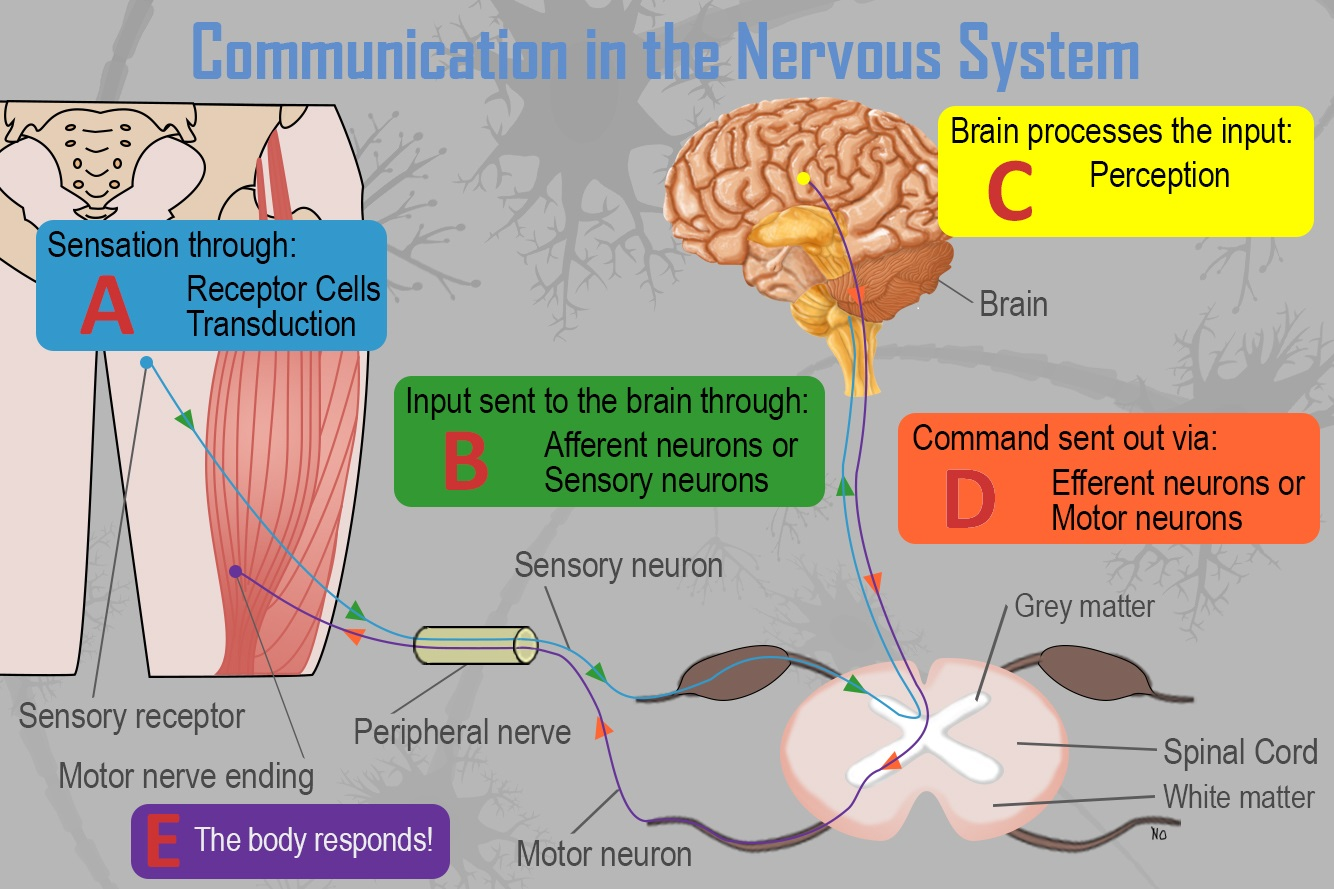
To truly understand brain structure and chemistry, it is a good idea to understand how communication occurs within the nervous system. See Figure 2.1 below. Simply:
要真正理解大脑结构和化学成分,了解神经系统内通信过程是个好主意。见图 2.1。简单来说:
- Receptor cells in each of the five sensory systems detect energy.
每个五感官系统中的感受细胞检测能量。 - This information is passed to the nervous system due to the process of transduction and through sensory or afferent neurons, which are part of the peripheral nervous system.
这条信息由于转导过程传递到神经系统,通过感觉或传入神经元,这些神经元是周围神经系统的一部分。 - The information is received by brain structures (central nervous system) and perception occurs.
信息由大脑结构(中枢神经系统)接收,并发生感知。 - Once the information has been interpreted, commands are sent out, telling the body how to respond (Step E), also via the peripheral nervous system.
一旦信息被解读,就会发出指令,告诉身体如何反应(步骤 E),也通过周围神经系统。
Figure 2.1. Communication in the Nervous System
图 2.1. 神经系统中的通信
Please note that we will not cover this process in full, but just the parts relevant to our topic of psychopathology.
请注意,我们不会全面涵盖这个过程,而只是涉及与我们心理病理学主题相关的内容。
2.2.1.2. The nervous system.2.2.1.2. 神经系统。
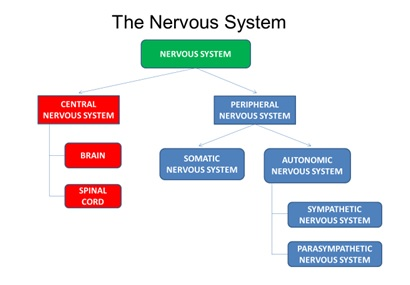
The nervous system consists of two main parts – the central and peripheral nervous systems. The central nervous system (CNS) is the control center for the nervous system, which receives, processes, interprets, and stores incoming sensory information. It consists of the brain and spinal cord. The peripheral nervous system consists of everything outside the brain and spinal cord. It handles the CNS’s input and output and divides into the somatic and autonomic nervous systems. The somatic nervous system allows for voluntary movement by controlling the skeletal muscles and carries sensory information to the CNS. The autonomic nervous system regulates the functioning of blood vessels, glands, and internal organs such as the bladder, stomach, and heart. It consists of sympathetic and parasympathetic nervous systems. The sympathetic nervous system is involved when a person is intensely aroused. It provides the strength to fight back or to flee (fight-or-flight instinct). Eventually, the response brought about by the sympathetic nervous system must end. The parasympathetic nervous system calms the body.
神经系统由两个主要部分组成——中枢神经系统和周围神经系统。中枢神经系统(CNS)是神经系统的控制中心,它接收、处理、解释和存储传入的感觉信息。它由大脑和脊髓组成。周围神经系统包括大脑和脊髓之外的所有东西。它处理 CNS 的输入和输出,并分为躯体神经系统和自主神经系统。躯体神经系统通过控制骨骼肌来实现自愿运动,并将感觉信息传递到 CNS。自主神经系统调节血管、腺体和膀胱、胃、心脏等内部器官的功能。它由交感神经系统和副交感神经系统组成。交感神经系统在一个人极度兴奋时发挥作用。它提供反击或逃跑的力量(战斗或逃跑本能)。最终,由交感神经系统引起的反应必须结束。副交感神经系统使身体平静。
Figure 2.2. The Structure of the Nervous System
图 2.2. 神经系统的结构
2.2.1.3. The neuron.2.2.1.3. 神经元。
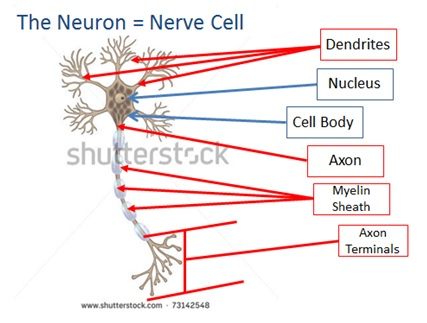
The fundamental unit of the nervous system is the neuron, or nerve cell (See Figure 2.3). It has several structures in common with all cells in the body. The nucleus is the control center of the neuron, and the soma is the cell body. In terms of distinctive structures, these focus on the ability of a neuron to send and receive information. The axon sends signals/information to neighboring neurons while the dendrites, which resemble little trees, receive information from neighboring neurons. Note the plural form of dendrite and the singular form of axon; there are many dendrites but only one axon. Also of importance to the neuron is the myelin sheath or the white, fatty covering which: 1) provides insulation so that signals from adjacent neurons do not affect one another and, 2) increases the speed at which signals are transmitted. The **axon terminals **are the end of the axon where the electrical impulse becomes a chemical message and passes to an adjacent neuron.
神经系统的基本单位是神经元,或神经细胞(见图 2.3)。它与身体中所有细胞具有几个共同的结构。细胞核是神经元的控制中心,而细胞体是细胞本身。就独特结构而言,这些结构关注神经元发送和接收信息的能力。轴突将信号/信息发送到邻近的神经元,而树突,类似于小树,从邻近的神经元接收信息。注意树突的复数形式和轴突的单数形式;有许多树突,但只有一个轴突。对神经元也很重要的是髓鞘或白色、脂肪状的覆盖物,它:1)提供绝缘,使相邻神经元的信号不会相互影响,2)增加信号传输的速度。轴突末端是轴突的末端,其中电脉冲变成化学信息并传递到相邻的神经元。
Though not neurons, **glial cells **play an important part in helping the nervous system to be the efficient machine that it is. Glial cells are support cells in the nervous system that serve five main functions:
尽管不是神经元,胶质细胞在帮助神经系统成为它所是的高效机器中发挥着重要作用。胶质细胞是神经系统中的支持细胞,具有五个主要功能:
- They act as a glue and hold the neuron in place.
他们像胶水一样固定神经元的位置。 - They form the myelin sheath.
他们形成髓鞘。 - They provide nourishment for the cell.
他们为细胞提供营养。 - They remove waste products.
他们移除废物。 - They protect the neuron from harmful substances.
他们保护神经元免受有害物质的侵害。
Finally, **nerves **are a group of axons bundled together like wires in an electrical cable.
最后,神经是一组像电线电缆中一样捆绑在一起的轴突。
Figure 2.3. The Structure of the Neuron
图 2.3. 神经元结构
2.2.1.4. Neural transmission.2.2.1.4. 神经传输。
Transducers or receptor cells in the major organs of our five sensory systems – vision (the eyes), hearing (the ears), smell (the nose), touch (the skin), and taste (the tongue) – convert the physical energy that they detect or sense and send it to the brain via the neural impulse. How so? See Figure 2.4 below. We will cover this process in three parts.
我们五感系统(视觉(眼睛)、听觉(耳朵)、嗅觉(鼻子)、触觉(皮肤)和味觉(舌头))的主要器官中的传感器或感受细胞将它们检测或感知到的物理能量转换为神经冲动,并将其发送到大脑。这是如何做到的?请参见下面的图 2.4。我们将分三部分介绍这个过程。
Part 1. The Axon and Neural Impulse
第 1 部分。轴突和神经冲动
The neural impulse proceeds across the following steps:
神经冲动通过以下步骤进行:
- Step 1 – Neurons waiting to fire are said to be in resting potential and polarized, or having a negative charge inside the neuron and a positive charge outside.
第一步 - 等待放电的神经元被称为处于静息电位和极化状态,或者内部带负电荷,外部带正电荷。 - Step 2 – If adequately stimulated, the neuron experiences an action potential and becomes depolarized. When this occurs, voltage-gated ion channels open, allowing positively charged sodium ions (Na+) to enter. This shifts the polarity to positive on the inside and negative outside. Note that ions are charged particles found both inside and outside the neuron.
第二步 - 如果得到足够的刺激,神经元会经历动作电位并去极化。当这种情况发生时,电压门控离子通道打开,允许带正电的钠离子(Na+)进入。这使内部变为正极,外部变为负极。请注意,离子是存在于神经元内外部的带电粒子。 - Step 3 – Once the action potential passes from one segment of the axon to the next, the previous segment begins to repolarize. This occurs because the Na channels close and potassium (K) channels open. K+ has a positive charge, so the neuron becomes negative again on the inside and positive on the outside.
第 3 步 - 一旦动作电位从一个轴突段传递到下一个段,前一个段开始复极化。这是因为钠通道关闭,钾(K)通道打开。K+带正电荷,因此神经元内部再次变为负电荷,外部变为正电荷。 - Step 4 – After the neuron fires, it will not fire again no matter how much stimulation it receives. This is called the absolute refractory period. Think of it as the neuron ABSOLUTELY will not fire, no matter what.
第 4 步 - 神经元放电后,无论接收多少刺激都不会再次放电。这被称为绝对不应期。把它想象成神经元绝对不会放电,无论发生什么。 - Step 5 – After a short time, the neuron can fire again, but needs greater than normal levels of stimulation to do so. This is called the relative refractory period.
第 5 步 - 经过一段时间后,神经元可以再次放电,但需要比正常水平更高的刺激才能做到。这被称为相对不应期。 - Step 6 – Please note that this process is cyclical. We started at resting potential in Step 1 and end at resting potential in Step 6.
第 6 步 - 请注意,这个过程是循环的。我们从第 1 步的静息电位开始,在第 6 步结束于静息电位。
Part 2. The Action Potential
第二部分。动作电位
Let’s look at the electrical portion of the process in another way and add some detail.
让我们以另一种方式审视这个过程中的电气部分,并添加一些细节。
Figure 2.4. The Action Potential
图 2.4. 动作电位
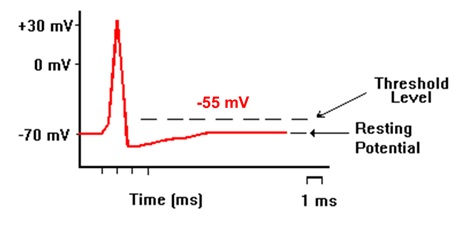
- Recall that a neuron is usually at resting potential and polarized. The charge inside is -70mV at rest.
回忆一下,神经元通常处于静息电位和极化状态。静息时内部电荷为-70mV。 - If it receives sufficient stimulation, causing the polarity inside the neuron to rise from -70 mV to -55mV (threshold of excitation), the neuron will fire or send an electrical impulse down the length of the axon (the action potential or depolarization). It should be noted that it either hits -55mV and fires, or it does not fire at all. This is the all-or-nothing principle. The threshold must be reached.
如果它接收足够的刺激,导致神经元内部的极性从-70mV 上升到-55mV(兴奋阈值),神经元就会放电或沿轴突长度发送电脉冲(动作电位或去极化)。需要注意的是,它要么达到-55mV 并放电,要么根本不放电。这就是全或无原则。阈值必须达到。 - Once the electrical impulse has passed from one segment of the axon to the next, the neuron begins the process of resetting called repolarization.
一旦电冲动从轴突的一段传到下一段,神经元便开始重置过程,称为复极化。 - During repolarization the neuron will not fire no matter how much stimulation it receives. This is called the absolute refractory period.
在复极化期间,无论神经元接收多少刺激,都不会放电。这被称为绝对不应期。 - The neuron next moves into a relative refractory period, meaning it can fire but needs higher than normal levels of stimulation. Notice how the line has dropped below -70mV. Hence, to reach -55mV and fire, it will need more than the normal gain of +15mV (-70 to -55 mV).
神经元随后进入相对不应期,这意味着它可以放电但需要高于正常水平的刺激。注意线条已降至-70mV 以下。因此,要达到-55mV 并放电,它将需要比正常增益+15mV(从-70 到-55 mV)更多的刺激。 - And then we return to resting potential, as you saw in Figure 2.4
然后我们回到静息电位,正如你在图 2.4 中看到的那样。
Part 3. The Synapse
第三部分。突触
The electrical portion of the neural impulse is just the start. The actual code passes from one neuron to another in a chemical form called a neurotransmitter. The point where this occurs is called the synapse. The synapse consists of three parts – the axon of the sending neuron, the space in between called the synaptic space, gap, or cleft, and the dendrite of the receiving neuron. Once the electrical impulse reaches the end of the axon, called the axon terminal, it stimulates synaptic vesicles or neurotransmitter sacs to release the neurotransmitter. Neurotransmitters will only bind to their specific receptor sites, much like a key will only fit into the lock it was designed for. You might say neurotransmitters are part of a lock-and-key system. What happens to the neurotransmitters that do not bind to a receptor site? They might go through reuptake, which is the process of the presynaptic neuron taking up excess neurotransmitters in the synaptic space for future use or enzymatic degradation when enzymes destroy excess neurotransmitters in the synaptic space.
神经冲动的电部分只是开始。实际的代码以神经递质这种化学形式从一个神经元传递到另一个神经元。这种发生的地方被称为突触。突触由三部分组成——发出神经元的轴突、称为突触间隙、间隙或裂隙的空间,以及接收神经元的树突。一旦电冲动到达轴突的末端,即轴突末端,它就会刺激突触小泡或神经递质囊泡释放神经递质。神经递质只会与它们的特定受体位点结合,就像钥匙只会适合它被设计的那把锁一样。你可以说神经递质是锁和钥匙系统的一部分。那些没有结合到受体位点的神经递质会怎样?它们可能会经历重摄取,这是突触前神经元在突触间隙中吸收过量神经递质以备将来使用或酶促降解的过程,当酶在突触间隙中破坏过量神经递质时。
2.2.1.5. Neurotransmitters.2.2.1.5. 神经递质。
What exactly are some of the neurotransmitters which are so critical for neural transmission, and are essential to our discussion of psychopathology?
究竟有哪些神经递质对于神经传导至关重要,并且对于我们的心理病理学讨论是必不可少的?
- Dopamine – controls voluntary movements and is associated with the reward mechanism in the brain
多巴胺 - 控制自愿运动,与大脑中的奖励机制相关 - Serotonin – regulates pain, sleep cycle, and digestion; leads to a stable mood, so low levels lead to depression
血清素 - 调节疼痛、睡眠周期和消化;导致情绪稳定,因此低水平会导致抑郁 - Endorphins – involved in reducing pain and making the person calm and happy
内啡肽 - 参与减轻疼痛,使人们平静和快乐 - Norepinephrine – increases the heart rate and blood pressure and regulates mood
去甲肾上腺素 - 提高心率、血压并调节情绪 - GABA – blocks the signals of excitatory neurotransmitters responsible for anxiety and panic
GABA - 阻断焦虑和恐慌的兴奋性神经递质的信号 - Glutamate – associated with learning and memory
谷氨酸——与学习和记忆相关
The critical thing to understand here is that there is a belief in the realm of mental health that chemical imbalances are responsible for many mental disorders. Chief among these are neurotransmitter imbalances. For instance, people with Seasonal Affective Disorder (SAD) have difficulty regulating serotonin. More on this throughout the book as we discuss each disorder.
这里关键要理解的是,在心理健康领域有一种信念,认为化学失衡是许多精神疾病的原因。其中最重要的是神经递质失衡。例如,患有季节性情感障碍(SAD)的人难以调节血清素。关于这一点,本书将详细讨论每种疾病。
2.2.1.6. The brain.2.2.1.6. 大脑。
The central nervous system consists of the brain and spinal cord; the former we will discuss briefly and in terms of key structures which include:
中枢神经系统由大脑和脊髓组成;我们将简要讨论前者,并涉及关键结构,包括:
- Medulla – regulates breathing, heart rate, and blood pressure
延髓 - 调节呼吸、心率及血压 - **Pons **– acts as a bridge connecting the cerebellum and medulla and helps to transfer messages between different parts of the brain and spinal cord
小脑桥核 - 作为连接小脑和延髓的桥梁,有助于在不同大脑部分和脊髓之间传递信息 - **Reticular formation **– responsible for alertness and attention
网状结构 - 负责警觉性和注意力 - Cerebellum – involved in our sense of balance and for coordinating the body’s muscles so that movement is smooth and precise. Involved in the learning of certain kinds of simple responses and acquired reflexes.
小脑——参与我们的平衡感,协调身体肌肉,使运动平稳精确。参与某些简单反应和条件反射的学习。 - **Thalamus **– the major sensory relay center for all senses except smell
丘脑 - 除嗅觉外所有感官的主要感觉中继中心 - Hypothalamus – involved in drives associated with the survival of both the individual and the species. It regulates temperature by triggering sweating or shivering and controls the complex operations of the autonomic nervous system
下丘脑——涉及与个体和物种生存相关的驱动力。它通过触发出汗或颤抖来调节体温,并控制自主神经系统的复杂运作。 - **Amygdala **– responsible for evaluating sensory information and quickly determining its emotional importance
杏仁核 - 负责评估感官信息并迅速确定其情感重要性 - Hippocampus – our “gateway” to memory. Allows us to form spatial memories so that we can accurately navigate through our environment and helps us to form new memories about facts and events
海马体——我们通往记忆的“门户”。使我们能够形成空间记忆,以便我们能够准确地在环境中导航,并帮助我们形成关于事实和事件的新的记忆。 - The **cerebrum **has four distinct regions in each cerebral hemisphere. First, the frontal lobe contains the motor cortex, which issues orders to the muscles of the body that produce voluntary movement. The frontal lobe is also involved in emotion and in the ability to make plans, think creatively, and take initiative. The parietal lobe contains the somatosensory cortex and receives information about pressure, pain, touch, and temperature from sense receptors in the skin, muscles, joints, internal organs, and taste buds. The occipital lobe contains the visual cortex for receiving and processing visual information. Finally, the temporal lobe is involved in memory, perception, and emotion. It contains the auditory cortex which processes sound.
大脑半球有四个不同的区域。首先,额叶包含运动皮层,它向身体肌肉发出指令,产生自愿运动。额叶还参与情绪、制定计划、创造性思考和采取主动。顶叶包含体感皮层,并从皮肤、肌肉、关节、内脏和味蕾的感觉受体接收有关压力、疼痛、触觉和温度的信息。枕叶包含视觉皮层,用于接收和处理视觉信息。最后,颞叶参与记忆、感知和情绪。它包含听觉皮层,处理声音。
Of course, this is not an exhaustive list of structures found in the brain but gives you a pretty good idea of function and which structure is responsible for it. What is important to mental health professionals is some disorders involve specific areas of the brain. For instance, Parkinson’s disease is a brain disorder that results in a gradual loss of muscle control and arises when cells in the substantia nigra, a long nucleus considered to be part of the basal ganglia, stop making dopamine. As these cells die, the brain fails to receive messages about when and how to move. In the case of depression, low levels of serotonin are responsible, at least partially. New evidence suggests “nerve cell connections, nerve cell growth, and the functioning of nerve circuits have a major impact on depression… and areas that play a significant role in depression are the amygdala, the thalamus, and the hippocampus.” Also, individuals with borderline personality disorder have been shown to have structural and functional changes in brain areas associated with impulse control and emotional regulation, while imaging studies reveal differences in the frontal cortex and subcortical structures for those suffering from OCD.
当然,这并不是大脑中所有结构的完整列表,但它为你提供了一个关于功能和负责该功能的结构的大致了解。对心理健康专业人士来说,重要的是有些疾病涉及大脑的特定区域。例如,帕金森病是一种导致肌肉控制逐渐丧失的大脑疾病,它发生在黑质细胞停止产生多巴胺时,黑质是一个被认为是基底神经节一部分的长核。随着这些细胞的死亡,大脑无法接收到关于何时以及如何移动的信息。在抑郁症的情况下,至少部分原因是血清素水平低。新证据表明,“神经细胞连接、神经细胞生长和神经回路的功能对抑郁症有重大影响……在抑郁症中发挥重要作用的区域是杏仁核、丘脑和海马体。”此外,研究表明,边缘型人格障碍个体在大脑与冲动控制和情绪调节相关的区域存在结构和功能变化,而影像学研究发现,强迫症患者的前额叶皮层和皮质下结构存在差异。
Check out the following from Harvard Health for more on depression and the brain as a cause: https://www.health.harvard.edu/mind-and-mood/what-causes-depression
查看哈佛健康中心的以下内容,了解更多关于抑郁症和大脑作为病因的信息:https://www.health.harvard.edu/mind-and-mood/what-causes-depression
2.2.2. Genes, Hormonal Imbalances, and Viral Infections 2.2.2. 基因、激素失衡和病毒感染
2.2.2.1. Genetic issues and explanations.2.2.2.1. 遗传问题及解释。
DNA, or deoxyribonucleic acid, is our heredity material. It exists in the nucleus of each cell, packaged in threadlike structures known as chromosomes, for which we have 23 pairs or 46 total. Twenty-two of the pairs are the same in both sexes, but the 23rd pair is called the sex chromosome and differs between males and females. Males have X and Y chromosomes while females have two Xs. According to the Genetics Home Reference website as part of NIH’s National Library of Medicine, a gene is “the basic physical and functional unit of heredity” (https://ghr.nlm.nih.gov/primer/basics/gene). They act as the instructions to make proteins, and it is estimated by the Human Genome Project that we have between 20,000 and 25,000 genes. We all have two copies of each gene, one inherited from our mother and one from our father.
DNA,或脱氧核糖核酸,是我们的遗传物质。它存在于每个细胞的细胞核中,以染色体这种线状结构的形式存在,我们共有 23 对染色体,即 46 条。其中 22 对在男性和女性中相同,但第 23 对被称为性染色体,在男性和女性之间有所不同。男性有 X 和 Y 染色体,而女性有两个 X 染色体。根据美国国家医学图书馆的遗传学之家参考网站,基因是“遗传的基本物理和功能单位”(https://ghr.nlm.nih.gov/primer/basics/gene)。它们作为制造蛋白质的指令,据人类基因组计划估计,我们拥有大约 20,000 到 25,000 个基因。我们每个人都有每个基因的两个副本,一个来自母亲,一个来自父亲。
Recent research has discovered that autism, ADHD, bipolar disorder, major depression, and schizophrenia all share genetic roots. They “were more likely to have suspect genetic variation at the same four chromosomal sites. These included risk versions of two genes that regulate the flow of calcium into cells.” Likewise, twin and family studies have shown that people with first-degree relatives suffering from OCD are at higher risk to develop the disorder themselves. The same is true of borderline personality disorder.
最近的研究发现,自闭症、ADHD、双相情感障碍、重度抑郁症和精神分裂症都有共同的遗传根源。他们“更有可能在相同的四个染色体位点上有可疑的基因变异。这包括调节细胞内钙流的两基因的风险版本。”同样,双胞胎和家庭研究表明,一级亲属患有强迫症的人自己患病的风险更高。边缘型人格障碍也是如此。
WebMD adds, “Experts believe many mental illnesses are linked to abnormalities in many genes rather than just one or a few and that how these genes interact with the environment is unique for every person (even identical twins). That is why a person inherits a susceptibility to a mental illness and doesn’t necessarily develop the illness. Mental illness itself occurs from the interaction of multiple genes and other factors–such as stress, abuse, or a traumatic event–which can influence, or trigger, an illness in a person who has an inherited susceptibility to it” (https://www.webmd.com/mental-health/mental-health-causes-mental-illness#1).
WebMD 补充说:“专家认为,许多精神疾病与许多基因的异常有关,而不仅仅是单个或少数几个基因,并且这些基因与环境的相互作用对每个人来说都是独特的(即使是同卵双胞胎)。这就是为什么一个人可能会遗传对精神疾病易感性,但并不一定发展出这种疾病。精神疾病本身是由多个基因和其他因素(如压力、虐待或创伤事件)的相互作用引起的,这些因素可能会影响或触发具有遗传易感性的个体的疾病”(https://www.webmd.com/mental-health/mental-health-causes-mental-illness#1)。
For more on the role of genes in the development of mental illness, check out this article from Psychology Today:
关于基因在精神疾病发展中的作用,请查看《今日心理学》这篇文章:
2.2.2.2. Hormonal imbalances.2.2.2.2. 内分泌失调。
The body has two coordinating and integrating systems, the nervous system and the endocrine system. The main difference between these two systems is the speed with which they act. The nervous system moves quickly with nerve impulses moving in a few hundredths of a second. The endocrine system moves slowly with hormones, released by endocrine glands, taking seconds, or even minutes, to reach their target. Hormones are important to psychologists because they manage the nervous system and body tissues at certain stages of development and activate behaviors such as alertness or sleepiness, sexual behavior, concentration, aggressiveness, reaction to stress, and a desire for companionship. The **pituitary gland **is the “master gland” which regulates other endocrine glands. It influences blood pressure, thirst, contractions of the uterus during childbirth, milk production, sexual behavior and interest, body growth, the amount of water in the body’s cells, and other functions as well. The **pineal gland **helps regulate the sleep-wake cycle while the thyroid gland regulates the body’s energy levels by controlling metabolism and the basal metabolic rate (BMR). It regulates the body’s rate of metabolism and so how energetic people are.
人体有两个协调和整合系统,即神经系统内分泌系统。这两个系统的主要区别在于它们的作用速度。神经系统通过神经冲动迅速行动,神经冲动在几百分之一秒内移动。内分泌系统通过激素缓慢行动,激素由内分泌腺分泌,需要几秒钟甚至几分钟才能到达目标。激素对心理学家来说很重要,因为它们在发育的某些阶段管理神经系统、身体组织,并激活警觉或困倦、性行为、注意力、攻击性、对压力的反应和寻求伴侣的欲望等行为。垂体腺是“主腺”,调节其他内分泌腺。它影响血压、口渴、分娩时子宫的收缩、乳汁分泌、性行为和兴趣、身体生长、体内细胞的水分含量以及其他功能。松果腺帮助调节睡眠-觉醒周期,而甲状腺通过控制新陈代谢和基础代谢率(BMR)来调节身体的能量水平。 它调节身体的新陈代谢速度,因此决定了人们的精力水平。
Of importance to mental health professionals are the adrenal glands, located on top of the kidneys, and which release cortisol to help the body deal with stress. Elevated levels of this hormone can lead to several problems, including increased weight gain, interference with learning and memory, reduced bone density, high cholesterol, and an increased risk of depression. Similarly, the overproduction of the hormone melatonin can lead to SAD.
肾上腺位于肾脏上方,分泌皮质醇以帮助身体应对压力,这对心理健康专业人士来说非常重要。这种激素水平升高可能导致多种问题,包括体重增加、干扰学习和记忆、骨密度降低、高胆固醇以及抑郁症风险增加。同样,褪黑激素的过度产生可能导致季节性情感障碍(SAD)。
2.2.2.3. Bacterial and viral infections. 2.2.2.3. 细菌和病毒感染。
Infections can cause brain damage and lead to the development of mental illness or exacerbate existing symptoms. For instance, evidence suggests that contracting strep throat, “an infection in the throat and tonsils caused by bacteria called group A Streptococcus” (for more on strep throat, please visit https://www.cdc.gov/groupastrep/diseases-public/strep-throat.html), can lead to the development of OCD, Tourette’s syndrome, and tic disorder in children (Mell, Davis, & Owens, 2005; Giedd et al., 2000; Allen et al., 1995; https://www.psychologytoday.com/blog/the-perfectionists-handbook/201202/can-infections-result-in-mental-illness). Influenza epidemics, caused by viral infections (for more on influenza, please see the following: https://www.mayoclinic.org/diseases-conditions/flu/symptoms-causes/syc-20351719), have also been linked to schizophrenia (Brown et al., 2004; McGrath and Castle, 1995; McGrath et al., 1994; O’callaghan et al., 1991) though more recent research suggests this evidence is weak at best (Selten & Termorshuizen, 2017; Ebert & Kotler, 2005).
感染可能导致脑损伤,引发精神疾病或加重现有症状。例如,有证据表明,患链球菌咽喉炎——“由 A 组链球菌引起的喉咙和扁桃体感染”(有关链球菌咽喉炎的更多信息,请访问 https://www.cdc.gov/groupastrep/diseases-public/strep-throat.html),可能导致儿童患强迫症、抽动秽语综合征和抽动障碍(Mell, Davis, & Owens, 2005; Giedd et al., 2000; Allen et al., 1995; https://www.psychologytoday.com/blog/the-perfectionists-handbook/201202/can-infections-result-in-mental-illness)。流感大流行,由病毒感染引起(有关流感的更多信息,请参阅以下内容:https://www.mayoclinic.org/diseases-conditions/flu/symptoms-causes/syc-20351719),也与精神分裂症有关(Brown et al., 2004; McGrath and Castle, 1995; McGrath et al., 1994; O’callaghan et al., 1991),尽管最近的研究表明这一证据最多是微弱的(Selten & Termorshuizen, 2017; Ebert & Kotler, 2005)。
2.2.3. Treatments 2.2.3. 治疗方法
2.2.3.1. Psychopharmacology and psychotropic drugs.2.2.3.1. 精神药理学和心理药物。
One option to treat severe mental illness is psychotropic medications. These medications fall under five major categories.
治疗严重精神疾病的一种选择是心理药物。这些药物分为五大类。
*Antidepressants *are used to treat depression, but also anxiety, insomnia, and pain. The most common types of antidepressants are SSRIs or selective serotonin reuptake inhibitors and include Citalopram, Paroxetine, and Fluoxetine (Prozac). Possible side effects include weight gain, sleepiness, nausea and vomiting, panic attacks, or thoughts about suicide or dying.
抗抑郁药用于治疗抑郁症,但也用于焦虑、失眠和疼痛。最常见的抗抑郁药类型是选择性 5-羟色胺再摄取抑制剂(SSRIs),包括西酞普兰、帕罗西汀和氟西汀(百忧解)。可能的副作用包括体重增加、嗜睡、恶心和呕吐、恐慌发作或自杀或死亡的念头。
*Anti-anxiety medications *help with the symptoms of anxiety and include benzodiazepines such as Clonazepam, Alprazolam, and Lorazepam. “Anti-anxiety medications such as benzodiazepines are effective in relieving anxiety and take effect more quickly than the antidepressant medications (or buspirone) often prescribed for anxiety. However, people can build up a tolerance to benzodiazepines if they are taken over a long period of time and may need higher and higher doses to get the same effect.” Side effects include drowsiness, dizziness, nausea, difficulty urinating, and irregular heartbeat, to name a few.
抗焦虑药物有助于缓解焦虑症状,包括氯硝西泮、阿普唑仑和劳拉西泮等苯二氮䓬类药物。“苯二氮䓬类药物等抗焦虑药物在缓解焦虑方面有效,且比常用于治疗焦虑的抗抑郁药物(或丁螺环酮)起效更快。然而,如果长期服用,人们可能会对苯二氮䓬类药物产生耐受性,可能需要更高和更高的剂量才能达到相同的效果。”副作用包括嗜睡、头晕、恶心、排尿困难和不规则心跳等。
*Stimulants *increase one’s alertness and attention and are frequently used to treat ADHD. They include Lisdexamfetamine, the combination of dextroamphetamine and amphetamine, and Methylphenidate. Stimulants are generally effective and produce a calming effect. Possible side effects include loss of appetite, headache, motor or verbal tics, and personality changes such as appearing emotionless.
兴奋剂可以提高人们的警觉性和注意力,常用于治疗 ADHD。它们包括赖右苯丙胺、右旋安非他命和安非他命的组合,以及哌甲酯。兴奋剂通常有效,并产生镇静作用。可能的副作用包括食欲不振、头痛、运动或言语抽搐,以及如显得无表情等个性变化。
*Antipsychotics *are used to treat psychosis or “conditions that affect the mind, and in which there has been some loss of contact with reality, often including delusions (false, fixed beliefs) or hallucinations (hearing or seeing things that are not really there).” They can be used to treat eating disorders, severe depression, PTSD, OCD, ADHD, and Generalized Anxiety Disorder. Common antipsychotics include Chlorpromazine, Perphenazine, Quetiapine, and Lurasidone. Side effects include nausea, vomiting, blurred vision, weight gain, restlessness, tremors, and rigidity.
抗精神病药用于治疗精神病或“影响心灵、与现实失去联系的状态,通常包括妄想(错误的、固定的信念)或幻觉(听到或看到实际上不存在的事物)。”它们可以用于治疗饮食障碍、重度抑郁症、PTSD、OCD、ADHD 和广泛性焦虑症。常见抗精神病药包括氯丙嗪、奋乃静、喹硫平和鲁拉西酮。副作用包括恶心、呕吐、视力模糊、体重增加、不安、震颤和僵硬。
*Mood stabilizers *are used to treat bipolar disorder and, at times, depression, schizoaffective disorder, and disorders of impulse control. A common example is Lithium; side effects include loss of coordination, hallucinations, seizures, and frequent urination.
情绪稳定剂用于治疗双相情感障碍,有时也用于治疗抑郁症、分裂情感性障碍和冲动控制障碍。一个常见的例子是锂;副作用包括协调能力丧失、幻觉、癫痫发作和频繁尿尿。
For more information on psychotropic medications, please visit:
有关精神药物更多信息,请访问:
https://www.nimh.nih.gov/health/topics/mental-health-medications/index.shtml
The use of these drugs has been generally beneficial to patients. Most report that their symptoms decline, leading them to feel better and improve their functioning. Also, long-term hospitalizations are less likely to occur as a result, though the medications do not benefit the individual in terms of improved living skills.
这些药物的使用通常对病人有益。大多数人表示,他们的症状有所减轻,这使他们感觉更好,并提高了他们的功能。此外,长期住院的可能性也因此降低,尽管这些药物并不能提高个人的生活技能。
2.2.3.2. Electroconvulsive therapy.2.2.3.2. 电休克疗法。
According to Mental Health America, “Electroconvulsive therapy (ECT) is a procedure in which a brief application of electric stimulus is used to produce a generalized seizure.” Patients are placed on a padded bed and administered a muscle relaxant to avoid injury during the seizures. Annually, approximately 100,000 undergo ECT to treat conditions such as severe depression, acute mania, suicidality, and some forms of schizophrenia. The procedure is still the most controversial available to mental health professionals due to “its effectiveness vs. the side effects, the objectivity of ECT experts, and the recent increase in ECT as a quick and easy solution, instead of long-term psychotherapy or hospitalization” (https://www.mhanational.org/ect). Its popularity has declined since the 1960s and 1970s.
根据美国心理健康协会,“电休克疗法(ECT)是一种通过短暂应用电刺激来产生全身性癫痫发作的程序。”患者在铺有垫子的床上放置,并给予肌肉松弛剂以避免在癫痫发作期间受伤。每年约有 10 万人接受 ECT 治疗,以治疗重度抑郁症、急性躁狂、自杀倾向和某些类型的精神分裂症。由于“其有效性与副作用、ECT 专家的客观性以及 ECT 作为快速简便解决方案而非长期心理治疗或住院的近期增加”,该程序仍然是心理健康专业人士最具争议性的方法(https://www.mhanational.org/ect)。自 20 世纪 60 年代和 70 年代以来,其受欢迎程度已有所下降。
2.2.3.3. Psychosurgery. 2.2.3.3. 心理外科手术。
Another option to treat mental disorders is to perform brain surgeries. In the past, we have conducted trephination and lobotomies, neither of which are used today. Today’s techniques are much more sophisticated and have been used to treat schizophrenia, depression, and some personality and anxiety disorders. However, critics cite obvious ethical issues with conducting such surgeries as well as scientific issues.
治疗精神疾病的一种选择是进行脑部手术。在过去,我们进行了钻孔术和脑叶切除术,这两种方法现在都不再使用。今天的手术技术更加复杂,已用于治疗精神分裂症、抑郁症以及一些人格和焦虑障碍。然而,批评者指出,进行此类手术存在明显的伦理问题和科学问题。
For more on psychosurgery, check out this article from Psychology Today:
关于心理外科的更多信息,请查看《今日心理学》这篇文章:
https://www.psychologytoday.com/articles/199203/psychosurgery
2.2.4. Evaluation of the Model 2.2.4. 模型评估
The biological model is generally well respected today but suffers a few key issues. First, consider the list of side effects given for psychotropic medications. You might make the case that some of the side effects are worse than the condition they are treating. Second, the viewpoint that all human behavior is explainable in biological terms, and therefore when issues arise, they can be treated using biological methods, overlooks factors that are not fundamentally biological. More on that over the next two sections.
生物模型今天通常受到尊重,但存在一些关键问题。首先,考虑一下精神药物给出的副作用列表。你可能会认为其中一些副作用比它们治疗的状况还要严重。其次,所有人类行为都可以用生物术语解释的观点,因此在出现问题时,可以使用生物方法进行治疗,忽略了不是根本生物因素的因素。更多内容将在下一两节中介绍。
Key Takeaways 关键要点
You should have learned the following in this section:
你应该在本节中学到了以下内容:
- Proponents of the biological model view mental illness as being a result of a malfunction in the body to include issues with brain anatomy or chemistry.
生物模型的支持者认为,精神疾病是身体功能失调的结果,包括大脑解剖结构或化学问题。 - Neurotransmitter imbalances and problems with brain structures/areas can result in mental disorders.
神经递质失衡和大脑结构/区域问题可能导致精神疾病。 - Many disorders have genetic roots, are a result of hormonal imbalances, or caused by viral infections such as strep.
许多疾病有遗传根源,是激素失衡的结果,或由链球菌等病毒感染引起。 - Treatments related to the biological model include drugs, ECT, and psychosurgery.
与生物模型相关的治疗方法包括药物、电抽搐和心理外科手术。
Section 2.2 Review Questions
第 2.2 节 复习题
- Briefly outline how communication in the nervous system occurs.
简要概述神经系统中的通信是如何发生的。 - What happens at the synapse during neural transmission? Why is this important to a discussion of psychopathology?
神经传递过程中突触发生了什么?为什么这对心理病理学的讨论很重要? - How is the anatomy of the brain important to a discussion of psychopathology?
大脑解剖学对于心理病理学的讨论有何重要性? - What is the effect of genes, hormones, and viruses on the development of mental disorders?
基因、激素和病毒对精神疾病的发展有何影响? - What treatments are available to clinicians courtesy of the biological model of psychopathology?
有哪些治疗方法是临床医生通过生物心理病理模型可用的? - What are some issues facing the biological model?
生物模型面临哪些问题?
2.3. Psychological Perspectives 2.3. 心理学视角
Section Learning Objectives 章节学习目标
- Describe the psychodynamic theory.
描述心理动力学理论。 - Outline the structure of personality and how it develops over time.
概述人格结构及其随时间的发展。 - Describe ways to deal with anxiety.
描述处理焦虑的方法。 - Clarify what psychodynamic techniques are used.
明确所使用的心理动力学技术。 - Evaluate the usefulness of psychodynamic theory.
评估心理动力学理论的有用性。 - Describe learning. 描述学习。
- Outline respondent conditioning and the work of Pavlov and Watson.
概述应答者条件作用和巴甫洛夫、华生的研究工作。 - Outline operant conditioning and the work of Thorndike and Skinner.
概述操作性条件作用以及桑代克和斯金纳的工作。 - Outline observational learning/social-learning theory and the work of Bandura.
概述观察学习/社会学习理论以及班杜拉的研究工作。 - Evaluate the usefulness of the behavioral model.
评估行为模型的有用性。 - Define the cognitive model.
定义认知模型。 - Exemplify the effect of schemas on creating abnormal behavior.
体现模式对产生异常行为的影响。 - Exemplify the effect of attributions on creating abnormal behavior.
体现归因对产生异常行为的影响。 - Exemplify the effect of maladaptive cognitions on creating abnormal behavior.
体现不适应认知对产生异常行为的影响。 - List and describe cognitive therapies.
列出并描述认知疗法。 - Evaluate the usefulness of the cognitive model.
评估认知模型的有用性。 - Describe the humanistic perspective.
描述人文主义视角。 - Describe the existential perspective.
描述存在主义观点。 - Evaluate the usefulness of humanistic and existential perspectives.
评估人文和存在主义视角的有用性。
2.3.1. Psychodynamic Theory 2.3.1. 心理动力学理论
In 1895, the book, Studies on Hysteria, was published by Josef Breuer (1842-1925) and Sigmund Freud (1856-1939), and marked the birth of psychoanalysis, though Freud did not use this actual term until a year later. The book published several case studies, including that of Anna O., born February 27, 1859 in Vienna to Jewish parents Siegmund and Recha Pappenheim, strict Orthodox adherents who were considered millionaires at the time. Bertha, known in published case studies as Anna O., was expected to complete the formal education typical of upper-middle-class girls, which included foreign language, religion, horseback riding, needlepoint, and piano. She felt confined and suffocated in this life and took to a fantasy world she called her “private theater.” Anna also developed hysteria, including symptoms such as memory loss, paralysis, disturbed eye movements, reduced speech, nausea, and mental deterioration. Her symptoms appeared as she cared for her dying father, and her mother called on Breuer to diagnosis her condition (note that Freud never actually treated her). Hypnosis was used at first and relieved her symptoms, as it had done for many patients (See Module 1). Breuer made daily visits and allowed her to share stories from her private theater, which she came to call “talking cure” or “chimney sweeping.” Many of the stories she shared were actually thoughts or events she found troubling and reliving them helped to relieve or eliminate the symptoms. Breuer’s wife, Mathilde, became jealous of her husband’s relationship with the young girl, leading Breuer to terminate treatment in June of 1882 before Anna had fully recovered. She relapsed and was admitted to Bellevue Sanatorium on July 1, eventually being released in October of the same year. With time, Anna O. did recover from her hysteria and went on to become a prominent member of the Jewish Community, involving herself in social work, volunteering at soup kitchens, and becoming ‘House Mother’ at an orphanage for Jewish girls in 1895. Bertha (Anna O.) became involved in the German Feminist movement, and in 1904 founded the League of Jewish Women. She published many short stories; a play called Women’s Rights, in which she criticized the economic and sexual exploitation of women; and wrote a book in 1900 called The Jewish Problem in Galicia, in which she blamed the poverty of the Jews of Eastern Europe on their lack of education. In 1935, Bertha was diagnosed with a tumor, and in 1936, she was summoned by the Gestapo to explain anti-Hitler statements she had allegedly made. She died shortly after this interrogation on May 28, 1936. Freud considered the talking cure of Anna O. to be the origin of psychoanalytic therapy and what would come to be called the cathartic method.
1895 年,约瑟夫·布洛伊尔(1842-1925)和西格蒙德·弗洛伊德(1856-1939)出版了《关于歇斯底里的研究》一书,标志着精神分析学的诞生,尽管弗洛伊德直到一年后才使用这个实际术语。该书发表了几项案例研究,包括安娜·O 的案例,她于 1859 年 2 月 27 日出生于维也纳,是犹太父母西格蒙德和雷查·帕帕尼姆的独生女,他们是当时被认为是百万富翁的严格正统派信徒。贝莎,在发表的案例研究中被称为安娜·O,本应完成典型的上层中产阶级女孩的正规教育,包括外语、宗教、骑马、刺绣和钢琴。她觉得在这个生活中感到束缚和窒息,并沉迷于她称之为“私人剧院”的幻想世界。安娜也患上了歇斯底里症,包括记忆力丧失、瘫痪、眼部运动紊乱、言语减少、恶心和心智衰退等症状。她的症状出现在她照顾临终的父亲时,她的母亲请布洛伊尔为她诊断病情(注意弗洛伊德从未真正为她治疗过)。最初使用了催眠术,并缓解了她的症状,就像它为许多患者所做的那样(见模块 1)。 布吕尔每天拜访她,并允许她分享她私人剧院的故事,她称之为“谈话疗法”或“烟囱清扫”。她分享的许多故事实际上是她觉得困扰和令人痛苦的想法或事件,重温这些故事有助于缓解或消除症状。布吕尔的妻子玛蒂尔德嫉妒她丈夫与年轻女孩的关系,导致布吕尔在 1882 年 6 月终止治疗,当时安娜还没有完全康复。她复发并被收入贝塞斯达疗养院,同年 10 月出院。随着时间的推移,安娜·O. 从她的歇斯底里中恢复过来,并成为犹太社区的重要成员,参与社会工作,在救济院志愿服务,并在 1895 年成为犹太女孩孤儿院的“家庭母亲”。贝莎(安娜·O.)参与了德国女权运动,并在 1904 年创立了犹太妇女联盟。 她发表了众多短篇小说;一部名为《妇女权利》的戏剧,其中她批评了女性的经济和性剥削;并在 1900 年撰写了一本名为《加利西亚的犹太问题》的书,书中她将东欧犹太人的贫困归咎于他们缺乏教育。1935 年,贝莎被诊断出患有肿瘤,1936 年,她被盖世太保传唤解释她所声称的反对希特勒的言论。她在 1936 年 5 月 28 日这次审讯后不久去世。弗洛伊德认为安娜·O.的谈话疗法是心理分析疗法的起源,以及后来被称为宣泄法的方法。
2.3.1.1. The structure of personality.2.3.1.1. 人格结构。
Freud’s psychoanalysis was unique in the history of psychology because it did not arise within universities as most major schools of thought did; rather, it emerged from medicine and psychiatry to address psychopathology and examine the unconscious. Freud believed that consciousness had three levels – 1) consciousness which was the seat of our awareness, 2) preconscious that included all of our sensations, thoughts, memories, and feelings, and 3) the unconscious, which was not available to us. The contents of the unconscious could move from the unconscious to preconscious, but to do so, it had to pass a Gate Keeper. Content that was turned away was said to be repressed.
弗洛伊德的心理学分析在心理学史上独树一帜,因为它并非像大多数主要思想流派那样起源于大学;相反,它从医学和心理学中产生,旨在解决心理病理学和探讨无意识。弗洛伊德认为意识有三个层次——1)意识是我们意识的核心,2)前意识包括我们所有的感觉、思想、记忆和情感,3)无意识,对我们来说不可触及。无意识的内容可以从无意识移动到前意识,但要这样做,它必须通过一个守门人。被拒绝的内容被称为被压抑的。
According to Freud, our personality has three parts – the id, superego, and ego, and from these our behavior arises. First, the **id **is the impulsive part that expresses our sexual and aggressive instincts. It is present at birth, completely unconscious, and operates on the pleasure principle, resulting in selfishly seeking immediate gratification of our needs no matter what the cost. The second part of personality emerges after birth with early formative experiences and is called the ego. The ego attempts to mediate the desires of the id against the demands of reality, and eventually, the moral limitations or guidelines of the superego. It operates on the reality principle, or an awareness of the need to adjust behavior, to meet the demands of our environment. The last part of the personality to develop is the superego, which represents society’s expectations, moral standards, rules, and represents our conscience. It leads us to adopt our parent’s values as we come to realize that many of the id’s impulses are unacceptable. Still, we violate these values at times and experience feelings of guilt. The superego is partly conscious but mostly unconscious, and part of it becomes our conscience. The three parts of personality generally work together well and compromise, leading to a healthy personality, but if the conflict is not resolved, intrapsychic conflicts can arise and lead to mental disorders.
根据弗洛伊德,我们的个性分为三个部分——本我、超我和自我,我们的行为由此产生。首先,本我是冲动的一部分,表达我们的性和攻击本能。它从出生时就存在,完全无意识,遵循快乐原则,导致我们自私地寻求需求的即时满足,不惜任何代价。个性的第二部分在出生后随着早期形成经验出现,被称为自我。自我试图调节本我的欲望与现实的诉求,以及最终超我的道德限制或指导原则。它遵循现实原则,或对调整行为以适应环境需求的意识。个性最后发展的一部分是超我,它代表社会的期望、道德标准、规则,以及代表我们的良心。它引导我们接受父母的价值观,因为我们意识到本我的许多冲动是不可接受的。然而,我们有时会违反这些价值观,并体验到罪恶感。 超我部分是意识到的,但大部分是无意识的,其中一部分变成了我们的良心。人格的三个部分通常能很好地合作和妥协,从而形成健康的人格,但如果冲突没有得到解决,就会产生内心冲突,导致心理疾病。
Personality develops over five distinct stages in which the libido focuses on different parts of the body. First, **libido **is the psychic energy that drives a person to pleasurable thoughts and behaviors. Our life instincts, or Eros, are manifested through it and are the creative forces that sustain life. They include hunger, thirst, self-preservation, and sex. In contrast, Thanatos, our death instinct, is either directed inward as in the case of suicide and masochism or outward via hatred and aggression. Both types of instincts are sources of stimulation in the body and create a state of tension that is unpleasant, thereby motivating us to reduce them. Consider hunger, and the associated rumbling of our stomach, fatigue, lack of energy, etc., that motivates us to find and eat food. If we are angry at someone, we may engage in physical or relational aggression to alleviate this stimulation.
人格在五个不同的阶段中发展,其中性欲集中在身体的不同部位。首先,性欲是推动人们产生愉悦思想和行为的心理能量。我们的生命本能,或称厄洛斯,通过它表现出来,是维持生命的创造力。它们包括饥饿、口渴、自我保护和性。相比之下,塔纳托斯,我们的死亡本能,要么以自杀和受虐狂的形式向内指向,要么以仇恨和侵略的形式向外指向。这两种本能都是身体上的刺激源,并创造一种不愉快的紧张状态,从而激励我们减少它们。以饥饿为例,以及与之相关的胃部咕噜声、疲劳、缺乏能量等,这些都会激励我们去寻找和进食。如果我们对某人生气,我们可能会进行身体或关系上的侵略来减轻这种刺激。
2.3.1.2. The development of personality.2.3.1.2. 人格发展。
Freud’s psychosexual stages of personality development are listed below. Please note that a person may become fixated at any stage, meaning they become stuck, thereby affecting later development and possibly leading to abnormal functioning, or psychopathology.
以下是弗洛伊德列出的人格发展阶段。请注意,一个人可能在任何阶段停滞不前,这意味着他们陷入困境,从而影响后续发展,并可能导致异常功能或心理病理学。
- Oral Stage – Beginning at birth and lasting to 24 months, the libido is focused on the mouth. Sexual tension is relieved by sucking and swallowing at first, and then later by chewing and biting as baby teeth come in. Fixation is linked to a lack of confidence, argumentativeness, and sarcasm.
口欲期 - 从出生开始,持续到 24 个月,性欲集中在口腔。最初通过吮吸和吞咽来缓解性张力,然后随着乳牙长出,通过咀嚼和咬来缓解。固着与缺乏自信、好辩和讽刺有关。 - Anal Stage – Lasting from 2-3 years, the libido is focused on the anus as toilet training occurs. If parents are too lenient, children may become messy or unorganized. If parents are too strict, children may become obstinate, stingy, or orderly.
肛门期 - 持续 2-3 年,性欲集中在肛门,随着如厕训练的发生。如果父母过于宽容,孩子可能会变得邋遢或不整洁。如果父母过于严格,孩子可能会变得固执、吝啬或有序。 - Phallic Stage – Occurring from about age 3 to 5-6 years, the libido is focused on the genitals, and children develop an attachment to the parent of the opposite sex and are jealous of the same-sex parent. The Oedipus complex develops in boys and results in the son falling in love with his mother while fearing that his father will find out and castrate him. Meanwhile, girls fall in love with the father and fear that their mother will find out, called the Electra complex. A fixation at this stage may result in low self-esteem, feelings of worthlessness, and shyness.
阴茎期 - 大约从 3 岁到 5-6 岁,性欲集中在生殖器上,孩子会依恋异性父母并嫉妒同性父母。在男孩中发展出俄狄浦斯情结,导致儿子爱上母亲,同时害怕父亲发现并阉割他。与此同时,女孩爱上父亲,害怕母亲发现,称为厄勒克特拉情结。在这个阶段固着可能会导致自尊心低下、无价值感和害羞。 - Latency Stage – From 6-12 years of age, children lose interest in sexual behavior, so boys play with boys and girls with girls. Neither sex pays much attention to the opposite sex.
潜伏期 - 6 至 12 岁期间,孩子们对性行为失去兴趣,所以男孩和男孩一起玩,女孩和女孩一起玩。两性都不太关注异性。 - Genital Stage – Beginning at puberty, sexual impulses reawaken and unfulfilled desires from infancy and childhood can be satisfied during lovemaking.
生殖阶段 - 从青春期开始,性冲动重新觉醒,婴儿和儿童时期的未满足欲望可以在性行为中得以满足。
2.3.1.3. Dealing with anxiety.2.3.1.3. 处理焦虑。
The ego has a challenging job to fulfill, balancing both the will of the id and the superego, and the overwhelming anxiety and panic this creates. Ego-defense mechanisms are in place to protect us from this pain but are considered maladaptive if they are misused and become our primary way of dealing with stress. They protect us from anxiety and operate unconsciously by distorting reality. Defense mechanisms include the following:
自我承担着一项具有挑战性的任务,既要平衡本我和社会超我的意志,又要应对由此产生的压倒性焦虑和恐慌。自我防御机制被用来保护我们免受这种痛苦,但如果被滥用并成为我们应对压力的主要方式,则被认为是不适应的。它们保护我们免受焦虑,并通过扭曲现实在无意识中运作。防御机制包括以下内容:
- Repression – When unacceptable ideas, wishes, desires, or memories are blocked from consciousness such as forgetting a horrific car accident that you caused. Eventually, though, it must be dealt with, or the repressed memory can cause problems later in life.
压抑——当不受欢迎的想法、愿望、欲望或记忆被阻止进入意识,例如忘记你造成的可怕车祸。然而,最终必须处理它,否则压抑的记忆可能会在以后的生活中引起问题。 - Reaction formation – When an impulse is repressed and then expressed by its opposite. For example, you are angry with your boss but cannot lash out at him, so you are super friendly instead. Another example is having lustful thoughts about a coworker than you cannot express because you are married, so you are extremely hateful to this person.
反应形成——当一种冲动被压抑后,又以相反的方式表达出来。例如,你对老板很生气,但又不能对他发火,所以你反而对他超级友好。另一个例子是,你对一个已婚的同事产生了欲望,但又不能表达出来,所以你对这个人极端仇恨。 - Displacement – When we satisfy an impulse with a different object because focusing on the primary object may get us in trouble. A classic example is taking out your frustration with your boss on your wife and/or kids when you get home. If you lash out at your boss, you could be fired. The substitute target is less dangerous than the primary target.
位移 - 当我们用不同的对象来满足一个冲动时,因为我们专注于主要对象可能会给我们带来麻烦。一个典型的例子是在家里把对老板的挫折发泄到妻子和/或孩子身上。如果你对老板发火,你可能会被解雇。替代目标是比主要目标更安全的目标。 - Projection – When we attribute threatening desires or unacceptable motives to others. An example is when we do not have the skills necessary to complete a task, but we blame the other members of our group for being incompetent and unreliable.
投射——当我们把威胁性的欲望或不被接受的理由归咎于他人时。一个例子是,当我们没有完成任务的必要技能时,但我们却责怪我们小组的其他成员无能和不可靠。 - Sublimation – When we find a socially acceptable way to express a desire. If we are stressed out or upset, we may go to the gym and box or lift weights. A person who desires to cut things may become a surgeon.
升华——当我们找到一种社会可接受的方式来表达欲望。如果我们感到压力或沮丧,我们可能会去健身房打拳或举重。一个渴望切割东西的人可能成为一名外科医生。 - Denial – Sometimes, life is so hard that all we can do is deny how bad it is. An example is denying a diagnosis of lung cancer given by your doctor.
否认——有时生活如此艰难,我们所能做的只是否认它的糟糕。一个例子就是否认医生给出的肺癌诊断。 - Identification – When we find someone who has found a socially acceptable way to satisfy their unconscious wishes and desires, and we model that behavior.
认同——当我们找到一个人已经找到了一种社会可接受的方式来满足他们的无意识愿望和欲望,并且我们模仿这种行为。 - Regression – When we move from a mature behavior to one that is infantile. If your significant other is nagging you, you might regress by putting your hands over your ears and saying, “La la la la la la la la…”
退行——当我们从成熟的行为转变为幼稚的行为。如果你的伴侣在唠叨你,你可能会通过用手捂住耳朵并说“啦啦啦……”来退行。 - Rationalization – When we offer well-thought-out reasons for why we did what we did, but these are not the real reason. Students sometimes rationalize not doing well in a class by stating that they really are not interested in the subject or saying the instructor writes impossible-to-pass tests.
合理化——当我们给出深思熟虑的理由来解释我们为什么这样做,但这些并不是真正的理由。学生有时会通过声称他们对这个科目不感兴趣或说讲师出的考试太难而无法通过来合理化他们在课堂上表现不佳。 - **Intellectualization **– When we avoid emotion by focusing on the intellectual aspects of a situation such as ignoring the sadness we are feeling after the death of our mother by focusing on planning the funeral.
理性化——当我们通过关注情境的理性方面来避免情绪,例如通过关注安排葬礼来忽略我们因母亲去世而感到的悲伤。
2.3.1.4. Psychodynamic techniques.2.3.1.4. 心理动力学技术。
Freud used three primary assessment techniques—free association, transference, and dream analysis—as part of psychoanalysis, or psychoanalytic therapy, to understand the personalities of his patients and expose repressed material. First, **free association **involves the patient describing whatever comes to mind during the session. The patient continues but always reaches a point when he/she cannot or will not proceed any further. The patient might change the subject, stop talking, or lose his/her train of thought. Freud said this **resistance **revealed where issues persisted.
弗洛伊德使用了三种主要的评估技术——自由联想、移情和梦的分析——作为心理分析或心理分析治疗的一部分,以了解其患者的个性和揭露压抑的材料。首先,自由联想涉及患者在会话中描述任何出现在脑海中的事物。患者继续进行,但最终会达到一个他/她无法或不愿意继续前进的点。患者可能会改变话题、停止说话或失去思路。弗洛伊德说这种阻力揭示了问题持续存在的地方。
Second, **transference **is the process through which patients transfer attitudes he/she held during childhood to the therapist. They may be positive and include friendly, affectionate feelings, or negative, and include hostile and angry feelings. The goal of therapy is to wean patients from their childlike dependency on the therapist.
其次,转移是指患者在童年时期持有的态度转移到治疗师身上的过程。这些态度可能是积极的,包括友好、亲密的感觉,也可能是消极的,包括敌意和愤怒的感觉。治疗的目标是帮助患者摆脱对治疗师的童年依赖。
Finally, Freud used dream analysis to understand a person’s innermost wishes. The content of dreams includes the person’s actual retelling of the dreams, called manifest content, and the hidden or symbolic meaning called latent content. In terms of the latter, some symbols are linked to the person specifically, while others are common to all people.
最后,弗洛伊德利用梦的解析来理解一个人的内心最深处的愿望。梦的内容包括人的实际讲述的梦境,称为显性内容,以及隐藏的或象征性的意义,称为隐性内容。在后者方面,一些符号与特定的人相关联,而另一些则对所有人都是共同的。
2.3.1.5. Evaluating psychodynamic theory.2.3.1.5. 评估心理动力学理论。
Freud’s psychodynamic theory made a lasting impact on the field of psychology but also has been criticized heavily. First, Freud made most of his observations in an unsystematic, uncontrolled way, and he relied on the case study method. Second, the participants in his studies were not representative of the broader population. Despite Freud’s generalization, his theory was based on only a few patients. Third, he relied solely on the reports of his patients and sought no observer reports. Fourth, it is difficult to empirically study psychodynamic principles since most operate unconsciously. This begs the question of how we can really know that they exist. Finally, psychoanalytic treatment is expensive and time consuming, and since Freud’s time, drug therapies have become more popular and successful. Still, Sigmund Freud developed useful therapeutic tools for clinicians and raised awareness about the role the unconscious plays in both normal and abnormal behavior.
弗洛伊德的心理动力学理论对心理学领域产生了持久的影响,但也遭到了严厉的批评。首先,弗洛伊德大部分观察都是非系统的、无控制的,他依赖案例研究法。其次,他研究中的参与者并不代表更广泛的群体。尽管弗洛伊德进行了概括,但他的理论仅基于少数患者。第三,他仅依赖患者的报告,而没有寻求观察者的报告。第四,由于大多数心理动力学原则都是在无意识中运作的,因此很难从实证上研究心理动力学原则。这引发了一个问题:我们如何真正知道它们的存在。最后,精神分析治疗昂贵且耗时,自从弗洛伊德时代以来,药物治疗已经变得更加流行和成功。尽管如此,西格蒙德·弗洛伊德为临床医生开发了有用的治疗工具,并提高了人们对无意识在正常和异常行为中扮演的角色的认识。
2.3.2. The Behavioral Model 2.3.2. 行为模型
2.3.2.1. What is learning?2.3.2.1. 学习是什么?
The behavioral model concerns the cognitive process of learning, which is any relatively permanent change in behavior due to experience and practice. Learning has two main forms – associative learning and observational learning. First, associative learning is the linking together of information sensed from our environment. Conditioning, or a type of associative learning, occurs when two separate events become connected. There are two forms: classical conditioning, or linking together two types of stimuli, and operant conditioning, or linking together a response with its consequence. Second, observational learning occurs when we learn by observing the world around us.
行为模型关注学习的认知过程,即由于经验和实践而引起的任何相对持久的行为变化。学习有两种主要形式——联想学习和观察学习。首先,联想学习是我们将环境感知到的信息联系起来。当两个独立的事件变得相关联时,就会发生条件反射,这是一种联想学习的形式。有两种形式:经典条件反射,即将两种类型的刺激联系起来,和操作性条件反射,即将一个反应与其后果联系起来。其次,当我们通过观察周围的世界来学习时,就会发生观察学习。
We should also note the existence of non-associative learning or when there is no linking of information or observing the actions of others around you. Types include habituation, or when we simply stop responding to repetitive and harmless stimuli in our environment such as a fan running in your laptop as you work on a paper, and sensitization, or when our reactions are increased due to a strong stimulus, such as an individual who experienced a mugging and now panics when someone walks up behind him/her on the street.
我们还应注意到非关联学习的存在,或者当你没有将信息联系起来或观察周围人的行为时。类型包括习惯化,或者当我们简单地停止对我们环境中重复且无害的刺激做出反应时,比如你在写论文时笔记本电脑上的风扇在运行,以及敏感化,或者当我们的反应因强烈的刺激而增加时,比如一个经历过抢劫的人现在当有人从后面走近他/她时就会恐慌。
Behaviorism is the school of thought associated with learning that began in 1913 with the publication of John B. Watson’s article, “Psychology as the Behaviorist Views It,” in the journal Psychological Review (Watson, 1913). Watson believed that the subject matter of psychology was to be observable behavior, and to that end, psychology should focus on the prediction and control of behavior. Behaviorism was dominant from 1913 to 1990 before being absorbed into mainstream psychology. It went through three major stages – behaviorism proper under Watson and lasting from 1913-1930 (discussed as classical/respondent conditioning), neobehaviorism under Skinner and lasting from 1930-1960 (discussed as operant conditioning), and sociobehaviorism under Bandura and Rotter and lasting from 1960-1990 (discussed as social learning theory).
行为主义是与学习相关的思想流派,始于 1913 年约翰·B·华生在《心理学评论》杂志上发表的文章《心理学作为行为主义者所看到的心理学》(华生,1913 年)。华生认为心理学的主题是可观察的行为,为此,心理学应专注于行为的预测和控制。行为主义在 1913 年至 1990 年期间占主导地位,之后被纳入主流心理学。它经历了三个主要阶段——华生时期的行为主义,持续从 1913 年到 1930 年(讨论为经典/应答性条件反射),斯金纳时期的新行为主义,持续从 1930 年到 1960 年(讨论为操作性条件反射),以及班杜拉和罗特时期的社会行为主义,持续从 1960 年到 1990 年(讨论为社会学习理论)。
2.3.2.2. Respondent conditioning.2.3.2.2. 应答性条件作用。
You have likely heard about Pavlov and his dogs, but what you may not know is that this was a discovery made accidentally. Ivan Petrovich Pavlov (1906, 1927, 1928), a Russian physiologist, was interested in studying digestive processes in dogs in response to being fed meat powder. What he discovered was the dogs would salivate even *before *the meat powder was presented. They would salivate at the sound of a bell, footsteps in the hall, a tuning fork, or the presence of a lab assistant. Pavlov realized some stimuli automatically elicited responses (such as salivating to meat powder) and other stimuli had to be paired with these automatic associations for the animal or person to respond to it (such as salivating to a bell). Armed with this stunning revelation, Pavlov spent the rest of his career investigating the learning phenomenon.
你可能听说过巴甫洛夫和他的狗,但你可能不知道这是一个意外发现的。伊万·彼得罗维奇·巴甫洛夫(1906 年、1927 年、1928 年),一位俄罗斯生理学家,对研究狗在喂食肉粉时的消化过程感兴趣。他发现狗甚至在肉粉出现之前就会分泌唾液。它们会在铃声、走廊的脚步声、音叉或实验室助手的出现时分泌唾液。巴甫洛夫意识到一些刺激物会自动引发反应(如对肉粉分泌唾液),而其他刺激物必须与这些自动联想配对,动物或人才能对其做出反应(如对铃声分泌唾液)。凭借这一惊人的发现,巴甫洛夫在余生中致力于研究学习现象。
The important thing to understand is that not all behaviors occur due to reinforcement and punishment as operant conditioning says. In the case of respondent conditioning, stimuli exert complete and automatic control over some behaviors. We see this in the case of reflexes. When a doctor strikes your knee with that little hammer, your leg extends out automatically. Another example is how a baby will root for a food source if the mother’s breast is placed near their mouth. And if a nipple is placed in their mouth, they will also automatically suck via the sucking reflex. Humans have several of these reflexes, though not as many as other animals due to our more complicated nervous system.
理解的关键在于,并非所有行为都如操作性条件作用所说,是由于强化和惩罚而产生的。在应答性条件作用的情况下,刺激对某些行为施加了完全和自动的控制。我们在反射的例子中看到这一点。当医生用那个小锤子敲你的膝盖时,你的腿会自动伸出来。另一个例子是,如果母亲的乳房放在婴儿的嘴边,婴儿会寻找食物来源。如果将乳头放入他们的口中,他们也会通过吸吮反射自动吸吮。人类有这些反射,尽管由于我们更复杂的神经系统,数量不如其他动物多。
Respondent conditioning (also called classical or Pavlovian conditioning) occurs when we link a previously neutral stimulus with a stimulus that is unlearned or inborn, called an unconditioned stimulus. In respondent conditioning, learning happens in three phases: preconditioning, conditioning, and postconditioning. See Figure 2.5 for an overview of Pavlov’s classic experiment.
应答性条件作用(也称为经典条件作用或巴甫洛夫条件作用)发生在我们将一个先前中性的刺激与一个未学习或天生的刺激(称为非条件刺激)联系起来时。在应答性条件作用中,学习发生在三个阶段:前条件作用、条件作用和后条件作用。参见图 2.5 了解巴甫洛夫经典实验的概述。
**Preconditioning. **Notice that preconditioning has both an A and a B panel. All this stage of learning signifies is that some learning is already present. There is no need to learn it again, as in the case of primary reinforcers and punishers in operant conditioning. In Panel A, food makes a dog salivate. This response does not need to be learned and shows the relationship between an unconditioned stimulus (UCS) yielding an unconditioned response (UCR). Unconditioned means unlearned. In Panel B, we see that a neutral stimulus (NS) produces no response. Dogs do not enter the world knowing to respond to the ringing of a bell (which it hears).
预条件。注意,预条件既有 A 面板也有 B 面板。这个阶段的学习所表示的只是已经存在一些学习。没有必要再次学习它,就像操作性条件反射中的初级强化剂和惩罚剂的情况一样。在面板 A 中,食物使狗流口水。这种反应不需要学习,显示了非条件刺激(UCS)产生非条件反应(UCR)之间的关系。非条件意味着未学习。在面板 B 中,我们看到一个中性刺激(NS)不会产生任何反应。狗生来并不知道要响应铃声(它听到的)。
**Conditioning. **Conditioning is when learning occurs. By pairing a neutral stimulus and unconditioned stimulus (bell and food, respectively), the dog will learn that the bell ringing (NS) signals food coming (UCS) and salivate (UCR). The pairing must occur more than once so that needless pairings are not learned such as someone farting right before your food comes out and now you salivate whenever someone farts (…at least for a while. Eventually the fact that no food comes will extinguish this reaction but still, it will be weird for a bit).
条件反射。条件反射是学习发生的时候。通过将中性刺激和无条件刺激(分别是铃声和食物)配对,狗会学会铃声响起(NS)预示着食物的到来(UCS)并分泌唾液(UCR)。这种配对必须发生多次,这样就不会学习到无意义的配对,比如有人在你食物出来之前放屁,现在你每次有人放屁都会分泌唾液(……至少一开始是这样。最终,由于没有食物到来,这种反应会消退,但仍然,一段时间内会感觉有点奇怪)。
Figure 2.5. Pavlov’s Classic Experiment
图 2.5. 巴甫洛夫的经典实验
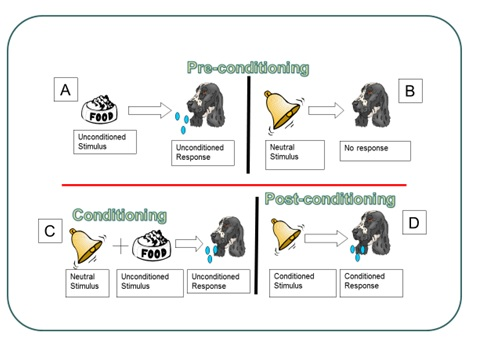
**Postconditioning. **Postconditioning, or *after *learning has occurred, establishes a *new *and not naturally occurring relationship of a conditioned stimulus (CS; previously the NS) and conditioned response (CR; the same response). So the dog now reliably salivates at the sound of the bell because he expects that food will follow, and it does.
后处理。后处理,或学习发生后,建立了一个新的、非自然发生的条件刺激(CS;之前为 NS)和条件反应(CR;相同的反应)之间的关系。因此,狗现在在听到铃声时会可靠地分泌唾液,因为他预期食物会跟随,而且确实如此。
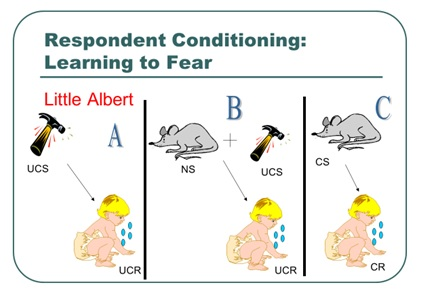
Watson and Rayner (1920) conducted one of the most famous studies in psychology. Essentially, they wanted to explore “the possibility of conditioning various types of emotional response(s).” The researchers ran a series of trials in which they exposed a 9-month-old child, known as Little Albert, to a white rat. Little Albert made no response outside of curiosity (NS–NR not shown). Panel A of Figure 2.6 shows the naturally occurring response to the stimulus of a loud sound. On later trials, the rat was presented (NS) and followed closely by a loud sound (UCS; Panel B). After several conditioning trials, the child responded with fear to the mere presence of the white rat (Panel C).
沃森和雷纳(1920 年)进行了心理学中最著名的研究之一。本质上,他们想探索“各种类型情绪反应的可能性。”研究人员进行了一系列试验,其中他们让一个 9 个月大的孩子,被称为小阿尔伯特,接触一只白鼠。小阿尔伯特除了好奇之外没有做出任何反应(NS–NR 未显示)。图 2.6 的 A 面板显示了自然发生的对响亮声音的刺激反应。在后续试验中,白鼠被呈现(NS),随后紧跟着一个响亮的声音(UCS;B 面板)。经过几次条件反射试验后,孩子对白鼠的出现产生了恐惧反应(C 面板)。
Figure 2.6. Learning to Fear
图 2.6. 学习恐惧
As fears can be learned, so too they can be unlearned. Considered the follow-up to Watson and Rayner (1920), Jones (1924; Figure 2.7) wanted to see if a child who learned to be afraid of white rabbits (Panel B) could be conditioned to become unafraid of them. Simply, she placed the child in one end of a room and then brought in the rabbit. The rabbit was far enough away so as not to cause distress. Then, Jones gave the child some pleasant food (i.e., something sweet such as cookies [Panel C]; remember the response to the food is unlearned, i.e., Panel A). The procedure in Panel C continued with the rabbit being brought a bit closer each time until, eventually, the child did not respond with distress to the rabbit (Panel D).
恐惧可以学会,同样也可以学会忘记。作为沃森和雷纳(1920 年)的后续研究,琼斯(1924 年;图 2.7)想看看一个学会害怕白色兔子的孩子(面板 B)是否可以通过条件反射变得不再害怕它们。简单来说,她将孩子放在房间的另一端,然后带进兔子。兔子离得足够远,以免引起孩子的恐慌。然后,琼斯给孩子一些美味的食物(例如,像饼干这样的甜食[面板 C];记住食物的反应是忘记的,即面板 A)。面板 C 中的程序继续进行,每次兔子都稍微靠近一点,直到最终孩子对兔子不再有恐慌的反应(面板 D)。
Figure 2.7. Unlearning Fears 图 2.7. 重新学习恐惧
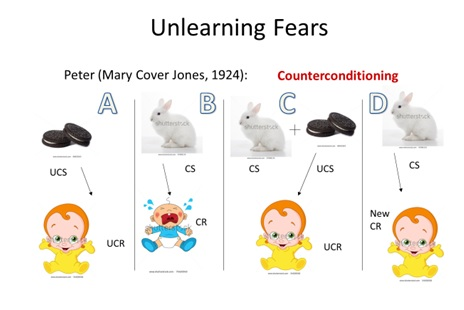
This process is called counterconditioning, or the reversal of previous learning.
这个过程被称为反条件作用,或先前学习的逆转。
Another respondent conditioning way to unlearn a fear is called flooding or exposing the person to the maximum level of stimulus and as nothing aversive occurs, the link between CS and UCS producing the CR of fear should break, leaving the person unafraid. That is the idea, at least. So, if you were afraid of clowns, you would be thrown into a room full of clowns. Hmm….
另一种消除恐惧的条件反应方法被称为“淹没”或“暴露”,即让某人接触到最大程度的刺激,如果没有发生任何厌恶的事情,那么产生恐惧条件反射的 CS(条件刺激)和 UCS(无条件刺激)之间的联系应该断裂,使这个人不再害怕。至少这是这个想法。所以,如果你害怕小丑,你将被扔进一个满是小丑的房间里。嗯……
Finally, respondent conditioning has several properties:
最终,应答者条件化具有几个特性:
- Respondent Generalization – When many similar CSs or a broad range of CSs elicit the same CR. An example is the sound of a whistle eliciting salivation much the same as a ringing bell, both detected via audition.
应答泛化 - 当许多相似的 CS 或广泛的 CS 引发相同的 CR 时。一个例子是哨声的声音引发唾液分泌,就像铃声一样,两者都是通过听觉检测到的。 - Respondent Discrimination – When a single CS or a narrow range of CSs elicits a CR, i.e., teaching the dog to respond to a specific bell and ignore the whistle. The whistle would not be followed by food, eventually leading to….
应答者辨别 - 当单个 CS 或狭窄范围内的 CSs 引发 CR 时,即训练狗对特定铃声做出反应而忽略哨声。哨声不会伴随食物,最终导致…… - Respondent Extinction – When the CS is no longer paired with the UCS. The sound of a school bell ringing (new CS that was generalized) is not followed by food (UCS), and so eventually, the dog stops salivating (the CR).
应答者消退 - 当条件刺激(CS)不再与无条件刺激(UCS)配对时。学校铃声响起(新 CS,已泛化)不会跟随食物(UCS),因此狗最终停止流口水(条件反射)。 - Spontaneous Recovery – When the CS elicits the CR after extinction has occurred. Eventually, the school bell will ring, making the dog salivate. If no food comes, the behavior will not continue. If food appears, the salivation response will be re-established.
自发性恢复 - 当条件刺激(CS)在消退发生后引发条件反应(CR)。最终,学校的铃声会响起,使狗分泌唾液。如果没有食物出现,这种行为将不会继续。如果出现食物,分泌唾液的反应将重新建立。
2.3.2.3. Operant conditioning.2.3.2.3. 操作性条件反射。
Influential on the development of Skinner’s operant conditioning, Thorndike (1905) proposed the law of effect or the idea that if our behavior produces a favorable consequence, in the future when the same stimulus is present, we will be more likely to make the response again, expecting the same favorable consequence. Likewise, if our action leads to dissatisfaction, then we will not repeat the same behavior in the future. He developed the law of effect thanks to his work with a puzzle box. Cats were food deprived the night before the experimental procedure was to occur. The next morning, researchers placed a hungry cat in the puzzle box and set a small amount of food outside the box, just close enough to be smelled. The cat could escape the box and reach the food by manipulating a series of levers. Once free, the cat was allowed to eat some food before being promptly returned to the box. With each subsequent escape and re-insertion into the box, the cat became faster at correctly manipulating the levers. This scenario demonstrates **trial and error learning **or making a response repeatedly if it leads to success. Thorndike also said that stimulus and responses were connected by the organism, and this led to learning. This approach to learning was called connectionism.
斯金纳的操作性条件反射理论受到桑代克(1905 年)的影响,他提出了效果法则或这样的观点:如果我们的行为产生了有利的结果,那么在未来,当相同的刺激出现时,我们更有可能再次做出反应,期望得到相同的有利结果。同样,如果我们的行动导致不满,那么我们将来不会重复同样的行为。他通过研究迷箱发展了效果法则。在实验前夜,猫被剥夺了食物。第二天早上,研究人员将一只饥饿的猫放入迷箱,并在箱外放置了一小部分食物,足够它闻到。猫可以通过操纵一系列杠杆逃离箱子并得到食物。一旦自由,猫被允许吃一些食物,然后立即被送回箱子。随着每次逃离和重新放入箱子,猫在正确操纵杠杆方面变得更快。这个场景展示了试错学习或重复做出反应以获得成功。 桑代克还说过,刺激和反应通过有机体相连,这导致了学习。这种学习方法被称为联结主义。
**Operant conditioning **is a type of associate learning which focuses on consequences that follow a response or behavior that we make (anything we do or say) and whether it makes a behavior more or less likely to occur. This should sound much like what you just read about in terms of Thorndike’s work. Skinner talked about **contingencies **or when one thing occurs due to another. Think of it as an If-Then statement. If I do X, then Y will happen. For operant conditioning, this means that if I make a behavior, then a specific consequence will follow. The events (response and consequence) are linked in time.
操作条件反射是一种关联学习类型,它关注于我们做出的反应或行为(我们所做或所说的任何事情)之后随之而来的后果,以及这些后果是否使行为更有可能发生。这应该听起来与你刚刚阅读的关于桑代克的工作的内容非常相似。斯金纳谈论了偶然性或一件事因另一件事而发生的情况。把它想象成一个如果-那么陈述。如果我做 X,那么 Y 就会发生。对于操作条件反射来说,这意味着如果我做出某种行为,那么就会随之产生特定的后果。这些事件(反应和后果)在时间上相互关联。
What form do these consequences take? There are two main ways they can present themselves.
这些后果以什么形式出现?它们主要有两种呈现方式。
- Reinforcement – Due to the consequence, a behavior/response is strengthened and more likely to occur in the future.
强化——由于后果,行为/反应得到加强,未来更有可能发生。 - Punishment – Due to the consequence, a behavior/response is weakened and less likely to occur in the future.
惩罚 - 由于后果,行为/反应会减弱,未来发生的可能性也会降低。
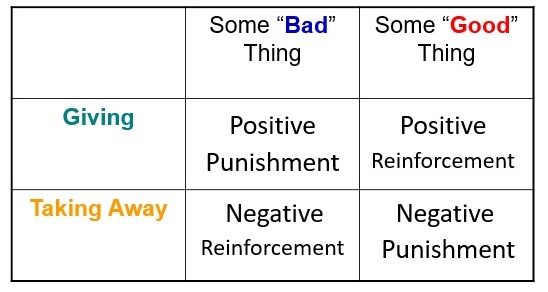
Reinforcement and punishment can occur as two types – positive and negative. These words have no affective connotation to them, meaning they do not imply good or bad. *Positive *means that you are giving something – good or bad. *Negative *means that something is being taken away – good or bad. Check out the figure below for how these contingencies are arranged.
强化和惩罚可以有两种类型——积极和消极。这些词没有情感含义,意味着它们不暗示好坏。积极意味着你正在给予某物——好或坏。消极意味着某物正在被剥夺——好或坏。查看下面的图示,了解这些后果是如何安排的。
Figure 2.8. Contingencies in Operant Conditioning
图 2.8. 操作性条件反射中的意外情况
Let’s go through each:
让我们逐一过一遍:
- Positive Punishment (PP) – If something bad or aversive is given or added, then the behavior is less likely to occur in the future. If you talk back to your mother and she slaps your mouth, this is a PP. Your response of talking back led to the consequence of the aversive slap being given to your face. Ouch!!!
积极惩罚(PP)- 如果给予或添加了不好的或令人厌恶的东西,那么行为在未来发生的可能性就会降低。如果你对母亲顶嘴,她打你的嘴巴,这就是一个积极惩罚。你顶嘴的行为导致了厌恶的嘴巴打脸的后果。哎呀!!! - Positive Reinforcement (PR) – If something good is given or added, then the behavior is more likely to occur in the future. If you study hard and receive an A on your exam, you will be more likely to study hard in the future. Similarly, your parents may give you money for your stellar performance. Cha Ching!!!
正强化(PR)- 如果给予或添加了好事,那么该行为在未来更有可能发生。如果你努力学习并在考试中取得 A,你将来更有可能努力学习。同样,如果你的表现出色,你的父母可能会给你钱。叮当!!! - Negative Reinforcement (NR) – This is a tough one for students to comprehend because the terms seem counterintuitive, even though we experience NR all the time. NR is when something bad or aversive is taken away or subtracted due to your actions, making it that you will be more likely to make the same behavior in the future when the same stimulus presents itself. For instance, what do you do if you have a headache? If you take Tylenol and the pain goes away, you will likely take Tylenol in the future when you have a headache. NR can either result in current escape behavior or future avoidance behavior. What does this mean? *Escape *occurs when we are presently experiencing an aversive event and want it to end. We make a behavior and if the aversive event, like the headache, goes away, we will repeat the taking of Tylenol in the future. This future action is an *avoidance *event. We might start to feel a headache coming on and run to take Tylenol right away. By doing so, we have removed the possibility of the aversive event occurring, and this behavior demonstrates that learning has occurred.
负强化(NR)——这对学生来说很难理解,因为术语似乎与直觉相反,尽管我们经常经历负强化。负强化是指由于你的行为,某种不好的或令人厌恶的东西被去除或减少,这使得你在相同的刺激再次出现时更有可能做出相同的行为。例如,如果你头疼,你会怎么做?如果你吃了泰诺,疼痛消失了,你将来头疼时可能会再次吃泰诺。负强化可能导致当前的逃避行为或未来的回避行为。这意味着什么?逃避发生在我们正在经历一种令人厌恶的事件并希望它结束的时候。我们做出某种行为,如果令人厌恶的事件,比如头疼,消失了,我们将来会重复采取泰诺的行为。这种未来的行为是一种回避事件。我们可能会开始感到头疼即将来临,然后立刻跑去看泰诺。通过这样做,我们消除了令人厌恶的事件发生的可能性,这种行为表明学习已经发生。 - Negative Punishment (NP) – This is when something good is taken away or subtracted, making a behavior less likely in the future. If you are late to class and your professor deducts 5 points from your final grade (the points are something good and the loss is negative), you will hopefully be on time in all subsequent classes.
负惩罚(NP)——这是指移除或减去一些好事,使得未来的行为可能性降低。如果你上课迟到,你的教授从你的最终成绩中扣除 5 分(这些分数是好事,损失是负面的),你希望在下一次课能准时。
The type of reinforcer or punisher we use is crucial. Some are naturally occurring, while others need to be learned. We describe these as primary and secondary reinforcers and punishers. *Primary *refers to reinforcers and punishers that have their effect without having to be learned. Food, water, temperature, and sex, for instance, are primary reinforcers, while extreme cold or hot or a punch on the arm are inherently punishing. A story will illustrate the latter. When I was about eight years old, I would walk up the street in my neighborhood, saying, “I’m Chicken Little and you can’t hurt me.” Most ignored me, but some gave me the attention I was seeking, a positive reinforcer. So I kept doing it and doing it until one day, another kid grew tired of hearing about my other identity and punched me in the face. The pain was enough that I never walked up and down the street echoing my identity crisis for all to hear. This was a positive punisher that did not have to be learned, and definitely not one of my finer moments in life.
我们使用的强化剂或惩罚剂类型至关重要。有些是自然发生的,而有些则需要学习。我们将这些描述为一级和二级强化剂和惩罚剂。一级指的是无需学习就能产生效果的强化剂和惩罚剂。例如,食物、水、温度和性都是一级强化剂,而极端的寒冷或炎热或手臂上的一拳则是固有的惩罚。一个故事将说明后者。当我大约八岁的时候,我会在我们街区的大街上走着,说:“我是小鸡快跑,你伤不了我。”大多数人忽略了我,但有些人给了我我寻求的关注,这是一种积极的强化剂。所以我一直这样做,直到有一天,另一个孩子厌倦了听我关于另一个身份的故事,然后打了我一拳。疼痛足够让我再也没有在大街上走来走去,大声宣布我的身份危机,让所有人都能听到。这是一个不需要学习的积极惩罚剂,绝对不是我一生中最好的时刻。
Secondary or conditioned reinforcers and punishers are not inherently reinforcing or punishing but must be learned. An example was the attention I received for saying I was Chicken Little. Over time I learned that attention was good. Other examples of secondary reinforcers include praise, a smile, getting money for working or earning good grades, stickers on a board, points, getting to go out dancing, and getting out of an exam if you are doing well in a class. Examples of secondary punishers include a ticket for speeding, losing television or video game privileges, ridicule, or a fee for paying your rent or credit card bill late. Really, the sky is the limit with reinforcers in particular.
二级或条件性强化剂和惩罚剂并非天生具有强化或惩罚作用,但必须通过学习获得。一个例子是我因为说自己是“小鸡快跑”而得到的关注。随着时间的推移,我学会了关注是好事。其他二级强化剂的例子包括表扬、微笑、因工作或取得好成绩而得到钱、在板上贴纸、积分、有机会去跳舞,以及如果你在课堂上表现良好,可以免考。二级惩罚剂的例子包括超速罚单、失去电视或电子游戏特权、嘲讽,或者支付房租或信用卡账单晚期的费用。实际上,特别是在强化剂方面,天空才是极限。
In operant conditioning, the rule for determining when and how often we will reinforce the desired behavior is called the **reinforcement schedule. **Reinforcement can either occur continuously meaning every time the desired behavior is made the subject will receive some reinforcer, or *intermittently/partially *meaning reinforcement does not occur with every behavior. Our focus will be on partial/intermittent reinforcement.
在操作性条件反射中,确定何时以及如何频繁地强化期望行为的规则被称为强化计划。强化可以是连续的,即每次期望行为发生时,主体都会收到一些强化物,或者是不连续的/部分的,即强化并不伴随每一次行为。我们的重点是部分/不连续强化。
Figure 2.9. Key Components of Reinforcement Schedules
图 2.9. 强化时间表的关键组件
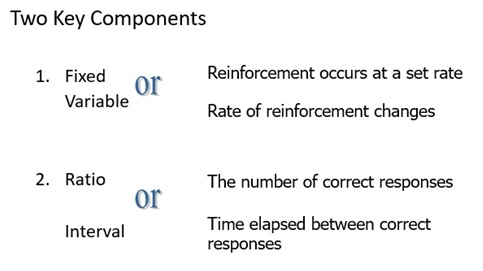
Figure 2.9 shows that that are two main components that make up a reinforcement schedule – when you will reinforce and what is being reinforced. In the case of when, it will be either fixed or at a set rate, or variable and at a rate that changes. In terms of what is being reinforced, we will either reinforce responses or time. These two components pair up as follows:
图 2.9 显示,构成强化日程的两个主要组成部分是——何时进行强化以及强化什么。在何时的情况下,它将是固定的或按设定比率,或者是可变的且比率会变化。至于强化什么,我们将强化反应或时间。这两个组成部分如下配对:
- Fixed Ratio schedule (FR) – With this schedule, we reinforce some set number of responses. For instance, every twenty problems (fixed) a student gets correct (ratio), the teacher gives him an extra credit point. A specific behavior is being reinforced – getting problems correct. Note that if we reinforce each occurrence of the behavior, the definition of continuous reinforcement, we could also describe this as an FR1 schedule. The number indicates how many responses have to be made, and in this case, it is one.
固定比率计划(FR)- 使用此计划,我们强化一定数量的响应。例如,每解决 20 个问题(固定)学生正确(比率),老师给他加一分。正在强化特定的行为——解决问题正确。注意,如果我们强化行为的每一次出现,即连续强化的定义,我们也可以将此描述为 FR1 计划。数字表示需要做出多少次响应,在这种情况下,是 1 次。 - Variable Ratio schedule (VR) – We might decide to reinforce some varying number of responses, such as if the teacher gives him an extra credit point after finishing between 40 and 50 correct problems. This approach is useful if the student is learning the material and does not need regular reinforcement. Also, since the schedule changes, the student will keep responding in the absence of reinforcement.
变量比率计划(VR)- 我们可能会决定强化一些变化数量的反应,例如如果老师在完成 40 到 50 个正确问题后给他额外的学分点。如果学生正在学习材料且不需要定期强化,这种方法很有用。此外,由于计划会变化,学生在没有强化的情况下也会继续做出反应。 - Fixed Interval schedule (FI) – With a FI schedule, you will reinforce after some set amount of time. Let’s say a company wanted to hire someone to sell their product. To attract someone, they could offer to pay them $10 an hour 40 hours a week and give this money every two weeks. Crazy idea, but it could work. Saying the person will be paid every indicates fixed, and two weeks is time or interval. So, FI.
固定时间表(FI)- 使用固定时间表,您将在设定的一段时间后进行强化。比如说,一家公司想要雇佣某人销售他们的产品。为了吸引某人,他们可以提供每小时 10 美元,每周 40 小时,并且每两周支付这笔钱。疯狂的想法,但可能奏效。说这个人会定期收到工资表明是固定的,两周是时间或间隔。所以,FI。 - Variable Interval schedule (VI) – Finally, you could reinforce someone at some changing amount of time. Maybe they receive payment on Friday one week, then three weeks later on Monday, then two days later on Wednesday, then eight days later on Thursday, etc. This could work, right? Not for a job, but maybe we could say we are reinforced on a VI schedule if we are.
变量间隔计划(VI)——最后,你可以在某个变化的时间量上强化某人。也许他们在一周的周五收到付款,然后三周后的周一,再过两天是周三,然后八天后的周四,等等。这可以行得通,对吧?不是针对工作,但如果我们是这样的话,我们可以说我们在 VI 计划上得到了强化。
Finally, four properties of operant conditioning – extinction, spontaneous recovery, stimulus generalization, and stimulus discrimination – are important. These are the same four discussed under respondent conditioning. First, **extinction **is when something that we do, say, think/feel has not been reinforced for some time. As you might expect, the behavior will begin to weaken and eventually stop when this occurs. Does extinction happen as soon as the anticipated reinforcer is removed? The answer is yes and no, depending on whether we are talking about continuous or partial reinforcement. With which type of schedule would you expect a person to stop responding to immediately if reinforcement is not there? Continuous or partial?
最后,操作性条件反射的四个特性——消退、自然恢复、刺激泛化和刺激辨别——很重要。这些与应答性条件反射下讨论的四个相同。首先,消退是指我们做的、说的、想的/感受的某件事在一段时间内没有得到强化。正如你可能预期的,当这种情况发生时,行为将开始减弱,最终停止。消退是在预期的强化剂被移除后立即发生的吗?答案是是和否,这取决于我们是在讨论连续强化还是部分强化。如果你期望一个人在没有强化时立即停止反应,你会选择哪种类型的日程安排?连续的还是部分的?
The answer is continuous. If a person is used to receiving reinforcement every time they perform a particular behavior, and then suddenly no reinforcer is delivered, he or she will cease the response immediately. Obviously then, with partial, a response continues being made for a while. Why is this? The person may think the schedule has simply changed. ‘Maybe I am not paid weekly now. Maybe it changed to biweekly and I missed the email.’ Due to this endurance, we say that intermittent or partial reinforcement shows resistance to extinction, meaning the behavior does weaken, but gradually.
答案持续存在。如果一个人习惯于每次执行特定行为时都得到强化,然后突然没有强化物被提供,他或她会立即停止反应。显然,在这种情况下,部分强化时,反应会持续一段时间。为什么是这样?这个人可能认为时间表只是改变了。“也许我现在不是每周支付了。也许它改为每两周支付一次,我错过了电子邮件。”由于这种耐力,我们说间歇性或部分强化显示出对消退的抵抗力,这意味着行为确实会减弱,但会逐渐减弱。
As you might expect, if reinforcement occurs after extinction has started, the behavior will re-emerge. Consider your parents for a minute. To stop some undesirable behavior you made in the past, they likely took away some privilege. I bet the bad behavior ended too. But did you ever go to your grandparent’s house and grandma or grandpa—or worse, BOTH—took pity on you and let you play your video games (or something equivalent)? I know my grandmother used to. What happened to that bad behavior that had disappeared? Did it start again and your parents could not figure out why?
正如你可能预料的那样,如果在消退开始之后发生强化,行为将会重新出现。考虑一下你的父母。为了停止你过去的一些不良行为,他们可能剥夺了你的一些特权。我敢打赌,那些不良行为也结束了。但你有没有去过你祖父母的家,奶奶或爷爷——更糟糕的是,两者都——同情你,让你玩你的电子游戏(或者类似的东西)?我知道我的祖母以前是这样的。那个已经消失的不良行为怎么了?它是不是又开始了,而你的父母无法理解为什么?
Additionally, you might have wondered if the person or animal will try to make the response again in the future even though it stopped being reinforced in the past. The answer is yes, and one of two outcomes is possible. First, the response is made, and nothing happens. In this case, extinction continues. Second, the response is made, and a reinforcer is delivered. The response re-emerges. Consider a rat trained to push a lever to receive a food pellet. If we stop providing the food pellets, in time, the rat will stop pushing the lever. If the rat pushes the lever again sometime in the future and food is delivered, the behavior spontaneously recovers. Hence, this phenomenon is called **spontaneous recovery. **
此外,你可能想知道,即使过去已经停止强化,人或动物是否还会尝试再次做出反应。答案是肯定的,可能出现两种结果。首先,做出反应,但没有发生任何事情。在这种情况下,消退继续。其次,做出反应,并给予强化。反应重新出现。考虑一只被训练按杠杆以获得食物颗粒的老鼠。如果我们停止提供食物颗粒,过一段时间,老鼠将停止按杠杆。如果老鼠在未来某个时候再次按杠杆并且提供食物,行为会自发恢复。因此,这种现象被称为自发恢复。
2.3.2.4. Observational learning.2.3.2.4. 观察学习。
There are times when we learn by simply watching others. This is called **observational learning **and is contrasted with enactive learning, which is learning by doing. There is no firsthand experience by the learner in observational learning, unlike enactive. As you can learn desirable behaviors such as watching how your father bags groceries at the grocery store (I did this and still bag the same way today), you can learn undesirable ones too. If your parents resort to alcohol consumption to deal with stressors life presents, then you also might do the same. The critical part is what happens to the person modeling the behavior. If my father seems genuinely happy and pleased with himself after bagging groceries his way, then I will be more likely to adopt this behavior. If my mother or father consumes alcohol to feel better when things are tough, and it works, then I might do the same. On the other hand, if we see a sibling constantly getting in trouble with the law, then we may not model this behavior due to the negative consequences.
有时候我们只是通过观察他人来学习。这被称为观察学习,与通过实践学习的主动学习相对。在观察学习中,学习者没有亲身体验,与主动学习不同。正如你可以通过观察父亲在杂货店打包货物的方式(我就是这样做的,至今仍以同样的方式打包)来学习可取的行为,你也可以学习不可取的行为。如果你的父母通过饮酒来应对生活中带来的压力,那么你也可能会这样做。关键在于模仿行为的人会发生什么。如果我的父亲在以自己的方式打包货物后看起来真的很高兴和满意,那么我更有可能采取这种行为。如果我的母亲或父亲在事情艰难时饮酒以感到更好,并且这有效,那么我也可能会这样做。另一方面,如果我们看到兄弟姐妹不断因违法而陷入麻烦,那么我们可能不会模仿这种行为,因为会有负面后果。
Albert Bandura conducted pivotal research on observational learning, and you likely already know all about it. Check out Figure 2.10 to see if you do. In Bandura’s experiment, children were first brought into a room to watch a video of an adult playing nicely or aggressively with a Bobo doll, which provided a model. Next, the children are placed in a room with several toys in it. The room contains a highly prized toy, but they are told they cannot play with it. All other toys are allowed, including a Bobo doll. Children who watched the aggressive model behaved aggressively with the Bobo doll while those who saw the gentle model, played nice. Both groups were frustrated when deprived of the coveted toy.
阿尔伯特·班杜拉对观察学习进行了关键性研究,你可能已经对此了如指掌。查看图 2.10 看看你是否了解。在班杜拉实验中,孩子们首先被带到房间里观看一个成年人用 Bobo 玩偶友好或攻击性地玩耍的视频,这提供了一个模型。接下来,孩子们被放在一个房间里,房间里有许多玩具。房间里有一个非常珍贵的玩具,但他们被告知不能玩。所有其他玩具都可以玩,包括 Bobo 玩偶。观看攻击性模型的孩子们在与 Bobo 玩偶互动时表现出攻击性行为,而看到温和模型的孩子们则表现得友好。当被剥夺了渴望的玩具时,两组人都感到沮丧。
Figure 2.10. Bandura’s Classic Experiment
图 2.10. 布兰达的经典实验
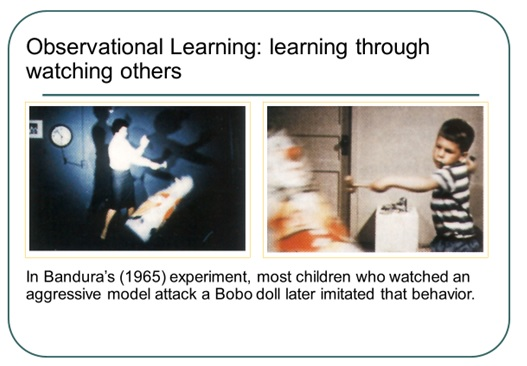
According to Bandura, all behaviors are learned by observing others, and we model our actions after theirs, so undesirable behaviors can be altered or relearned in the same way. Modeling techniques change behavior by having subjects observe a model in a situation that usually causes them some anxiety. By seeing the model interact nicely with the fear evoking stimulus, their fear should subside. This form of behavior therapy is widely used in clinical, business, and classroom situations. In the classroom, we might use modeling to demonstrate to a student how to do a math problem. In fact, in many college classrooms, this is exactly what the instructor does. In the business setting, a model or trainer demonstrates how to use a computer program or run a register for a new employee.
根据班杜拉,所有行为都是通过观察他人学到的,我们模仿他们的行为,因此可以通过同样的方式改变或重新学习不良行为。通过让受试者在通常会引起他们焦虑的情况下观察一个模型,模仿技术可以改变行为。通过看到模型与引起恐惧的刺激物友好互动,他们的恐惧应该会减轻。这种形式的行为疗法在临床、商业和课堂环境中得到广泛应用。在课堂上,我们可能会用模仿来向学生展示如何解决数学问题。事实上,在许多大学课堂上,这正是教师所做的事情。在商业环境中,一个模型或培训师会向新员工展示如何使用计算机程序或操作收银机。
However, keep in mind that we do not model everything we see. Why? First, we cannot pay attention to everything going on around us. We are more likely to model behaviors by someone who commands our attention. Second, we must remember what a model does to imitate it. If a behavior is not memorable, it will not be imitated. We must try to convert what we see into action. If we are not motivated to perform an observed behavior, we probably will not show what we have learned.
然而,请注意,我们并不是对所见的一切都进行建模。为什么?首先,我们无法关注周围发生的所有事情。我们更有可能模仿那些能吸引我们注意力的人的行为。其次,我们必须记住一个模型是如何做的,以便模仿它。如果一个行为不可记忆,它就不会被模仿。我们必须尝试将所见转化为行动。如果我们没有动机去执行观察到的行为,我们可能不会展示我们所学的。
2.3.2.5. Evaluating the behavioral model.2.3.2.5. 评估行为模型。
Within the context of psychopathology, the behavioral perspective is useful because explains maladaptive behavior in terms of learning gone awry. The good thing is that what is learned can be unlearned or relearned through behavior modification, the process of changing behavior. To begin, an applied behavior analyst identifies a target behavior, or behavior to be changed, defines it, works with the client to develop goals, conducts a functional assessment to understand what the undesirable behavior is, what causes it, and what maintains it. With this knowledge, a plan is developed and consists of numerous strategies to act on one or all these elements – antecedent, behavior, and/or consequence. The strategies arise from all three learning models. In terms of operant conditioning, strategies include antecedent manipulations, prompts, punishment procedures, differential reinforcement, habit reversal, shaping, and programming. Flooding and desensitization are typical respondent conditioning procedures used with phobias, and modeling arises from social learning theory and observational learning. Watson and Skinner defined behavior as what we do or say, but later behaviorists added what we think or feel. In terms of the latter, cognitive behavior modification procedures arose after the 1960s and with the rise of cognitive psychology. This led to a cognitive-behavioral perspective that combines concepts from the behavioral and cognitive models, the latter discussed in the next section.
在心理病理学背景下,行为视角是有用的,因为它用学习出错来解释不适应行为。好事是,所学的可以通过行为改变来忘记或重新学习,这是改变行为的过程。首先,应用行为分析师确定一个目标行为,或要改变的行为,定义它,与客户合作制定目标,进行功能评估以了解不良行为是什么,它是由什么引起的,以及是什么维持了它。有了这些知识,就制定了计划,并包括针对这些要素(前因、行为和/或后果)的多种策略。策略源于所有三种学习模型。在操作性条件反射方面,策略包括前因操纵、提示、惩罚程序、差异强化、习惯逆转、塑造和编程。洪水疗法和脱敏是典型的条件反射程序,用于治疗恐惧症,而模仿源于社会学习理论和观察学习。 沃森和斯金纳将行为定义为我们所做或所说的事情,但后来行为主义者增加了我们所思考和感受的内容。在后者方面,20 世纪 60 年代以后,随着认知心理学的兴起,出现了认知行为修正程序。这导致了将行为模型和认知模型的概念相结合的认知行为视角,后者将在下一节中讨论。
Critics of the behavioral perspective point out that it oversimplifies behavior and often ignores inner determinants of behavior. Behaviorism has also been accused of being mechanistic and seeing people as machines. This criticism would be true of behaviorism’s first two stages, though sociobehaviorism steered away from this proposition and even fought against any mechanistic leanings of behaviorists.
批评行为观点的人指出,它过于简化行为,并且经常忽视行为的内在决定因素。行为主义还被指责为机械论,将人视为机器。这种批评对于行为主义的前两个阶段是正确的,尽管社会行为主义偏离了这一命题,甚至反对行为主义者的任何机械倾向。
The greatest strength or appeal of the behavioral model is that its tenets are easily tested in the laboratory, unlike those of the psychodynamic model. Also, many treatment techniques have been developed and proven to be effective over the years. For example, desensitization (Wolpe, 1997) teaches clients to respond calmly to fear-producing stimuli. It begins with the individual learning a relaxation technique such as diaphragmatic breathing. Next, a fear hierarchy, or list of feared objects and situations, is constructed in which the individual moves from least to most feared. Finally, the individual either imagines (systematic) or experiences in real life (in-vivo) each object or scenario from the hierarchy and uses the relaxation technique while doing so. This represents the individual pairings of a feared object or situation and relaxation. So, if there are 10 objects/situations in the list, the client will experience ten such pairings and eventually be able to face each without fear. Outside of phobias, desensitization has been shown to be effective in the treatment of Obsessive-Compulsive Disorder symptoms (Hakimian and Souza, 2016) and limitedly with the treatment of depression when co-morbid with OCD (Masoumeh and Lancy, 2016).
行为模型的最大优势或吸引力在于其原则很容易在实验室中进行测试,这与心理动力学模型不同。此外,多年来已经开发并证明了许多治疗方法是有效的。例如,脱敏疗法(Wolpe,1997)教导客户对产生恐惧的刺激保持冷静的反应。它从个体学习放松技巧,如膈式呼吸开始。接下来,构建一个恐惧等级,或列出恐惧的对象和情境,个体从最不恐惧到最恐惧进行移动。最后,个体要么想象(系统性的)要么在现实生活中(现场)体验等级中的每个对象或情境,并在这样做的同时使用放松技巧。这代表了恐惧对象或情境与放松的个体配对。因此,如果列表中有 10 个对象/情境,客户将经历十次这样的配对,最终能够面对每个对象而不感到恐惧。 除恐惧症外,脱敏疗法已被证明在治疗强迫症症状(Hakimian 和 Souza,2016)以及与 OCD 共病时的抑郁症治疗中有限有效(Masoumeh 和 Lancy,2016)。
2.3.3. The Cognitive Model 2.3.3. 认知模型
2.3.3.1. What is it?2.3.3.1. 它是什么?
As noted earlier, the idea of people being machines, called mechanism, was a key feature of behaviorism and other schools of thought in psychology until about the 1960s or 1970s. In fact, behaviorism said psychology was to be the study of observable behavior. Any reference to cognitive processes was dismissed as this was not overt, but covert according to Watson and later Skinner. Of course, removing cognition from the study of psychology ignored an important part of what makes us human and separates us from the rest of the animal kingdom. Fortunately, the work of George Miller, Albert Ellis, Aaron Beck, and Ulrich Neisser demonstrated the importance of cognitive abilities in understanding thoughts, behaviors, and emotions, and in the case of psychopathology, show that people can create their problems by how they come to interpret events experienced in the world around them. How so?
如前所述,人被看作机器,即机制,是行为主义和其他心理学流派在 20 世纪 60 年代或 70 年代之前的一个关键特征。事实上,行为主义认为心理学应该是可观察行为的研究。任何关于认知过程的提及都被视为这是沃森和后来的斯金纳所认为的隐蔽的,而不是公开的。当然,从心理学研究中去除认知忽略了人类的重要部分,这也是我们与其他动物王国区分开来的原因。幸运的是,乔治·米勒、阿尔伯特·艾利斯、阿伦·贝克和乌尔里希·内塞尔的工作证明了认知能力在理解思想、行为和情感中的重要性,以及在心理病理学的情况下,表明人们可以通过他们对周围世界经历的事件的解释方式来创造他们的问题。为什么会这样?
2.3.3.2. Schemas and cognitive errors.2.3.3.2. 模式和认知错误。
First, consider the topic of social cognition or the process of collecting and assessing information about others. So what do we do with this information? Once collected or sensed (sensation is the cognitive process of detecting the physical energy given off or emitted by physical objects), the information is sent to the brain through the neural impulse. Once in the brain, it is processed and interpreted. This is where assessing information about others comes in and involves the cognitive process of perception, or adding meaning to raw sensory data. We take the information just detected and use it to assign people to categories, or groups. For each category, we have a schema, or a set of beliefs and expectations about a group of people, presumed to apply to all members of the group, and based on experience.
首先,考虑社会认知或收集和评估他人信息的过程。那么我们如何处理这些信息?一旦收集或感知(感知是检测物理对象发出的或发射的物理能量的认知过程),信息就会通过神经冲动发送到大脑。一旦进入大脑,它就会被处理和解释。这就是评估他人信息的地方,涉及到感知的认知过程,或为原始感官数据添加意义。我们使用刚刚检测到的信息来将人们分配到类别或群体中。对于每个类别,我们都有一个模式,或是一套关于一群人的信念和期望,假定适用于该群体的所有成员,并基于经验。
Can our schemas lead us astray or be false? Consider where students sit in a class. It is generally understood that the students who sit in the front of the class are the overachievers and want to earn an A in the class. Those who sit in the back of the room are underachievers who don’t care. Right? Where do you sit in class, if you are on a physical campus and not an online student? Is this correct? What about other students in the class that you know? What if you found out that a friend who sits in the front row is a C student but sits there because he cannot see the screen or board, even with corrective lenses? What about your friend or acquaintance in the back? This person is an A student but does not like being right under the nose of the professor, especially if he/she tends to spit when lecturing. The person in the back could also be shy and prefer sitting there so that s/he does not need to chat with others as much. Or, they are easily distracted and sits in the back so that all stimuli are in front of him/her. Again, your schema about front row and back row students is incorrect and causes you to make certain assumptions about these individuals. This might even affect how you interact with them. Would you want notes from the student in the front or back of the class?
我们的模式会误导我们或出错吗?考虑一下学生在课堂上的座位。通常人们认为坐在教室前面的是成绩优秀的学生,他们想要在课堂上得到 A。而坐在教室后面的是成绩不佳的学生,他们不在乎。对吧?如果你在实体校园而不是在线学习,你在课堂上的座位在哪里?这是正确的吗?你认识的其他同学呢?如果你发现一个坐在前排的朋友其实是个 C 学生,但他坐在那里是因为他即使戴着矫正眼镜也看不到屏幕或黑板,会怎么样?你后面的朋友或熟人呢?这个人是个 A 学生,但他不喜欢坐在教授鼻子下面,尤其是如果他/她讲课时喜欢吐口水。坐在后面的那个人也可能很害羞,宁愿坐在那里以免需要和他人过多交谈。或者,他们很容易分心,坐在后面以便所有刺激都在他们面前。再次强调,你对前排和后排学生的模式是错误的,这让你对这些个体做出了某些假设。 这可能甚至会影响你与他们互动的方式。你希望学生的笔记放在课堂的前面还是后面?
2.3.3.3. Attributions and cognitive errors.2.3.3.3. 归因和认知错误。
Second, consider the very interesting social psychology topic attribution theory, or the idea that people are motivated to explain their own and other people’s behavior by attributing causes of that behavior to personal reasons or dispositional factors that are in the person themselves or linked to some trait they have; or situational factors that are linked to something outside the person. Like schemas, the attributions we make can lead us astray. How so? The **fundamental attribution error **occurs when we automatically assume a dispositional reason for another person’s actions and ignore situational factors. In other words, we assume the person who cut us off is an idiot (dispositional) and do not consider that maybe someone in the car is severely injured and this person is rushing them to the hospital (situational). Then there is the self-serving bias, which is when we attribute our success to our own efforts (dispositional) and our failures to external causes (situational). Our attribution in these two cases is in error, but still, it comes to affect how we see the world and our subjective well-being.
其次,考虑一个非常有趣的社会心理学主题——归因理论,或者人们通过将行为的原因归因于个人原因或性格因素(这些因素存在于个人自身或与他们的某些特质相关联)或情境因素(这些因素与个人外部的事物相关联)来解释自己和他人行为的想法;或者情境因素。就像图式一样,我们做出的归因可能会让我们误入歧途。为什么会这样?基本归因错误发生在我们自动假设他人的行为是由性格原因引起的,而忽略了情境因素。换句话说,我们假设挡我们车的人是个白痴(性格),而没有考虑到可能车上有严重受伤的人,这个人正在紧急送他们去医院(情境)。然后是自我服务偏见,即当我们把成功归因于自己的努力(性格)和失败归因于外部原因(情境)时。在这些情况下,我们的归因是错误的,但仍然会影响我们看待世界和我们主观幸福感的方式。
2.3.3.4. Maladaptive cognitions.2.3.3.4. 适应性认知障碍。
Irrational thought patterns can be the basis of psychopathology. Throughout this book, we will discuss several treatment strategies used to change unwanted, maladaptive cognitions, whether they are present as an excess such as with paranoia, suicidal ideation, or feelings of worthlessness; or as a deficit such as with self-confidence and self-efficacy. More specifically, cognitive distortions/maladaptive cognitions can take the following forms:
不合理的思维模式可能是心理病理学的基础。在本书中,我们将讨论几种用于改变不受欢迎的、适应性认知障碍的治疗策略,无论它们是以过度形式存在,如偏执、自杀意念或自卑感;还是以不足形式存在,如自信和自我效能感。更具体地说,认知扭曲/适应性认知障碍可以采取以下形式:
- Overgeneralizing – You see a larger pattern of negatives based on one event.
过度概括——你根据一个事件看到了更大的负面模式。 - Mind Reading – Assuming others know what you are thinking without any evidence.
心灵感应 - 假设其他人知道你在想什么,没有任何证据。 - What if? – Asking yourself ‘what if something happens,’ without being satisfied by any of the answers.
如果?——问自己“如果发生了什么”,却对任何答案都不满意。 - Blaming – You focus on someone else as the source of your negative feelings and do not take any responsibility for changing yourself.
责怪 - 你将负面情绪的来源归咎于他人,而不承担改变自己的责任。 - Personalizing – Blaming yourself for adverse events rather than seeing the role that others play.
个性化——将不利事件归咎于自己,而不是看到他人所扮演的角色。 - Inability to disconfirm – Ignoring any evidence that may contradict your maladaptive cognition.
无法证伪 - 忽略任何可能反驳你不良认知的证据。 - Regret orientation – Focusing on what you could have done better in the past rather than on improving now.
遗憾取向 - 专注于过去本可以做得更好的事情,而不是专注于现在的改进。 - Dichotomous thinking – Viewing people or events in all-or-nothing terms.
二分法思维 - 用全有或全无的方式看待人或事件。
2.3.3.5. Cognitive therapies.2.3.3.5. 认知疗法。
According to the National Alliance on Mental Illness (NAMI), cognitive behavioral therapy “focuses on exploring relationships among a person’s thoughts, feelings and behaviors. During CBT a therapist will actively work with a person to uncover unhealthy patterns of thought and how they may be causing self-destructive behaviors and beliefs.” CBT attempts to identify negative or false beliefs and restructure them. They add, “Oftentimes someone being treated with CBT will have homework in between sessions where they practice replacing negative thoughts with more realistic thoughts based on prior experiences or record their negative thoughts in a journal.” For more on CBT, visit: https://www.nami.org/About-Mental-Illness/Treatments/Psychotherapy. Some commonly used strategies include cognitive restructuring, cognitive coping skills training, and acceptance techniques.
根据国家精神疾病联盟(NAMI),认知行为疗法“专注于探索一个人的思想、情感和行为之间的关系。在认知行为疗法(CBT)过程中,治疗师将积极与个人合作,揭示不健康的思维模式以及它们可能导致的自我破坏性行为和信念。”CBT 试图识别消极或错误的信念并对其进行重构。他们补充说,“通常,接受 CBT 治疗的人在会话之间会有家庭作业,他们练习用更现实的想法来替代消极的想法,这些想法基于以往的经验,或者记录他们的消极想法在日记中。”有关 CBT 的更多信息,请访问:https://www.nami.org/About-Mental-Illness/Treatments/Psychotherapy。一些常用的策略包括认知重构、认知应对技能培训和接受技巧。
First, you can use cognitive restructuring, also called rational restructuring, in which maladaptive cognitions are replaced with more adaptive ones. To do this, the client must be aware of the distressing thoughts, when they occur, and their effect on them. Next, help the client stop thinking these thoughts and replace them with more rational ones. It’s a simple strategy, but an important one. Psychology Today published a great article on January 21, 2013, which described four ways to change your thinking through cognitive restructuring. Briefly, these included:
首先,你可以使用认知重构,也称为理性重构,在这种方法中,不适应的认知被更适应的认知所取代。为此,客户必须意识到令人不安的想法,它们何时发生,以及它们对他们的影响。接下来,帮助客户停止这些想法,并用更理性的想法来替代。这是一个简单的策略,但非常重要。《今日心理学》于 2013 年 1 月 21 日发表了一篇优秀的文章,其中描述了通过认知重构改变思维的四种方法。简要来说,这些包括:
- Notice when you are having a maladaptive cognition, such as making “negative predictions.” Figure out what is the worst thing that could happen and what alternative outcomes are possible.
注意当你有不良认知时,比如做出“负面预测”。想清楚最坏的情况可能是什么,以及可能出现的其他结果。 - Track the accuracy of the thought. If you believe focusing on a problem generates a solution, then write down each time you ruminate and the result. You can generate a percentage of times you ruminated to the number of successful problem-solving strategies you generated.
追踪思维的准确性。如果你认为专注于问题会产生解决方案,那么每次你沉思时都写下它以及结果。你可以计算出你沉思的次数与产生的成功问题解决策略的数量之间的百分比。 - Behaviorally test your thought. Try figuring out if you genuinely do not have time to go to the gym by recording what you do each day and then look at open times of the day. Add them up and see if making some minor, or major, adjustments to your schedule will free an hour to get in some valuable exercise.
行为测试你的想法。试着通过记录你每天所做的事情,然后查看一天中的空闲时间,来判断你是否真的没有时间去健身房。加起来看看是否对时间表进行一些小的或大的调整,可以腾出一个小时来进行一些有价值的锻炼。 - Examine the evidence both for and against your thought. If you do not believe you do anything right, list evidence of when you did not do something right and then evidence of when you did. Then write a few balanced statements such as the one the article suggests, “I’ve made some mistakes that I feel embarrassed about, but a lot of the time, I make good choices.”
审查你想法的利弊证据。如果你不相信自己做得对,列出你没有做对的事情的证据,然后列出你做对的事情的证据。然后写几条平衡的陈述,例如文章建议的,“我犯了一些让我感到尴尬的错误,但很多时候,我做出了好的选择。”
The article also suggested a few non-cognitive restructuring techniques, including mindfulness meditation and self-compassion. For more on these, visit: https://www.psychologytoday.com/blog/in-practice/201301/cognitive-restructuring
文章还建议了几种非认知重构技术,包括正念冥想和自我同情。更多关于这些内容,请访问:https://www.psychologytoday.com/blog/in-practice/201301/cognitive-restructuring
The second major CBT strategy is called cognitive coping skills training. This strategy teaches social skills, communication, assertiveness through direct instruction, role playing, and modeling. For social skills training, identify the appropriate social behavior such as making eye contact, saying no to a request, or starting up a conversation with a stranger and determine whether the client is inhibited from making this behavior due to anxiety. For communication, decide if the problem is related to speaking, listening, or both and then develop a plan for use in various interpersonal situations. Finally, assertiveness training aids the client in protecting their rights and obtaining what they want from others. Those who are not assertive are often overly passive and never get what they want or are unreasonably aggressive and only get what they want. Treatment starts with determining situations in which assertiveness is lacking and developing a hierarchy of assertiveness opportunities. Least difficult situations are handled first, followed by more difficult situations, all while rehearsing and mastering all the situations present in the hierarchy. For more on these techniques, visit http://cogbtherapy.com/cognitive-behavioral-therapy-exercises/.
第二项主要的认知行为治疗策略被称为认知应对技巧训练。该策略通过直接指导、角色扮演和模仿来教授社交技巧、沟通和自信。对于社交技巧训练,确定适当的社会行为,如进行眼神交流、拒绝请求或与陌生人开始对话,并确定客户是否因焦虑而抑制这种行为。对于沟通,确定问题是否与说话、倾听或两者都有关,然后制定用于各种人际交往场合的计划。最后,自信训练帮助客户保护自己的权利并从他人那里获得他们想要的东西。那些不自信的人往往过于被动,永远得不到他们想要的东西,或者过于激进,只得到他们想要的东西。治疗从确定缺乏自信的情况开始,并制定自信机会的等级制度。首先处理最简单的情况,然后是更困难的情况,同时练习和掌握等级制度中出现的所有情况。 有关这些技术的更多信息,请访问 http://cogbtherapy.com/cognitive-behavioral-therapy-exercises/。
Finally, acceptance techniques help reduce a client’s worry and anxiety. Life involves a degree of uncertainty, and at times we must accept this. Techniques might include weighing the pros and cons of fighting uncertainty or change. The disadvantages should outweigh the advantages and help you to end the struggle and accept what is unknown. Chances are you are already accepting the unknown in some areas of life and identifying these can help you to see why it is helpful in these areas, and how you can apply this in more difficult areas. Finally, does uncertainty always lead to a negative end? We may think so, but a review of the evidence for and against this statement will show that it does not and reduce how threatening it seems.
最后,接受技巧有助于减少客户的担忧和焦虑。生活涉及一定程度的不确定性,有时我们必须接受这一点。技巧可能包括权衡与不确定性和变化作斗争的利弊。不利因素应该超过有利因素,帮助你结束斗争并接受未知。可能你已经在生活的某些领域接受了未知,识别这些可以帮助你了解为什么它在这些领域有帮助,以及你如何在更困难的地方应用这一点。最后,不确定性是否总是导致负面结果?我们可能会这样认为,但审查支持或反对这一陈述的证据将表明并非如此,并减少它看起来有多威胁。
2.3.3.6. Evaluating the cognitive model.2.3.3.6. 评估认知模型。
The cognitive model made up for an apparent deficit in the behavioral model – overlooking the role cognitive processes play in our thoughts, feelings, and behaviors. Right before his death, Skinner (1990) reminded psychologists that the only thing we can truly know and study was the observable. Cognitive processes cannot be empirically and reliably measured and should be ignored. Is there merit to this view? **Social desirability **states that sometimes participants do not tell us the truth about what they are thinking, feeling, or doing (or have done) because they do not want us to think less of them or to judge them harshly if they are outside the social norm. In other words, they present themselves in a favorable light. If this is true, how can we know anything about controversial matters? The person’s true intentions or thoughts and feelings are not readily available to us, or are covert, and do not make for useful empirical data. Still, cognitive-behavioral therapies have proven their efficacy for the treatment of OCD (McKay et al., 2015), perinatal depression (Sockol, 2015), insomnia (de Bruin et al., 2015), bulimia nervosa (Poulsen et al., 2014), hypochondriasis (Olatunji et al., 2014), and social anxiety disorder (Leichsenring et al., 2014) to name a few. Other examples will be discussed throughout this book.
认知模型弥补了行为模型的一个明显缺陷——忽视了认知过程在我们思考、感受和行为中的作用。在斯金纳(1990)去世前,他提醒心理学家,我们真正能了解和研究的只有可观察到的。认知过程无法通过经验方法可靠地测量,应该被忽略。这种观点是否有价值?社会期望性原则指出,有时参与者不会告诉我们他们所想、所感或所做的事情(或已经做过的事情),因为他们不想让我们小看他们,或者如果他们偏离社会规范,不想让我们严厉地评判他们。换句话说,他们会以有利的方式展示自己。如果这是真的,我们如何了解有争议的问题?一个人的真实意图或思想感情并不容易为我们所知,或者是不公开的,并不构成有用的经验数据。然而,认知行为疗法已被证明对治疗强迫症(麦凯等人,2015 年)、围产期抑郁症(索科尔,2015 年)、失眠(德布鲁因等人,2015 年)、神经性贪食症(普尔森等人)有效。,2014),疑病症(Olatunji 等,2014),以及社交焦虑症(Leichsenring 等,2014)等。本书将讨论其他例子。
2.3.4. The Humanistic and Existential Perspectives 2.3.4. 人文与存在主义视角
2.3.4.1. The humanistic perspective.2.3.4.1. 人文主义视角。
The humanistic perspective, or third force psychology (psychoanalysis and behaviorism being the other two forces), emerged in the 1960s and 1970s as an alternative viewpoint to the largely deterministic view of personality espoused by psychoanalysis and the view of humans as machines advocated by behaviorism. Key features of the perspective include a belief in human perfectibility, personal fulfillment, valuing self-disclosure, placing feelings over intellect, an emphasis on the present, and hedonism. Its key figures were Abraham Maslow, who proposed the hierarchy of needs, and Carl Rogers, who we will focus on here.
人文主义视角,或第三势力心理学(心理分析和行为主义是其他两个势力),在 20 世纪 60 年代和 70 年代出现,作为一种对心理分析所宣扬的很大程度上决定论的人格观和行为主义所倡导的人类如机器的观点的替代观点。这一视角的关键特征包括相信人的完善性、个人满足感、重视自我披露、情感高于理智、强调当下和享乐主义。其关键人物包括提出需求层次理论的亚伯拉罕·马斯洛和在此处我们将关注的卡尔·罗杰斯。
Rogers said that all people want to have positive regard from significant others in their life. When the individual is accepted as they are, they receive *unconditional positive regard *and become a fully functioning person. They are open to experience, live every moment to the fullest, are creative, accepts responsibility for their decisions, do not derive their sense of self from others, strive to maximize their potential, and are self-actualized. Their family and friends may disapprove of some of their actions but overall, respect and love them. They then realize their worth as a person but also that they are not perfect. Of course, most people do not experience this but instead are made to feel that they can only be loved and respected if they meet certain standards, called conditions of worth. Hence, they experience conditional positive regard. Their self-concept becomes distorted, now seen as having worth only when these significant others approve, leading to a disharmonious state and psychopathology. Individuals in this situation are unsure of what they feel, value, or need leading to dysfunction and the need for therapy. Rogers stated that the humanistic therapist should be warm, understanding, supportive, respectful, and accepting of his/her clients. This approach came to be called client-centered therapy.
罗杰斯说,所有人都在寻求生活中重要他人对他们的正面评价。当个人被接纳为真实的自己时,他们会得到无条件的爱和尊重,成为一个完全功能的人。他们愿意体验,尽情享受每一刻,富有创造力,对自己的决定负责,不依赖他人的看法来定义自我,努力发挥自己的潜力,并实现自我实现。他们的家人和朋友可能不赞成他们的某些行为,但总体上尊重和爱他们。然后他们意识到自己的价值,但也认识到自己并不完美。当然,大多数人没有经历过这种感受,而是被灌输只有达到某些标准才能被爱和尊重的观念,这些标准被称为价值条件。因此,他们体验到有条件的正面评价。他们的自我概念变得扭曲,现在只有在这些重要他人认可时才有价值,导致不和谐的状态和心理疾病。处于这种情况的个人对自己的感受、价值观或需求感到不确定,导致功能障碍和需要治疗。 罗杰斯表示,人本治疗师应该热情、理解、支持、尊重并接受其客户。这种方法被称为以客户为中心的治疗。
2.3.4.2. The existential perspective.2.3.4.2. 存在主义视角。
This approach stresses the need for people to re-create themselves continually and be self-aware, acknowledges that anxiety is a normal part of life, focuses on free will and self-determination, emphasizes that each person has a unique identity known only through relationships and the search for meaning, and finally, that we develop to our maximum potential. Abnormal behavior arises when we avoid making choices, do not take responsibility, and fail to actualize our full potential. Existential therapy is used to treat substance abuse, “excessive anxiety, apathy, alienation, nihilism, avoidance, shame, addiction, despair, depression, guilt, anger, rage, resentment, embitterment, purposelessness, psychosis, and violence. They also focus on life-enhancing experiences like relationships, love, caring, commitment, courage, creativity, power, will, presence, spirituality, individuation, self-actualization, authenticity, acceptance, transcendence, and awe.” For more information, please visit: https://www.psychologytoday.com/therapy-types/existential-therapy
这种方法强调人们需要不断重新创造自己并保持自我意识,承认焦虑是生活的一部分,关注自由意志和自我决定,强调每个人只有通过关系和意义的寻求才能拥有独特的身份,最终,我们发展至最大潜能。当避免做出选择、不承担责任和未能实现全部潜能时,会出现异常行为。存在主义疗法用于治疗物质滥用、“过度焦虑、冷漠、疏离、虚无主义、逃避、羞愧、成瘾、绝望、抑郁、罪恶感、愤怒、狂怒、怨恨、苦涩、无意义、精神错乱和暴力”。他们还关注提升生活体验,如关系、爱情、关怀、承诺、勇气、创造力、力量、意志、存在、灵性、个性化、自我实现、真实性、接受、超越和敬畏。”更多信息,请访问:https://www.psychologytoday.com/therapy-types/existential-therapy
2.3.4.3. Evaluating the humanistic and existential perspectives.2.3.4.3. 评估人文和存在主义视角。
The biggest criticism of these models is that the concepts are abstract and fuzzy and so very difficult to research. Rogers did try to investigate his propositions scientifically, but most other humanistic-existential psychologists rejected the use of the scientific method. They also have not developed much in the way of theory, and the perspectives tend to work best with people suffering from adjustment issues and not as well with severe mental illness. The perspectives do offer hope to people suffering tragedy by asserting that we control our destiny and can make our own choices.
这些模型的最大批评是概念抽象模糊,因此研究非常困难。罗杰斯确实试图用科学方法调查他的命题,但大多数其他人文-存在主义心理学家拒绝使用科学方法。他们也没有在理论方面取得很大进展,这些视角通常与遭受调整问题的个人效果最好,而与严重精神疾病的效果则不那么好。这些视角确实通过断言我们控制自己的命运并可以做出自己的选择,为遭受悲剧的人们提供了希望。
Key Takeaways 关键要点
You should have learned the following in this section:
你应该在本节中学到了以下内容:
- According to Freud, consciousness had three levels (consciousness, preconscious, and the unconscious), personality had three parts (the id, ego, and superego), personality developed over five stages (oral, anal, phallic, latency, and genital), there are ten defense mechanisms to protect the ego such as repression and sublimation, and finally three assessment techniques (free association, transference, and dream analysis) could be used to understand the personalities of his patients and expose repressed material.
根据弗洛伊德,意识有三个层次(意识、前意识和潜意识),人格有三个部分(本我、自我和超我),人格发展经过五个阶段(口腔期、肛门期、生殖器期、潜伏期和生殖期),有十种防御机制来保护自我,如压抑和升华,最后有三种评估技术(自由联想、移情和梦的分析)可以用来理解他的病人的个性并揭露被压抑的材料。 - The behavioral model concerns the cognitive process of learning, which is any relatively permanent change in behavior due to experience and practice and has two main forms – associative learning to include classical and operant conditioning and observational learning.
行为模型关注学习的认知过程,即由于经验和实践而产生的任何相对持久的行为变化,主要有两种形式——联想学习,包括经典条件反射和操作性条件反射,以及观察学习。 - Respondent conditioning (also called classical or Pavlovian conditioning) occurs when we link a previously neutral stimulus with a stimulus that is unlearned or inborn, called an unconditioned stimulus.
应答性条件作用(也称为经典条件作用或巴甫洛夫条件作用)发生在我们将一个先前中性的刺激与一个未学习或天生的刺激,即非条件刺激,联系起来时。 - Operant conditioning is a type of associate learning which focuses on consequences that follow a response or behavior that we make (anything we do, say, or think/feel) and whether it makes a behavior more or less likely to occur.
操作条件反射是一种关联学习类型,它关注于我们做出的反应或行为(我们所做的一切、所说的话、所想或所感)之后的后果,以及这些后果是否使行为更有可能发生或更不可能发生。 - Observational learning is learning by watching others and modeling techniques change behavior by having subjects observe a model in a situation that usually causes them some anxiety.
观察学习是通过观察他人并模仿技术来改变行为,通过让受试者在通常会引起他们焦虑的情况下观察一个模型来学习。 - The cognitive model focuses on schemas, cognitive errors, attributions, and maladaptive cognitions and offers strategies such as CBT, cognitive restructuring, cognitive coping skills training, and acceptance.
认知模型侧重于图式、认知错误、归因和不良认知,并提供了诸如认知行为疗法(CBT)、认知重构、认知应对技巧训练和接纳等策略。 - The humanistic perspective focuses on positive regard, conditions of worth, and the fully functioning person while the existential perspective stresses the need for people to re-create themselves continually and be self-aware, acknowledges that anxiety is a normal part of life, focuses on free will and self-determination, emphasizes that each person has a unique identity known only through relationships and the search for meaning, and finally, that we develop to our maximum potential.
人文视角关注积极的尊重、价值条件和完全发挥功能的人,而存在主义视角强调人们不断重新创造自己、自我意识的需要,承认焦虑是生活的一部分,关注自由意志和自我决定,强调每个人只有通过关系和意义的寻求才能认识到其独特的身份,最后,我们发展到了我们的最大潜能。
Section 2.3 Review Questions
第二章第 2.3 节复习题
- What are the three parts of personality according to Freud?
弗洛伊德认为人格的三个部分是什么? - What are the five psychosexual stages according to Freud?
弗洛伊德提出的五个性心理发展阶段是什么? - List and define the ten defense mechanisms proposed by Freud.
列出并定义弗洛伊德提出的十种防御机制。 - What are the three assessment techniques used by Freud?
弗洛伊德使用了哪三种评估技术? - What is learning and what forms does it take?
什么是学习以及它有哪些形式? - Describe respondent conditioning. 描述受访者条件。
- Describe operant conditioning. 描述操作性条件反射。
- Describe observational learning and modeling.
描述观察学习和建模。 - How does the cognitive model approach psychopathology?
认知模型如何处理精神病理学? - How does the humanistic perspective approach psychopathology?
人类主义视角如何处理精神病学? - How does the existential perspective approach psychopathology?
如何从存在主义视角研究精神病理学?
2.4. The Sociocultural Model 2.4. 社会文化模型
Section Learning Objectives 章节学习目标
- Describe the sociocultural model.
描述社会文化模型。 - Clarify how socioeconomic factors affect mental illness.
明确社会经济因素如何影响精神疾病。 - Clarify how gender factors affect mental illness.
明确性别因素如何影响精神疾病。 - Clarify how environmental factors affect mental illness.
明确环境因素如何影响精神疾病。 - Clarify how multicultural factors affect mental illness.
明确多元文化因素如何影响精神疾病。 - Evaluate the sociocultural model.
评估社会文化模型。
Outside of biological and psychological factors on mental illness, race, ethnicity, gender, religious orientation, socioeconomic status, sexual orientation, etc. also play a role, and this is the basis of the sociocultural model. How so? We will explore a few of these factors in this section.
除了生物和心理因素对精神疾病的影响外,种族、民族、性别、宗教取向、社会经济地位、性取向等也起着作用,这是社会文化模型的基础。为什么会这样?在本节中,我们将探讨这些因素中的几个。
2.4.1. Socioeconomic Factors 2.4.1. 社会经济因素
Low socioeconomic status has been linked to higher rates of mental and physical illness (Ng, Muntaner, Chung, & Eaton, 2014) due to persistent concern over unemployment or under-employment, low wages, lack of health insurance, no savings, and the inability to put food on the table, which then leads to feeling hopeless, helpless, and dependency on others. This situation places considerable stress on an individual and can lead to higher rates of anxiety disorders and depression. Borderline personality disorder has also been found to be higher in people in low-income brackets (Tomko et al., 2012) and group differences for personality disorders have been found between African and European Americans (Ryder, Sunohara, and Kirmayer, 2015).
低社会经济地位与更高的心理和身体健康问题发生率相关(Ng,Muntaner,Chung,& Eaton,2014),这主要是由于对失业或低就业、低工资、缺乏医疗保险、没有储蓄以及无法养家糊口的持续担忧,这进而导致感到绝望、无助和对他人的依赖。这种情况给个人带来了相当大的压力,可能导致焦虑症和抑郁症的发生率更高。边缘型人格障碍在低收入群体中也被发现更为普遍(Tomko 等人,2012),非洲裔美国人欧洲裔美国人之间在人格障碍的群体差异方面也发现了差异(Ryder,Sunohara,和 Kirmayer,2015)。
2.4.2. Gender Factors 2.4.2. 性别因素
Gender plays an important, though at times, unclear role in mental illness. Gender is not a cause of mental illness, though differing demands placed on males and females by society and their culture can influence the development and course of a disorder. Consider the following:
性别在精神疾病中扮演着重要角色,尽管有时并不明确。性别不是精神疾病的原因,尽管社会和文化对男性和女性的不同要求可能会影响疾病的发展和进程。考虑以下情况:
- Rates of eating disorders are higher among women than men, though both genders are affected. In the case of men, muscle dysphoria is of concern and is characterized by extreme concern over being more muscular.
女性患饮食失调的比率高于男性,尽管两种性别都会受到影响。在男性情况下,肌肉失调值得关注,其特征是对肌肉过于发达的极度担忧。 - OCD has an earlier age of onset in girls than boys, with most people being diagnosed by age 19.
强迫症在女孩中的发病年龄比男孩早,大多数人被诊断时年龄为 19 岁。 - Females are at higher risk for developing an anxiety disorder than men.
女性患焦虑症的风险比男性高。 - ADHD is more common in males than females, though females are more likely to have inattention issues.
注意缺陷多动障碍在男性中比女性更常见,尽管女性更容易出现注意力不集中问题。 - Boys are more likely to be diagnosed with Autism Spectrum Disorder.
男孩更容易被诊断为自闭症谱系障碍。 - Depression occurs with greater frequency in women than men.
抑郁症在女性中比在男性中更常见。 - Women are more likely to develop PTSD compared to men.
女性比男性更容易患上创伤后应激障碍。 - Rates of SAD (Seasonal Affective Disorder) are four times greater in women than men. Interestingly, younger adults are more likely to develop SAD than older adults.
SAD(季节性情感障碍)的发病率在女性中比男性高四倍。有趣的是,年轻人比老年人更容易患上 SAD。
Consider this… 考虑这个……
In relation to men: “While mental illnesses affect both men and women, the prevalence of mental illnesses in men is often lower than women. Men with mental illnesses are also less likely to have received mental health treatment than women in the past year. However, men are more likely to die by suicide than women, according to the Centers for Disease Control and Prevention. Recognizing the signs that you or someone you love may have a mental disorder is the first step toward getting treatment. The earlier that treatment begins, the more effective it can be.”
关于男性:虽然精神疾病影响男性和女性,但男性患精神疾病的发生率通常低于女性。在过去一年中,患有精神疾病的男性接受心理健康治疗的可能性也比女性低。然而,根据疾病控制与预防中心的数据,男性自杀的可能性比女性更高。认识到你或你所爱的人可能患有精神疾病是寻求治疗的第一步。治疗开始得越早,效果越可能显著。
https://www.nimh.nih.gov/health/topics/men-and-mental-health/index.shtml
In relation to women: “Some disorders are more common in women such as depression and anxiety. There are also certain types of disorders that are unique to women. For example, some women may experience symptoms of mental disorders at times of hormone change, such as perinatal depression, premenstrual dysphoric disorder, and perimenopause-related depression. When it comes to other mental disorders such as schizophrenia and bipolar disorder, research has not found differences in the rates at which men and women experience these illnesses. But women may experience these illnesses differently – certain symptoms may be more common in women than in men, and the course of the illness can be affected by the sex of the individual. Researchers are only now beginning to tease apart the various biological and psychosocial factors that may impact the mental health of both women and men.”
关于女性: “某些疾病在女性中更为常见,如抑郁症和焦虑症。还有一些特定类型的疾病是女性独有的。例如,一些女性可能在激素变化时出现精神疾病症状,如围产期抑郁症、经前期抑郁障碍和更年期相关抑郁症。至于其他精神疾病,如精神分裂症和双相情感障碍,研究尚未发现男性和女性患这些疾病的比例有差异。但女性可能对这些疾病有不同的体验——某些症状在女性中可能比男性更常见,疾病的进程也可能受到个体性别的影响。研究人员现在才开始逐步揭示可能影响男女双方精神健康的各种生物学和心理社会因素。”
https://www.nimh.nih.gov/health/topics/women-and-mental-health/index.shtml
2.4.3. Environmental Factors 2.4.3. 环境因素
Environmental factors also play a role in the development of mental illness. How so?
环境因素也在精神疾病的发展中发挥作用。怎么会这样?
- In the case of borderline personality disorder, many people report experiencing traumatic life events such as abandonment, abuse, unstable relationships or hostility, and adversity during childhood.
在边缘型人格障碍的情况下,许多人报告经历过创伤性生活事件,例如被遗弃、虐待、不稳定的关系或敌意,以及童年时期的逆境。 - Cigarette smoking, alcohol use, and drug use during pregnancy are risk factors for ADHD.
孕期吸烟、饮酒和药物使用是 ADHD 的风险因素。 - Divorce or the death of a spouse can lead to anxiety disorders.
离婚或配偶去世可能导致焦虑症。 - Trauma, stress, and other extreme stressors are predictive of depression.
创伤、压力和其他极端压力源是预测抑郁症的因素。 - Malnutrition before birth, exposure to viruses, and other psychosocial factors are potential causes of schizophrenia.
出生前营养不良、病毒暴露以及其他心理社会因素是精神分裂症的可能原因。 - SAD occurs with greater frequency for those living far north or south from the equator (Melrose, 2015). Horowitz (2008) found that rates of SAD are just 1% for those living in Florida while 9% of Alaskans are diagnosed with the disorder.
抑郁症在远离赤道的北方或南方地区的人中更为常见(Melrose,2015)。Horowitz(2008)发现,在佛罗里达州生活的人中,抑郁症的患病率仅为 1%,而阿拉斯加有 9%的人被诊断出患有这种疾病。
Source: https://www.nimh.nih.gov/health/topics/index.shtml
来源:https://www.nimh.nih.gov/health/topics/index.shtml
2.4.4. Multicultural Factors 2.4.4. 多元文化因素
Racial, ethnic, and cultural factors are also relevant to understanding the development and course of mental illness. Multicultural psychologists assert that both normal behavior and abnormal behavior need to be understood in the context of the individual’s unique culture and the group’s value system. Racial and ethnic minorities must contend with prejudice, discrimination, racism, economic hardships, etc. as part of their daily life and this can lead to disordered behavior (Lo & Cheng, 2014; Jones, Cross, & DeFour, 2007; Satcher, 2001), though some research suggests that ethnic identity can buffer against these stressors and protect mental health (Mossakowski, 2003). To address this unique factor, culture-sensitive therapies have been developed and include increasing the therapist’s awareness of cultural values, hardships, stressors, and/or prejudices faced by their client; the identification of suppressed anger and pain; and raising the client’s self-worth (Prochaska & Norcross, 2013). These therapies have proven efficacy for the treatment of depression (Kalibatseva & Leong, 2014) and schizophrenia (Naeem et al., 2015).
种族、民族和文化因素也与理解精神疾病的发展和进程有关。多元文化心理学家认为,正常行为和异常行为都需要在个体独特文化和群体价值观的背景下理解。种族和民族少数群体必须应对偏见、歧视、种族主义、经济困难等问题,这些问题成为他们日常生活的一部分,这可能导致行为紊乱(Lo & Cheng,2014;Jones,Cross,& DeFour,2007;Satcher,2001),尽管一些研究表明,民族认同可以缓冲这些压力并保护心理健康(Mossakowski,2003)。为了应对这一独特因素,已经开发出文化敏感的治疗方法,包括提高治疗师对其客户面临的文化价值观、困难、压力和/或偏见的认识;识别被压抑的愤怒和痛苦;以及提高客户的自尊(Prochaska & Norcross,2013)。这些疗法已被证明对治疗抑郁症(Kalibatseva & Leong,2014)和精神分裂症(Naeem 等,2015)有效。
2.4.5. Evaluation of the Model 2.4.5. 模型评估
The sociocultural model has contributed significantly to our understanding of the nuances of mental illness diagnosis, prognosis, course, and treatment for other races, cultures, genders, ethnicities. In Module 3, we will discuss diagnosing and classifying abnormal behavior from the perspective of the DSM-5-TR (Diagnostic and Statistical Manual of Mental Disorders, 5th edition, Text-Revision). Important here is that specific culture- and gender-related diagnostic issues are discussed for each disorder, demonstrating increased awareness of the impact of these factors. Still, the sociocultural model suffers from unclear findings and not allowing for the establishment of causal relationships, reliance on more qualitative data gathered from case studies and ethnographic analyses (one such example is Zafra, 2016), and an inability to make predictions about abnormal behavior for individuals.
社会文化模型对我们理解其他种族、文化、性别和民族的疾病诊断、预后、病程和治疗细微差别做出了重大贡献。在模块 3 中,我们将从 DSM-5-TR(精神疾病诊断与统计手册,第 5 版,修订版)的角度讨论诊断和分类异常行为。重要的是,每个疾病都讨论了与特定文化和性别相关的诊断问题,展示了对这些因素影响的提高认识。然而,社会文化模型存在发现不明确、不允许建立因果关系、依赖于从案例研究和民族志分析中收集的更多定性数据(例如,Zafra,2016 年的一项例子),以及无法对个体异常行为做出预测的问题。
Key Takeaways 关键要点
You should have learned the following in this section:
你应该在本节中学到了以下内容:
- The sociocultural model asserts that race, ethnicity, gender, religious orientation, socioeconomic status, sexual orientation all play a role in the development and treatment of mental illness.
社会文化模型认为,种族、民族、性别、宗教取向、社会经济地位、性取向都在精神疾病的发展和治疗方法中发挥作用。
Section 2.4 Review Questions
第二章第 4 节 复习题
- How do socioeconomic, gender, environmental, and multicultural factors affect mental illness and its treatment?
社会经济、性别、环境和多元文化因素如何影响精神疾病及其治疗? - How effective is the sociocultural model at explaining psychopathology and its treatment?
社会文化模型在解释心理疾病及其治疗方面有多有效?
Module Recap 模块总结
In Module 2, we first distinguished uni- and multi-dimensional models of abnormality and made a case that the latter was better to subscribe to. We then discussed biological, psychological, and sociocultural models of abnormality. In terms of the biological model, neurotransmitters, brain structures, hormones, genes, and viral infections were identified as potential causes of mental illness and three treatment options were given. In terms of psychological perspectives, Freud’s psychodynamic theory; the learning-related research of Watson, Skinner, and Bandura and Rotter; the cognitive model; and the humanistic and existential perspectives were discussed. Finally, the sociocultural model indicated the role of socioeconomic, gender, environmental, and multicultural factors on abnormal behavior.
在模块 2 中,我们首先区分了单维和多维异常模型,并提出了后者更适合订阅的观点。然后,我们讨论了异常的生物、心理和社会文化模型。在生物模型方面,神经递质、大脑结构、激素、基因和病毒感染被确定为精神疾病的潜在原因,并提出了三种治疗方案。在心理视角方面,讨论了弗洛伊德的动力学理论;沃森、斯金纳、班杜拉和罗特与学习相关的研究;认知模型;以及人文和存在主义视角。最后,社会文化模型指出了社会经济、性别、环境和多元文化因素对异常行为的作用。
3rd edition 第三版
Source: https://opentext.wsu.edu/abnormal-psych/chapter/module-2-models-of-abnormal-psychology/