Module 05 · Schizophrenia Spectrum Disorders
Module 12: Schizophrenia Spectrum and Other Psychotic Disorders模块 12:精神分裂症谱系及其他精神病性障碍
3rd edition as of July 2023
截至 2023 年 7 月的第 3 版
Module Overview 模块概述
In Module 12, we will discuss matters related to schizophrenia spectrum disorders to include their clinical presentation, epidemiology, comorbidity, etiology, and treatment options. Our discussion will consist of schizophrenia, schizophreniform disorder, schizoaffective disorder, and delusional disorder. Be sure you refer Modules 1-3 for explanations of key terms (Module 1), an overview of the various models to explain psychopathology (Module 2), and descriptions of the therapies (Module 3).
在模块 12 中,我们将讨论与精神分裂症谱系障碍相关的问题,包括其临床表现、流行病学、共病、病因和治疗选择。我们的讨论将包括精神分裂症、精神分裂症样障碍、分裂情感性障碍和妄想性障碍。请确保您参考模块 1-3 以了解关键术语的解释(模块 1)、各种解释心理病理学的模型概述(模块 2)以及治疗描述(模块 3)。
Module Outline 模块大纲
- 12.1. Clinical Presentation 12.1. 临床表现
- 12.2. Epidemiology 12.2. 流行病学
- 12.3. Comorbidity 12.3. 并发症
- 12.4. Etiology 12.4. 病因学
- 12.5. Treatment 12.5. 治疗
Module Learning Outcomes 模块学习成果
- Describe how schizophrenia spectrum disorders present.
描述精神分裂症谱系障碍的表现。 - Describe the epidemiology of schizophrenia spectrum disorders.
描述精神分裂症谱系障碍的流行病学。 - Describe comorbidity in relation to schizophrenia spectrum disorders.
描述与精神分裂症谱系障碍相关的共病情况。 - Describe the etiology of schizophrenia spectrum disorders.
描述精神分裂症谱系障碍的病因。 - Describe treatment options for schizophrenia spectrum disorders.
描述精神分裂症谱系障碍的治疗方案。
12.1. Clinical Presentation 12.1. 临床表现
Section Learning Objectives 章节学习目标
- List and describe distinguishing features that make up the clinical presentation of schizophrenia spectrum disorders.
列出并描述构成精神分裂症谱系障碍临床表现的鉴别特征。 - Describe how schizophrenia presents.
描述精神分裂症的表现。 - Describe how schizophreniform disorder presents.
描述精神分裂样障碍的表现。 - Describe how schizoaffective disorder presents.
描述精神分裂症情感障碍的表现。 - Describe how delusional disorder presents.
描述妄想症的表现方式。
12.1.1. The Clinical Presentation of Schizophrenia Spectrum Disorders 12.1.1. 精神分裂症谱系障碍的临床表现
The schizophrenia spectrum and other psychotic disorders are defined by one of the following main symptoms: delusions, hallucinations, disorganized thinking (speech), disorganized or abnormal motor behavior, and negative symptoms. Individuals diagnosed with a schizophrenia spectrum disorder experience **psychosis, **which is defined as a loss of contact with reality. Psychosis episodes make it difficult for individuals to perceive and respond to environmental stimuli, causing a significant disturbance in everyday functioning. While there are a vast number of symptoms displayed in schizophrenia spectrum disorders, presentation of symptoms varies greatly among individuals, as there are rarely two cases similar in presentation, triggers, course, or responsiveness to treatment.
精神分裂症谱系和其他精神病性障碍由以下主要症状之一定义:妄想、幻觉、思维(言语)紊乱、紊乱或异常的运动行为,以及阴性症状。被诊断为精神分裂症谱系障碍的个人会经历精神病,这被定义为与现实失去联系。精神病性发作使个人难以感知和应对环境刺激,导致日常生活功能严重紊乱。虽然精神分裂症谱系障碍中表现出大量症状,但症状的表现因人而异,因为很少有两个病例在表现、触发因素、病程或对治疗的反应上相似。
** 12.1.1.1. Delusions. Delusions** are “fixed beliefs that are not amenable to change in light of conflicting evidence” (APA, 2022, pp. 101). This means that despite evidence contradicting one’s thoughts, the individual is unable to distinguish their thoughts from reality. The inability to identify thoughts as delusional is likely likely due to a lack of insight. There are a wide range of delusions that are seen in the schizophrenia related disorders to include:
12.1.1.1. 妄想。妄想是指“在存在矛盾证据的情况下,仍无法改变的固定信念”(APA,2022,第 101 页)。这意味着尽管有证据与个人的想法相矛盾,个人仍然无法区分他们的想法与现实。无法识别想法为妄想可能是由于缺乏洞察力。在精神分裂症相关疾病中,可以看到各种各样的妄想,包括:
- Delusions of grandeur – belief they have exceptional abilities, wealth, or fame; belief they are God or other religious saviors
妄自尊大——相信自己有非凡的能力、财富或名声;相信自己就是上帝或其他宗教救世主 - Delusions of control– belief that others control their thoughts/feelings/actions
控制妄想 - 认为他人控制自己的思想/情感/行为 - Delusions of thought broadcasting– belief that one’s thoughts are transparent and everyone knows what they are thinking
思维广播妄想——认为自己的思想是透明的,每个人都知道他们在想什么 - Delusions of persecution– belief they are going to be harmed, harassed, plotted or discriminated against by either an individual or an institution; it is the most common delusion (Arango & Carpenter, 2010)
被迫害妄想——相信他们将被伤害、骚扰、阴谋或歧视,无论是个人还是机构;这是最常见的妄想(Arango & Carpenter,2010) - Delusions of reference– belief that specific gestures, comments, or even larger environmental cues are directed directly to them
妄想性自我参照——相信特定的手势、评论甚至更大的环境线索是直接针对他们的 - Delusions of thought withdrawal– belief that one’s thoughts have been removed by another source
思维抽离妄想——相信自己的思想被其他来源移除
It is believed that the presentation of the delusion is primarily related to the social, emotional, educational, and cultural background of the individual (Arango & Carpenter, 2010). For example, an individual with schizophrenia who comes from a highly religious family is more likely to experience religious delusions (delusions of grandeur) than another type of delusion.
人们认为,妄想的呈现主要与个人的社会、情感、教育和文化背景有关(Arango & Carpenter,2010)。例如,来自高度宗教家庭的患有精神分裂症的人比其他人更容易经历宗教妄想(妄自尊大)。
** 12.1.1.2. Hallucinations. Hallucinations** are “perception-like experiences that occur without an external stimulus” (APA, 2022, pg. 102). They can occur in any of the five senses: hearing (auditory hallucinations), seeing (visual hallucinations), smelling (olfactory hallucinations), touching (tactile hallucinations), and tasting (gustatory hallucinations). Additionally, they can occur in a single modality or present across a combination of modalities (e.g., having auditory and visual hallucinations). For the most part, individuals recognize that their hallucinations are not real and attempt to engage in normal behavior while simultaneously combating ongoing hallucinations.
12.1.1.2. 幻觉。幻觉是指“在没有外部刺激的情况下发生的‘感知’体验”(APA,2022,第 102 页)。它们可以发生在五种感官中的任何一种:听觉(听觉幻觉)、视觉(视觉幻觉)、嗅觉(嗅觉幻觉)、触觉(触觉幻觉)和味觉(味觉幻觉)。此外,它们可以单独出现在一种感官模式中,或者出现在多种感官模式的组合中(例如,同时出现听觉和视觉幻觉)。在大多数情况下,个体会意识到他们的幻觉不是真实的,并试图在同时对抗持续幻觉的同时参与正常行为。
According to various research studies, nearly half of all patients with schizophrenia report auditory hallucinations, 15% report visual hallucinations, and 5% report tactile hallucinations (DeLeon, Cuesta, & Peralta, 1993). Among the most common types of auditory hallucinations are voices talking to the patient or various voices talking to one another. Generally, these hallucinations are not attributable to any one person that the individual knows. They are usually clear, objective, and definite (Arango & Carpenter, 2010). Additionally, the auditory hallucinations can be pleasurable, providing comfort to the patient; however, in other individuals, the auditory hallucinations can be unsettling as they produce commands or malicious intent.
根据各种研究,几乎所有精神分裂症患者中近一半报告有听觉幻觉,15%报告有视觉幻觉,5%报告有触觉幻觉(DeLeon, Cuesta, & Peralta, 1993)。最常见的听觉幻觉类型是患者听到有人与患者交谈或各种声音相互交谈。通常,这些幻觉不是由患者所认识的人引起的。它们通常是清晰、客观和明确的(Arango & Carpenter, 2010)。此外,听觉幻觉可以是令人愉悦的,为患者提供安慰;然而,在其他个体中,听觉幻觉可能会令人不安,因为它们产生命令或恶意意图。
** 12.1.1.3. Disorganized thinking (Speech). **Among the most common cognitive impairments displayed in patients with schizophrenia are disorganized thoughts, communication, and speech. More specifically, thoughts and speech patterns may appear to be circumstantial or tangential. For example, patients may give unnecessary details in response to a question before they finally produce the desired response. While the question is eventually answered in circumstantial speech patterns, in tangential speech patterns the patient never reaches the point. Another common cognitive symptom is speech *incoherence *or word salad, where speech is “nearly incomprehensible and resembles receptive aphasia in its linguistic disorganization” (APA, 2022, pg. 102). Derailment, or the illogical connection in a chain of thoughts, is another common type of disorganized thinking. Although not always, derailment is often seen in *illogicality, *or the tendency to provide bizarre explanations for things.
12.1.1.3. 思维混乱(言语)。在精神分裂症患者中表现出的最常见的认知障碍包括思维混乱、交流和言语。更具体地说,思维和言语模式可能看起来是无关紧要的或离题的。例如,患者在最终给出期望的回答之前,可能会在回答问题时提供不必要的细节。虽然问题最终以无关紧要的言语模式得到回答,但在离题的言语模式中,患者永远不会达到那个点。另一种常见的认知症状是言语不连贯或词组混乱,其中言语“几乎无法理解,在语言混乱方面类似于接受性失语症”(APA,2022,第 102 页)。脱轨,或思维链中的逻辑连接不当,是另一种常见的思维混乱类型。尽管不总是如此,但脱轨通常在逻辑不合理性或为事物提供奇异解释的倾向中看到。
These types of distorted thought patterns are often related to concrete thinking. That is, the individual is focused on one aspect of a concept or thing and neglects all other aspects. This type of thinking makes treatment difficult as individuals lack insight into their illness and symptoms.
这些扭曲的思维模式通常与具体思维有关。也就是说,个体专注于一个概念或事物的某个方面,而忽略了所有其他方面。这种思维方式使得治疗变得困难,因为个体缺乏对其疾病和症状的认识。
** 12.1.1.4. Disorganized/abnormal motor behavior. **These symptoms manifest as childlike “silliness” to unpredictable agitation. Catatonic behavior, the decreased or complete lack of reactivity to the environment, is among the most commonly seen grossly disorganized motor behavior in schizophrenia. There runs a range of catatonic behaviors from negativism (resistance to instruction); mutism or *stupor *(complete lack of verbal and motor responses); *rigidity *(maintaining a rigid or upright posture while resisting efforts to be moved); or posturing (holding odd, awkward postures for long periods). There is one type of catatonic behavior, catatonic excitement, where the individual experiences hyperactivity of motor behavior, in a seemingly excited or delirious way. Other features include repeated stereotyped movements, staring, grimacing, and the echoing of speech (APA, 2022, pg. 102).
12.1.1.4. 混乱/异常运动行为。这些症状表现为幼稚的“愚蠢”到不可预测的激动。木僵行为,对环境的反应减少或完全缺乏,是精神分裂症中最常见的明显混乱运动行为之一。木僵行为包括从消极(对指令的抵抗);缄默或木僵(完全缺乏言语和运动反应);僵直(在抵抗移动的努力中保持僵硬或直立姿势);或姿势(长时间保持奇怪、不自然的姿势)。有一种木僵行为,称为木僵兴奋,个体经历运动行为的过度活跃,以一种看似兴奋或妄想的程度。其他特征包括重复的刻板动作、凝视、做鬼脸和言语回声(APA,2022,第 102 页)。
** 12.1.1.5. Negative symptoms. **Up until this point, all the symptoms can be categorized as positive symptoms, or symptoms that are an over-exaggeration of normal brain processes; these symptoms are also new to the individual. The final diagnostic criterion is negative symptoms, which are defined as the inability or decreased ability to initiate actions, speech, express emotion, or feel pleasure (Barch, 2013). Negative symptoms often present before positive symptoms and remain once positive symptoms remit. Because of their prevalence through the course of the disorder, they are also more indicative of prognosis, with more negative symptoms suggesting a poorer prognosis. The poorer prognosis may be explained by the lack of effectiveness antipsychotic medications have in addressing negative symptoms (Kirkpatrick, Fenton, Carpenter, & Marder, 2006). There are six main types of negative symptoms seen in patients with schizophrenia. Such symptoms include:
12.1.1.5. 负性症状。到目前为止,所有症状都可以归类为阳性症状,或是对正常大脑过程的过度夸张;这些症状对个人来说也是新的。最终的诊断标准是负性症状,定义为无法或能力下降去启动行动、言语、表达情感或感受快乐(Barch,2013)。负性症状通常在阳性症状之前出现,并在阳性症状缓解后仍然存在。由于它们在整个疾病过程中的普遍性,它们也更能预示预后,更多的负性症状意味着更差的预后。较差的预后可能可以解释为抗精神病药物在处理负性症状方面的无效性(Kirkpatrick,Fenton,Carpenter,& Marder,2006)。在精神分裂症患者中观察到六种主要的负性症状。这些症状包括:
- Diminished emotional expression – Reduction in emotional expression; reduced display of emotional expression
情绪表达减弱 - 情绪表达减少;情绪表达展示减少 - Alogia – Poverty of speech or speech content
阿洛吉亚 - 语言或语言内容的贫乏 - Anhedonia – Inability to experience pleasure
无快感症 - 无法体验快乐 - Asociality – Lack of interest in social relationships
社交缺乏 - 缺乏对社交关系的兴趣 - Avolition – Lack of motivation for goal-directed behavior
执行缺乏目标行为的动机
12.1.2. Schizophrenia 12.1.2. 精神分裂症
As stated above, the hallmark symptoms of schizophrenia include the presentation of at least two of the following during a one month period: delusions, hallucinations, disorganized speech, disorganized/abnormal behavior, or negative symptoms. These symptoms create significant impairment in an individual’s ability to engage in normal daily functioning such as work, school, relationships with others, or self-care, and continuous signs of the disturbance persist for at least 6 months. It should be noted that the presentation of schizophrenia varies significantly among individuals, as it is a heterogeneous clinical syndrome (APA, 2022).
如上所述,精神分裂症的特征症状包括在一月内至少出现以下两种症状:妄想、幻觉、言语紊乱、紊乱/异常行为或阴性症状。这些症状会显著损害个人参与正常日常活动的能力,如工作、学习、与他人关系或自我照顾,且持续至少 6 个月的持续症状。需要注意的是,精神分裂症的表现因人而异,因为它是一种异质性的临床综合征(APA,2022)。
While the presence of symptoms must persist for a minimum of 6 months to meet the criteria for a schizophrenia diagnosis, it is not uncommon to have **prodromal **symptoms that precede the active phase of the disorder and **residual **symptoms that follow it. These prodromal and residual symptoms are “subthreshold” forms of psychotic symptoms that do not cause significant impairment in functioning, with the exception of negative symptoms (Lieberman et al., 2001). Due to the severity of psychotic symptoms, mood disorder symptoms are also common among individuals with schizophrenia; however, these mood symptoms are distinct from a mood disorder diagnosis in that psychotic features will exist beyond the remission of depressive symptoms.
尽管症状的存在必须持续至少 6 个月才能符合精神分裂症的诊断标准,但在疾病活跃期之前出现的前驱症状和之后出现的残留症状并不罕见。这些前驱和残留症状是“阈下”形式的精神病症状,不会导致功能显著受损,除了负面症状(Lieberman 等,2001 年)。由于精神病症状的严重性,精神分裂症患者中也常见情绪障碍症状;然而,这些情绪症状与情绪障碍诊断不同,因为精神病特征将在抑郁症状缓解后仍然存在。
12.1.3. Schizophreniform Disorder 12.1.3. 精神分裂样障碍
Schizophreniform disorder is similar to schizophrenia, except for the length of presentation of symptoms. Schizophreniform disorder is considered an “intermediate” disorder between schizophrenia and brief psychotic disorder as the symptoms are present for at least one month but *not *longer than six months. Schizophrenia symptoms must be present for at least six months and a brief psychotic disorder is diagnosed when symptoms are present for *less *than one month. Approximately two-thirds of individuals who are initially diagnosed with schizophreniform disorder will have symptoms that last longer than six months, at which time their diagnosis is changed to schizophrenia (APA, 2022).
精神分裂症样障碍与精神分裂症相似,但症状出现的持续时间不同。精神分裂症样障碍被视为介于精神分裂症和短暂精神病性障碍之间的“中间”障碍,因为症状持续至少一个月但不超过六个月。精神分裂症症状必须持续至少六个月,而短暂精神病性障碍是在症状持续不到一个月时被诊断的。大约三分之二最初被诊断为精神分裂症样障碍的人,其症状持续时间将超过六个月,此时其诊断将改为精神分裂症(APA,2022)。
Another key distinguishing feature of schizophreniform disorder is the lack of criteria related to impaired functioning. While many individuals with schizophreniform disorder do display impaired functioning, it is not essential for diagnosis. Finally, any major mood episodes—either depressive or manic— that are present concurrently with the psychotic features must only be present for a short time, otherwise a diagnosis of schizoaffective disorder may be more appropriate (APA, 2022).
精神分裂症样障碍的另一个关键鉴别特征是缺乏与功能障碍相关的标准。虽然许多患有精神分裂症样障碍的人确实表现出功能障碍,但这并非诊断所必需。最后,任何与精神病症状同时存在的重大情绪发作——无论是抑郁还是躁狂——都必须只持续很短的时间,否则可能更适合诊断为精神分裂情感障碍(APA,2022)。
Making Sense of the Disorders 理解疾病
In relation to schizophrenia spectrum and other psychotic disorders, note the following:
关于精神分裂症谱系及其他精神障碍,请注意以下事项:
- Diagnosis brief psychotic disorder …… if symptoms have been present for *less *than one month
诊断:短暂精神病性障碍……如果症状持续不到一个月 - Diagnosis schizophreniform disorder …… if symptoms have been present for at least one month but *not *longer than six months
诊断精神分裂样障碍……如果症状持续至少一个月但不超过六个月 - Diagnosis schizophrenia … if the symptoms have been present for at least six months
诊断:精神分裂症……如果症状持续至少六个月
12.1.4. Schizoaffective Disorder 12.1.4. 分裂情感性障碍
Schizoaffective disorder is characterized by the psychotic symptoms included in schizophrenia *and *a concurrent uninterrupted period of a major mood episode—either a major depressive or manic episode. It should be noted that because the loss of interest in pleasurable activities is a common symptom of schizophrenia, to meet the criteria for a depressive episode within schizoaffective disorder, the individual must present with a pervasive depressed mood (APA, 2022). While schizophrenia and schizophreniform disorder do *not *have a significant mood component, schizoaffective disorder requires the presence of a depressive or manic episode for the majority, if not the total duration of the disorder. While psychotic symptoms are sometimes present in depressive episodes, they often remit once the depressive episode is resolved. For individuals with schizoaffective disorder, psychotic symptoms should continue for at least two weeks in the absence of a major mood disorder (APA, 2022). This is the key distinguishing feature between schizoaffective disorder and major depressive disorder with psychotic features.
分裂情感障碍的特征包括精神分裂症中的精神病症状和同时存在的连续不断的重大情绪发作期——要么是重度抑郁发作,要么是躁狂发作。需要注意的是,由于对愉悦活动的兴趣丧失是精神分裂症的常见症状,要符合分裂情感障碍中抑郁发作的标准,个体必须表现出普遍的抑郁情绪(APA,2022)。虽然精神分裂症和精神分裂样障碍没有显著的情绪成分,但分裂情感障碍需要大多数情况下,如果不是整个病程中,存在抑郁或躁狂发作。虽然精神病症状有时出现在抑郁发作中,但一旦抑郁发作缓解,它们通常会消失。对于分裂情感障碍的个体,在没有重大情绪障碍的情况下,精神病症状应持续至少两周(APA,2022)。这是分裂情感障碍和具有精神病特征的重度抑郁症之间的关键区别特征。
12.1.5. Delusional Disorder 12.1.5. 虚妄性障碍
As suggestive of its title, delusional disorder requires the presence of at least one delusion that lasts for at least one month in duration. It is important to note that if an individual experiences hallucinations, disorganized speech, disorganized or catatonic behavior, or negative symptoms—in addition to delusions—they should *not *be diagnosed with delusional disorder as their symptoms are more aligned with a schizophrenia diagnosis. Unlike most other schizophrenia-related disorders, daily functioning is not overly impacted due to the delusions. Additionally, if symptoms of depressive or manic episodes present during delusions, they are typically brief compared to the duration of the delusions.
如标题所示,妄想性障碍需要至少存在一种持续至少一个月的妄想。需要注意的是,如果个体经历幻觉、言语紊乱、紊乱或木僵行为,或负面症状——除了妄想之外——他们不应被诊断为妄想性障碍,因为他们的症状与精神分裂症的诊断更为吻合。与大多数其他与精神分裂症相关的障碍不同,由于妄想,日常生活功能并未受到过度影响。此外,如果在妄想期间出现抑郁或躁狂发作的症状,它们通常与妄想的持续时间相比较短。
The DSM-V-TR (APA, 2022) has identified five main subtypes of delusional disorder to better categorize the symptoms of the individual’s disorder. When making a diagnosis of delusional disorder, one of the following modifiers (in addition to mixed presentation) is included. **Erotomanic delusion **occurs when an individual reports a delusion of another person being in love with them. Generally speaking, the individual whom the convictions are about is of higher status, such as a celebrity. Grandiose delusion involves the conviction of having great talent or insight. Occasionally, patients will report they have made an important discovery that benefits the general public. Grandiose delusions may also take on religious affiliation, as people believe they are prophets or even God. Jealous delusion revolves around the conviction that one’s spouse or partner is/has been unfaithful. While many individuals may have this suspicion at some point in their relationship, a jealous delusion is much more extensive and generally based on incorrect inferences that lack evidence. **Persecutory delusion **involves the individual believing that they are being conspired against, spied on, followed, poisoned or drugged, maliciously maligned, harassed, or obstructed in pursuit of their long-term goals (APA, 2022). Of all subtypes of delusional disorder, those experiencing persecutory delusions are the most at risk of becoming aggressive or hostile, likely due to the persecutory nature of their distorted beliefs. Finally, somatic delusion involves delusions regarding bodily functions or sensations. While these delusions can vary significantly, the most common beliefs are that the individual emits a foul odor despite attempts to rectify the smell; there is an infestation of insects on the skin; or that they have an internal parasite (APA, 2022). If no one delusion predominates, the mixed type specifier is used and if the dominant delusional belief cannot be clearly determined, use the **unspecified type **specifier. A separate specifier is used when the content of the delusions are deemed **bizarre **or implausible, not understandable, and not derived from ordinary life experience.
DSM-V-TR(APA,2022)已确定五种主要亚型妄想性障碍,以更好地分类个体疾病的症状。在做出妄想性障碍的诊断时,以下修饰符之一(除混合表现外)被包括在内。当一个人报告另一个人爱上他们时,就会发生恋爱妄想。一般来说,被信念所涉及的人地位较高,如名人。夸大妄想涉及相信自己拥有伟大才能或洞察力。有时,患者会报告他们做出了对公众有益的重要发现。夸大妄想也可能与宗教信仰有关,因为人们相信他们是先知甚至上帝。嫉妒妄想围绕着一个信念,即配偶或伴侣不忠。虽然许多人在关系的某个阶段可能有过这种怀疑,但嫉妒妄想要广泛得多,通常基于缺乏证据的错误推断。 迫害妄想涉及个人相信自己受到阴谋、监视、跟踪、中毒或药物滥用、恶意诽谤、骚扰或阻碍以追求其长期目标(APA,2022)。在所有妄想性障碍亚型中,那些经历迫害妄想的人最有可能变得具有攻击性或敌意,这可能是由于他们扭曲信念的迫害性质。最后,躯体妄想涉及对身体功能或感觉的妄想。虽然这些妄想可能差异很大,但最常见的信念是个人尽管试图纠正气味,但仍然散发出恶臭;皮肤上有昆虫侵扰;或者他们体内有寄生虫(APA,2022)。如果没有一种妄想占主导地位,则使用混合型指定词,如果主要的妄想信念无法明确确定,则使用未指定型指定词。当妄想的内含被认为奇特或不合逻辑、无法理解且不是来自普通生活经验时,使用单独的指定词。
Key Takeaways 关键要点
You should have learned the following in this section:
您应该在本节中学到了以下内容:
- Schizophrenia spectrum disorders are characterized by delusions, hallucinations, disorganized thinking (speech), disorganized or abnormal motor behavior, and negative symptoms.
精神分裂症谱系障碍以妄想、幻觉、思维(言语)紊乱、紊乱或异常的运动行为以及阴性症状为特征。 - Delusions are beliefs that do not change even when conflicting evidence is presented and can be of grandeur, control, thought broadcasting, persecution, reference, and thought withdrawal.
妄想是指即使面对矛盾的证据,信念也不会改变,可以是宏伟、控制、思想广播、迫害、引用和思想抽离。 - Hallucinations occur in any sense modality and most individuals recognize that they are not real.
幻觉出现在任何感官模态中,大多数个体都认识到它们不是真实的。 - Disorganized thinking, abnormal motor behavior, catatonic behavior, and negative symptoms such as affective flattening, alogia, anhedonia, asociality, and avolition are also common to schizophrenia spectrum disorders.
思维紊乱、异常运动行为、木僵行为以及情感淡漠、言语贫乏、快感缺失、社交退缩和意志缺乏等阴性症状也常见于精神分裂症谱系障碍。 - Schizophrenia is characterized by delusions, hallucinations, disorganized speech, disorganized/abnormal behavior, or negative symptoms lasting six months.
精神分裂症以妄想、幻觉、言语紊乱、紊乱/异常行为或持续六个月的阴性症状为特征。 - Schizophreniform disorder is considered an “intermediate” disorder between schizophrenia and brief psychotic disorder as the symptoms are present for at least one month but not longer than six months.
精神分裂症样障碍被认为是精神分裂症和短暂精神病之间的“中间”状态,因为症状持续至少一个月,但不超过六个月。 - Schizoaffective disorder is characterized by the psychotic symptoms included in schizophrenia and a concurrent uninterrupted period of a major mood episode—either a depressive or manic episode.
分裂情感障碍的特征包括精神分裂症中的精神病症状,以及同时存在的连续不断的重大情绪发作期——要么是抑郁发作,要么是躁狂发作。 - Delusional disorder requires the presence of at least one delusion that lasts for at least one month in duration to include erotomanic, grandiose, jealous, persecutory, and somatic.
妄想性障碍需要至少存在一种持续至少一个月的妄想,包括情爱妄想、夸大妄想、嫉妒妄想、被害妄想和躯体妄想。
Section 12.1 Review Questions
第 12.1 节 复习题
- What are the four positive symptoms identified in a schizophrenia diagnosis? Define and identify their difference.
四项在精神分裂症诊断中识别出的阳性症状是什么?定义并区分它们。 - What is meant by negative symptoms? What are the negative symptoms observed in schizophrenia related disorders?
什么是阴性症状?精神分裂症相关障碍中观察到的阴性症状有哪些? - Identify diagnostic differences between schizophrenia, schizophreniform, schizoaffective, and delusional disorders.
识别精神分裂症、精神分裂样障碍、分裂情感性障碍和妄想性障碍之间的诊断差异。
12.2. Epidemiology 12.2. 流行病学
Section Learning Objectives 章节学习目标
- Describe the epidemiology of schizophrenia spectrum disorders.
描述精神分裂症谱系障碍的流行病学。
Schizophrenia occurs in approximately 0.3%-0.7% of the general population (APA, 2022). There is some discrepancy in rates of diagnosis between genders; these differences appear to be related to the emphasis of various symptoms. For example, men typically present with more negative symptoms, whereas women present with more affect-laden symptoms. Despite gender differences in the presentation of symptoms, there appears to be an equal risk for both genders to develop the disorder.
精神分裂症在大约 0.3%-0.7%的普通人群中发生(APA,2022)。在性别之间的诊断率存在一些差异;这些差异似乎与各种症状的强调有关。例如,男性通常表现出更多负面症状,而女性则表现出更多情感症状。尽管在症状表现上存在性别差异,但似乎两种性别患病的风险是相等的。
Schizophrenia typically occurs between late teens and mid-30s, with the onset of the disorder slightly earlier for males than females (APA, 2022). Earlier onset of the disorder is generally predictive of a worse overall prognosis. Onset of symptoms is typically gradual, with initial symptoms presenting similarly to depressive disorders; however, some individuals will present with an abrupt presentation of the disorder. Negative symptoms appear to be more predictive of prognosis than other symptoms. This may be due to negative symptoms being the most persistent, and therefore, most difficult to treat. Overall, an estimated 13.5% of individuals diagnosed with schizophrenia meet recovery criteria, according to one meta-analysis of 50 studies of individuals with broadly defined schizophrenia (APA, 2022).
精神分裂症通常在青春期晚期至 30 多岁中期发病,男性发病时间略早于女性(APA,2022)。疾病的早期发病通常预示着更差的总体预后。症状的出现通常是渐进的,初始症状与抑郁障碍相似;然而,有些人会突然出现疾病的症状。阴性症状似乎比其他症状更能预测预后。这可能是因为阴性症状最为持久,因此,治疗难度最大。总的来说,根据一项对广泛定义的精神分裂症患者进行的 50 项研究的荟萃分析,估计有 13.5%的精神分裂症患者符合康复标准(APA,2022)。
Schizoaffective disorder, schizophreniform disorder, and delusional disorder prevalence rates are all significantly less than that of schizophrenia, occurring in 0.2% to 0.3% of the general population. While schizoaffective disorder is diagnosed more in females than males (similar to schizophrenia but using the less stringent DSM-IV criteria), schizophreniform and delusional disorder appear to be diagnosed equally between genders (APA, 2022).
分裂情感性障碍、精神分裂样障碍和妄想性障碍的患病率均显著低于精神分裂症,在普通人群中占 0.2%至 0.3%。虽然分裂情感性障碍在女性中的诊断比例高于男性(类似于精神分裂症,但使用较宽松的 DSM-IV 标准),而精神分裂样障碍和妄想性障碍在性别之间的诊断似乎相等(APA,2022)。
Key Takeaways 关键要点
You should have learned the following in this section:
您应该在本节中学到了以下内容:
- Less than 1% of the general population is diagnosed with schizophrenia and 13.5% of these people fully recovery from the disorder.
不到 1%的普通人群被诊断为精神分裂症,其中 13.5%的人完全康复。 - Both genders have an equal risk of developing schizophrenia while men typically display more negative symptoms while women present with more affect-laden symptoms.
男女患精神分裂症的风险相等,而男性通常表现出更多负面症状,而女性则表现出更多情感症状。 - Schizoaffective disorder, schizophreniform disorder, and delusional disorder have prevalence rates between 0.2 to 0.3%.
分裂情感障碍、精神分裂样障碍和妄想障碍的患病率在 0.2 至 0.3%之间。
Section 12.2 Review Questions
第 12.2 节 复习题
- Discuss the different prevalence rates across the schizophrenia related disorders. Are there differences among the disorders? Between genders?
讨论精神分裂症相关疾病的患病率差异。这些疾病之间有差异吗?性别之间有差异吗? - Are there differences in prevalence rates depending on symptom presentations? If so, what?
是否存在根据症状表现的不同而出现患病率差异?如果存在,是什么差异?
12.3. Comorbidity 12.3. 并发症
Section Learning Objectives 章节学习目标
- Describe the comorbidity of schizophrenia spectrum disorders.
描述精神分裂症谱系障碍的共病情况。
There is a high comorbidity between schizophrenia and substance abuse disorder and there is some evidence to suggest that the use of various substances (particularly marijuana) may place an individual at an increased risk of developing schizophrenia if the genetic predisposition is also present (see diathesis-stress model below; Corcoran et al., 2003). Additionally, there appears to be comorbidity with anxiety-related disorders, specifically panic disorder, and obsessive-compulsive disorder, among individuals with schizophrenia than compared to the general public. Schizotypal or paranoid personality disorder sometimes precede the onset of schizophrenia. About 5-6% of individuals diagnosed with schizophrenia die by suicide, about 20% have attempted suicide on at least one occasion, and many more have significant suicidal ideation.
精神分裂症与物质滥用障碍的共病率较高,有证据表明,如果存在遗传易感性,使用各种物质(尤其是大麻)可能会增加个体患精神分裂症的风险(参见下文倾向-压力模型;Corcoran 等,2003 年)。此外,与焦虑相关障碍(特别是惊恐障碍和强迫症)的共病性在精神分裂症患者中似乎比在普通人群中更为常见。精神分裂型或偏执型人格障碍有时会先于精神分裂症的发生。大约 5-6%被诊断为精神分裂症的人死于自杀,大约 20%至少尝试过一次自杀,许多人有严重的自杀意念。
It should also be noted that individuals diagnosed with a schizophrenia-related disorder are also at an increased risk for associated medical conditions such as weight gain, diabetes, metabolic syndrome, and cardiovascular and pulmonary disease (APA, 2022). This predisposition to various medical conditions is likely related to medications and poor lifestyle choices, and also place individuals at risk for a reduced life expectancy.
应注意的是,被诊断为精神分裂症相关疾病的个体也增加了患相关医疗状况的风险,如体重增加、糖尿病、代谢综合征以及心血管和肺疾病(APA,2022)。这种对各种医疗状况的易感性可能与药物和不良生活方式选择有关,并使个体面临预期寿命缩短的风险。
Schizoaffective disorder is comorbid with substance use disorders and anxiety disorders. Metabolic syndrome occurs at a higher rate than for the general population as well.
分裂情感障碍与物质使用障碍和焦虑障碍共病。代谢综合征的发病率也高于普通人群。
Comorbidity information is not given for delusional disorder or schizophreniform disorder.
共病信息未提供关于妄想性障碍或精神分裂样障碍。
Key Takeaways 关键要点
You should have learned the following in this section:
您应该在本节中学到了以下内容:
- Schizophrenia has a high comorbidity with substance abuse disorders, anxiety-related disorders, OCD, and some medical conditions.
精神分裂症与物质滥用障碍、焦虑相关障碍、强迫症以及某些医疗状况具有较高的共病率。 - Schizoaffective disorder is comorbid with substance use disorders, anxiety disorder, and metabolic syndrome.
分裂情感障碍与物质使用障碍、焦虑障碍和代谢综合征共病。
Section 12.3 Review Questions
第 12.3 节 复习题
- What comorbidities exist between schizophrenia spectrum and other psychotic disorders?
哪些共病存在于精神分裂症谱系与其他精神疾病之间?
12.4. Etiology 12.4. 病因
Section Learning Objectives 章节学习目标
- Describe the biological causes of schizophrenia spectrum disorders.
描述精神分裂症谱系障碍的生物原因。 - Describe the psychological causes of schizophrenia spectrum disorders.
描述精神分裂症谱系障碍的心理原因。 - Describe the sociocultural causes of schizophrenia spectrum disorders.
描述精神分裂症谱系障碍的社会文化原因。
12.4.1. Biological 12.4.1. 生物
** 12.4.1.1. Genetic/Family studies. **Twin and family studies consistently support the biological theory. More specifically, if one identical twin develops schizophrenia, there is a 48% chance that the other will also develop the disorder within their lifetime (Coon & Mitter, 2007). This percentage drops to 17% in fraternal twins. Similarly, family studies have also found similarities in brain abnormalities among individuals with schizophrenia and their relatives; the more similarities, the higher the likelihood that the family member also developed schizophrenia (Scognamiglio & Houenou, 2014).
12.4.1.1. 遗传/家族研究。双胞胎和家庭研究一致支持生物理论。更具体地说,如果一个同卵双胞胎患有精神分裂症,另一个在其一生中患病的可能性为 48%(Coon & Mitter,2007)。这个比例在异卵双胞胎中降至 17%。同样,家庭研究也发现精神分裂症患者及其亲属在脑部异常方面存在相似性;相似性越多,家庭成员也患有精神分裂症的可能性就越高(Scognamiglio & Houenou,2014)。
** 12.4.1.2. Neurobiological. **There is consistent and reliable evidence of a neurobiological component in the transmission of schizophrenia. More specifically, neuroimaging studies have found a significant reduction in overall and specific brain region volumes, as well as tissue density of individuals with schizophrenia compared to healthy controls (Brugger, & Howes, 2017). Additionally, there has been evidence of ventricle enlargement as well as volume reductions in the medial temporal lobe. As you may recall, structures such as the amygdala (involved in emotion regulation), the hippocampus (involved in memory), as well as the neocortical surface of the temporal lobes (processing of auditory information) are all structures within the medial temporal lobe (Kurtz, 2015). Additional studies also indicate a reduction in the orbitofrontal regions of the brain, a part of the frontal lobe that is responsible for response inhibition (Kurtz, 2015).
12.4.1.2. 神经生物学。关于精神分裂症的传播,有持续可靠的证据表明存在神经生物学成分。更具体地说,神经影像学研究发现,与健康对照组相比,精神分裂症患者的大脑总体和特定脑区体积以及组织密度显著减少(Brugger, & Howes, 2017)。此外,还有关于脑室扩大以及内侧颞叶体积减少的证据。如您所记得,杏仁核(参与情绪调节)、海马体(参与记忆)以及颞叶新皮层表面(处理听觉信息)都是内侧颞叶的结构(Kurtz,2015)。其他研究还表明,大脑额叶中负责反应抑制的眶额叶区域也出现了减少(Kurtz,2015)。
** 12.4.1.3. Stress cascade. **The stress-vulnerability model suggests that individuals have a genetic or biological predisposition to develop the disorder; however, symptoms will not present unless there is a stressful precipitating factor that elicits the onset of the disorder. Researchers have identified the HPA axis and its consequential neurological effects as the likely responsible neurobiological component responsible for this stress cascade.
12.4.1.3. 压力级联。压力-易感性模型表明,个体可能具有遗传或生物易感性,导致疾病发展;然而,除非有压力诱发因素导致疾病发作,否则不会出现症状。研究人员已确定 HPA 轴及其随之而来的神经效应为可能导致这种压力级联的可能神经生物学成分。
The HPA axis is one of the main neurobiological structures that mediate stress. It involves the regulation of three chemical messengers (corticotropin-releasing hormone [CRH], adrenocorticotropic hormone [ACTH], and glucocorticoids) as they respond to a stressful situation (Corcoran et al., 2003). Glucocorticoids, more commonly referred to as cortisol, is the final neurotransmitter released which is responsible for the physiological change that accompanies stress to prepare the body to “fight” or “flight.”
HPA 轴是调节压力的主要神经生物学结构之一。它涉及调节三种化学信使(促肾上腺皮质激素释放激素[CRH]、促肾上腺皮质激素[ACTH]和糖皮质激素)在应对压力情况时的调节(Corcoran 等,2003)。糖皮质激素,通常称为皮质醇,是最后释放的神经递质,负责伴随压力发生的生理变化,使身体准备“战斗”或“逃跑”。
It is hypothesized that in combination with abnormal brain structures, persistently increased levels of glucocorticoids in brain structures may be the key to the onset of psychosis in prodromal patients (Corcoran et al., 2003). More specifically, stress exposure (and increased glucocorticoids) affects the neurotransmitter system and exacerbates psychotic symptoms due to changes in dopamine activity (Walker & Diforio, 1997). While research continues to explore the relationship between stress and onset of the disorder, evidence for the implication of stress and symptom relapse is strong. More specifically, schizophrenia patients experience more stressful life events leading up to a relapse of symptoms. Similarly, it is hypothesized that the worsening or exacerbation of symptoms is also a source of stress as they interfere with daily functioning (Walker & Diforio, 1997). This stress alone may be enough to initiate the onset of a relapse.
假设在异常脑结构的基础上,大脑结构中持续升高的糖皮质激素水平可能是前驱期患者精神病发作的关键(Corcoran 等,2003 年)。更具体地说,压力暴露(和糖皮质激素增加)会影响神经递质系统,并通过多巴胺活动变化加剧精神症状(Walker & Diforio,1997 年)。尽管研究继续探索压力与疾病发作之间的关系,但压力和症状复发的证据很强。更具体地说,精神分裂症患者经历更多导致症状复发的压力生活事件。同样,有假设认为,症状的恶化或加剧也是压力的来源,因为它们干扰了日常生活(Walker & Diforio,1997 年)。这种压力本身可能足以引发复发的发作。
12.4.2. Psychological 12.4.2. 心理的
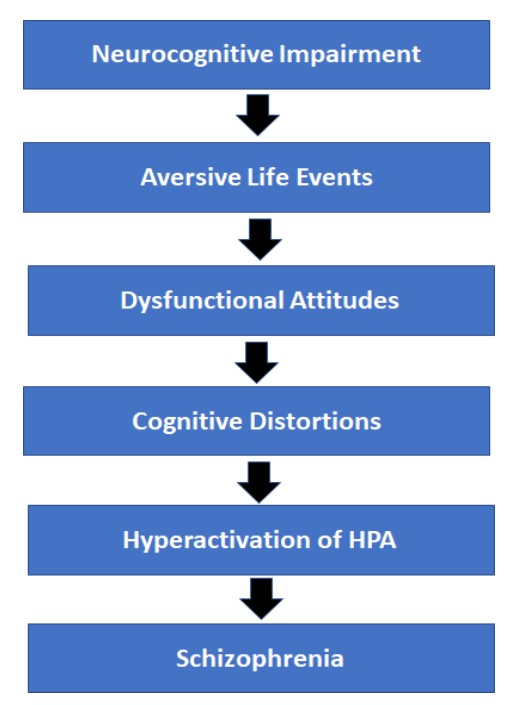
** 12.4.2.1. Cognitive. **The cognitive model utilizes some of the aspects of the diathesis-stress model in that it proposes that premorbid neurocognitive impairment places individuals at risk for aversive work/academic/interpersonal experiences. These experiences, in turn, lead to dysfunctional beliefs and cognitive appraisals, ultimately leading to maladaptive behaviors such as delusions/hallucinations (Beck & Rector, 2005). Beck proposed the following diathesis-stress model for how schizophrenia develops (Fee Figure 12.1).
12.4.2.1 认知。认知模型借鉴了倾向-压力模型的一些方面,即它提出,患病前神经认知障碍使个体面临负面工作/学术/人际交往经历的风险。这些经历反过来导致功能失调的信念和认知评估,最终导致不适应的行为,如妄想/幻觉(Beck & Rector,2005)。Beck 提出了以下倾向-压力模型来解释精神分裂症的发展(费图 12.1)。
Figure 12.1. Diathesis-Stress Model of the Development of Schizophrenia
图 12.1. 精神分裂症发展中的易感性-应激模型
Adapted from Beck & Rector, 2005, pg. 580
改编自 Beck & Rector,2005,第 580 页
Based on this theory, an underlying neurocognitive impairment (as discussed above) makes an individual more vulnerable to experience aversive life events such as homelessness, conflict within the family, etc. Individuals with schizophrenia are more likely to evaluate these aversive life events with a dysfunctional attitude and maladaptive cognitive distortions. The combination of the aversive events and negative interpretations produces a stress response in the individual, thus igniting hyperactivation of the HPA axis. According to Beck and Rector (2005), it is the culmination of these events leads to the development of schizophrenia.
基于这一理论,潜在的神经认知障碍(如上所述)使个体更容易经历如无家可归、家庭冲突等厌恶的生活事件。精神分裂症患者更有可能用功能失调的态度和认知扭曲来评估这些厌恶的生活事件。厌恶事件和负面解释的结合会在个体中产生压力反应,从而引发 HPA 轴的过度激活。根据 Beck 和 Rector(2005)的研究,这些事件的累积导致精神分裂症的发展。
12.4.3. Sociocultural 12.4.3. 社会文化
** 12.4.3.1. Expressed emotion. **Research regarding supportive family environments suggests that families high in expressed emotion, meaning families that have high hostile, critical, or overinvolved family members, are predictors of relapse (Bebbington & Kuipers, 2011). In fact, individuals who return post-hospitalization to families with high criticism and emotional involvement are twice as likely to relapse compared to those who return to families with low expressed emotion (Corcoran et al., 2003). Several meta-analyses have concluded that family atmosphere is causally related to relapse in patients with schizophrenia, and that these outcomes can be improved when the family environment is improved (Bebbington & Kuipers, 2011). Therefore, one major treatment goal in families of patients with schizophrenia is to reduce expressed emotion within family interactions.
12.4.3.1. 表达情感。关于支持性家庭环境的调查研究表明,表达情感高的家庭,即有高敌意、批评或过度参与的家庭成员的家庭,是复发的预测因素(Bebbington & Kuipers,2011)。事实上,那些从医院出院后回到高批评和情感投入的家庭的人,复发的可能性是那些回到表达情感低的家庭的人的两倍(Corcoran 等,2003)。几项荟萃分析得出结论,家庭氛围与精神分裂症患者的复发有因果关系,并且当家庭环境得到改善时,这些结果可以得到改善(Bebbington & Kuipers,2011)。因此,精神分裂症患者家庭的主要治疗目标之一是减少家庭互动中的表达情感。
** 12.4.3.2. Family dysfunction. **Even for families with low levels of expressed emotion, there is often an increase in family stress due to the secondary effects of schizophrenia. Having a family member with schizophrenia increases the likelihood of a disruptive family environment due to managing the patient’s symptoms and ensuring their safety while they are home (Friedrich et al., 2015). Because of the severity of symptoms, families with a loved one diagnosed with schizophrenia often report more conflict in the home as well as more difficulty communicating with one another (Kurtz, 2015).
12.4.3.2. 家庭功能障碍。即使对于表达情感水平较低的家庭,由于精神分裂症的次生效应,家庭压力也常常增加。拥有精神分裂症家庭成员会增加破坏性家庭环境的风险,因为需要管理患者的症状并确保他们在家时的安全(Friedrich 等,2015)。由于症状的严重性,被诊断为精神分裂症的家庭成员的家庭往往报告更多的家庭冲突以及更多的沟通困难(Kurtz,2015)。
Key Takeaways 关键要点
You should have learned the following in this section:
您应该在本节中学到了以下内容:
- Biological causes of schizophrenia spectrum and other psychotic disorders include genetics, several brain structures, and the HPA axis.
生物学上导致精神分裂症谱系及其他精神病的因素包括遗传、多个脑结构和 HPA 轴。 - Psychological causes of schizophrenia spectrum disorders include the diathesis-stress model.
精神分裂症谱系障碍的心理原因包括易感-应激模型。 - Sociocultural causes of schizophrenia spectrum disorders include families high in expressed emotion and family dysfunction.
社会文化因素导致的精神分裂症谱系障碍包括表达情感强烈和家族功能障碍的家庭。
Section 12.4 Review Questions
第 12.4 节 复习题
- What evidence is there to support a biological model with respect to explaining the development and maintenance of the schizophrenia spectrum and other psychotic disorders?
有什么证据支持用生物学模型来解释精神分裂症谱系和其他精神病的发病和发展? - Discuss the stress-vulnerability model with respect to schizophrenia spectrum and other psychotic disorders.
讨论精神分裂症谱系及其他精神病的压力-易损性模型。 - How does the sociocultural model explain the maintenance (and relapse) of schizophrenia related symptoms?
社会文化模型如何解释精神分裂症相关症状的维持(以及复发)?
12.5. Treatment 12.5. 治疗
Section Learning Objectives 章节学习目标
- Describe psychopharmacological treatment options for schizophrenia spectrum and other psychotic disorders.
描述精神分裂症谱系及其他精神病的心理药理学治疗方案。 - Describe psychological treatment options for schizophrenia spectrum and other psychotic disorders.
描述精神分裂症谱系及其他精神病的心理治疗方法。 - Describe family interventions for schizophrenia spectrum and other psychotic disorders.
描述精神分裂症谱系及其他精神病的家庭干预措施。
While a combination of psychopharmacological, psychological, and family interventions is the most effective treatment in managing schizophrenia symptoms, rarely do these treatments restore a patient to premorbid levels of functioning (Kurtz, 2015; Penn et al., 2004). Although more recent advancements in treatment for schizophrenia appear promising, the disease itself is still viewed as one that requires lifelong treatment and care.
尽管心理药理学、心理和家庭干预相结合是管理精神分裂症症状最有效的治疗方法,但这些治疗很少能恢复患者到患病前的功能水平(Kurtz,2015;Penn 等,2004)。尽管近年来对精神分裂症的治疗取得了更多进展,但这种疾病本身仍被视为需要终身治疗和护理的疾病。
12.5.1. Psychopharmacological12.5.1. 精神药理学
Among the first antipsychotic medications used for the treatment of schizophrenia was Thorazine. Developed as a derivative of antihistamines, Thorazine was the first line of treatment that produced a calming effect on even the most severely agitated patients and allowed for the organization of thoughts. Despite their effectiveness in managing psychotic symptoms, *conventional *antipsychotics (such as Thorazine and Chlorpromazine) also produced significant side effects similar to that of neurological disorders. Therefore, psychotic symptoms were replaced with muscle tremors, involuntary movements, and muscle rigidity. Additionally, these conventional antipsychotics also produced **tardive dyskinesia **in patients, which included involuntary movements isolated to the tongue, mouth, and face (Tenback et al., 2006). While only 10% of patients reported the development of tardive dyskinesia, this percentage increased the longer patients were on the medication, as well as the higher the dose (Achalia, Chaturvedi, Desai, Rao, & Prakash, 2014). In efforts to avoid these symptoms, clinicians have been cognizant of not exceeding the clinically effective dose of conventional antipsychotic medications. If the management of psychotic symptoms cannot be resolved at this level, alternative medications are often added to produce a synergistic effect (Roh et al., 2014).
在治疗精神分裂症的第一批抗精神病药物中,Thorazine 是其中之一。作为抗组胺药物的衍生物,Thorazine 是第一种对即使是最严重激动的患者也能产生镇静作用的疗法,并有助于组织思维。尽管它们在管理精神病症状方面有效,但传统抗精神病药(如 Thorazine 和 Chlorpromazine)也产生了类似于神经系统疾病的显著副作用。因此,精神病症状被肌肉震颤、不自主运动和肌肉僵硬所取代。此外,这些传统抗精神病药还在患者中产生了迟发性运动障碍,包括仅限于舌头、口腔和面部的不自主运动(Tenback 等,2006 年)。尽管只有 10%的患者报告了迟发性运动障碍的发展,但随着患者用药时间的延长以及剂量的增加,这一比例也随之上升(Achalia,Chaturvedi,Desai,Rao 和 Prakash,2014 年)。 为避免这些症状,临床医生已经意识到不要超过常规抗精神病药物的疗效剂量。如果在这个水平上无法解决精神症状的管理,通常会添加其他药物以产生协同作用(Roh 等,2014)。
Due to the harsh side effects of conventional antipsychotic drugs, newer, arguably more effective *second-generation *or *atypical *antipsychotic drugs have been developed. The atypical antipsychotic drugs appear to act on both dopamine and serotonin receptors, as opposed to only dopamine receptors in the conventional antipsychotics. Because of this, common medications such as clozapine (Clozaril), risperidone (Risperdal), and aripiprazole (Abilify), appear to be more effective in managing both positive and negative symptoms. While there continues to be a risk of developing side effects such as tardive dyskinesia, recent studies suggest it is much lower than that of the conventional antipsychotics (Leucht, Heres, Kissling, & Davis, 2011). Thus, due to their effectiveness and minimal side effects, atypical antipsychotic medications are typically the first line of treatment for schizophrenia (Barnes & Marder, 2011).
由于传统抗精神病药物的严重副作用,已经开发出更有效的新一代或非典型抗精神病药物。非典型抗精神病药物似乎作用于多巴胺和血清素受体,而传统抗精神病药物仅作用于多巴胺受体。因此,如氯氮平(Clozaril)、利培酮(Risperdal)和阿立哌唑(Abilify)等常见药物在管理阳性症状和阴性症状方面似乎更为有效。尽管仍有发生副作用的风险,如迟发性运动障碍,但近期研究表明,其风险远低于传统抗精神病药物(Leucht, Heres, Kissling, & Davis, 2011)。因此,由于它们的疗效和副作用最小,非典型抗精神病药物通常是治疗精神分裂症的首选治疗方法(Barnes & Marder, 2011)。
It should be noted that because of the harsh side effects of antipsychotic medications in general, many individuals, nearly one half to three-quarters of patients, discontinue the use of antipsychotic drugs (Leucht, Heres, Kissling, & Davis, 2011). Because of this, it is also important to incorporate psychological interventions along with psychopharmacological treatment to both address medication adherence, as well as provide additional support for symptom management.
应注意的是,由于抗精神病药物普遍存在严重的副作用,许多个体,近一半到四分之三的患者,会停止使用抗精神病药物(Leucht,Heres,Kissling,& Davis,2011)。因此,在心理药物治疗的同时,结合心理干预措施,也是非常重要的,以解决药物依从性问题,并为症状管理提供额外的支持。
12.5.2. Psychological Interventions12.5.2. 心理干预
** 12.5.2.1.** **Cognitive Behavioral Therapy (CBT). **As discussed in previous chapters, the goal of treatment is to identify the negative biases and attributions that influence an individual’s interpretations of events and the subsequent consequences of these thoughts and behaviors. For schizophrenia, CBT focuses on the maladaptive emotional and behavioral responses to psychotic experiences, which is directly related to distress and disability. Therefore, the goal of CBT is not on symptom reduction, but rather to improve the interpretations and understandings of these symptoms (and experiences) which will reduce associated distress (Kurtz, 2015). Common features of CBT for schizophrenia patients include psychoeducation about their disease and the course of their symptoms (i.e., ways to identify coming and going of delusions/hallucinations), challenging and replacing the negative thoughts/behaviors associated with their delusions/hallucinations to more positive thoughts/behaviors, and finally, learning positive coping strategies to deal with their unpleasant symptoms (Veiga-Martinez, Perez-Alvarez, & Garcia-Montes, 2008).
12.5.2.1. 认知行为疗法(CBT)。如前几章所述,治疗的目标是识别影响个体对事件解释及其后续思维和行为后果的负面偏见和归因。对于精神分裂症,CBT 侧重于对精神病体验的适应不良情绪和行为反应,这与痛苦和残疾直接相关。因此,CBT 的目标不是症状减轻,而是改善对这些症状(和体验)的解释和理解,这将减少相关的痛苦(Kurtz,2015)。精神分裂症患者 CBT 的常见特征包括关于其疾病和症状进程的心理教育(即识别妄想的到来和消失的方法),挑战和替换与他们的妄想/幻觉相关的负面思维/行为,以更积极的思维/行为,最后,学习积极的应对策略来处理他们不愉快的症状(Veiga-Martinez,Perez-Alvarez,& Garcia-Montes,2008)。
Findings from studies exploring CBT as a supportive treatment have been promising. One study conducted by Aaron Beck (the founder of CBT) and colleagues (Grant, Huh, Perivoliotis, Stolar, & Beck, 2011) found that recovery-oriented CBT produced a marked improvement in overall functioning as well as symptom reduction in patients diagnosed with schizophrenia. This study suggests that by focusing on targeted goals such as independent living, securing employment, and improving social relationships, patients were able to slowly move closer to these targeted goals. By also including a variety of CBT strategies such as role-playing, scheduling community outings, and addressing negative cognitions, individuals were also able to address cognitive and social skill deficits.
研究探索认知行为治疗(CBT)作为辅助治疗的方法发现前景良好。一项由 Aaron Beck(CBT 的创始人)及其同事(Grant、Huh、Perivoliotis、Stolar 和 Beck,2011 年)进行的研究发现,以康复为导向的 CBT 在患者整体功能改善以及症状减轻方面产生了显著效果。这项研究表明,通过关注目标如独立生活、确保就业和改善社交关系,患者能够逐渐接近这些目标。通过包括角色扮演、安排社区活动以及解决负面认知等多样化的 CBT 策略,个人也能够解决认知和社会技能缺陷。
12.5.3. Family Interventions12.5.3. 家庭干预
The diathesis-stress model of schizophrenia has primarily influenced family interventions. As previously discussed, the emergence of the disorder and exacerbation of symptoms is likely related to environmental stressors and psychological factors. While the degree in which environmental stress stimulates an exacerbation of symptoms varies among individuals, there is significant evidence to conclude that stress *does *impact illness presentation (Haddock & Spaulding, 2011). Therefore, the overall goal of family interventions is to reduce the stress on the individual that is likely to elicit the onset of symptoms.
精神分裂症的易感性-应激模型主要影响了家庭干预。如前所述,该病的出现和症状的加剧可能与环境应激源和心理因素有关。虽然环境应激刺激症状加剧的程度在个体之间有所不同,但有许多证据表明,应激确实会影响疾病的表现(Haddock & Spaulding,2011)。因此,家庭干预的总体目标是减少可能导致症状发作的个体压力。
Unlike many other psychological interventions, there is not a specific outline for family-based interventions related to schizophrenia. However, the majority of programs include the following components: psychoeducation, problem-solving skills, and cognitive-behavioral therapy.
与其他许多心理干预不同,针对精神分裂症的家庭干预没有特定的框架。然而,大多数项目包括以下组成部分:心理教育、问题解决技能和认知行为疗法。
Psychoeducation is important for both the patient and family members as it is reported that more than half of those recovering from a psychotic episode reside with their family (Haddock & Spaulding, 2011). Therefore, educating families on the course of the illness, as well as ways to recognize onset of psychotic symptoms, is important to ensure optimal recovery.
心理教育对病人和家庭成员都很重要,因为据报道,超过一半从精神错乱期恢复过来的人与家人同住(Haddock & Spaulding,2011)。因此,教育家人了解疾病进程以及识别精神症状发作的方法,对于确保最佳恢复至关重要。
Problem-solving is a crucial component in the family intervention model. Seeing as family conflict can increase stress within the home, which in return can lead to worsening of psychotic symptoms, family members benefit from learning effective methods of problem-solving to address family conflicts. Additionally, teaching positive coping strategies for dealing with the symptoms of mental illness and its direct effect on the family environment may also alleviate some friction within the home
问题解决是家庭干预模型的关键组成部分。鉴于家庭冲突可能会增加家庭内的压力,从而可能导致精神症状恶化,家庭成员从学习有效的解决问题的方法中受益,以解决家庭冲突。此外,教授应对精神疾病症状及其对家庭环境直接影响的积极应对策略,也可能缓解家庭内的某些摩擦。
The third component, CBT, is similar to that described above. The goal of family-based CBT is to reduce negativity among family member interactions, as well as help family members adjust to living with someone with psychotic symptoms. These three components within the family intervention program have been shown to reduce re-hospitalization rates, as well as slow the worsening of schizophrenia-related symptoms (Pitschel-Walz, Leucht, Baumi, Kissling, & Engel, 2001).
第三部分,认知行为治疗(CBT),与上述描述类似。家庭式 CBT 的目标是减少家庭成员之间的消极情绪,同时帮助家庭成员适应与患有精神症状的人共同生活。家庭干预计划中的这三个组成部分已被证明可以降低再住院率,以及减缓精神分裂症相关症状的恶化(Pitschel-Walz,Leucht,Baumi,Kissling,& Engel,2001)。
** 12.5.3.1.** **Social skills training. **Given the poor interpersonal functioning among individuals with schizophrenia, social skills training is another type of treatment commonly suggested to improve psychosocial functioning. Research has indicated that poor interpersonal skills not only predate the onset of the disorder but also remain significant even with the management of symptoms via antipsychotic medications. Impaired ability to interact with individuals in a social, occupational, or recreational setting is related to poorer psychological adjustment (Bellack, Morrison, Wixted, & Mueser, 1990). This can lead to greater isolation and reduced social support among individuals with schizophrenia. As previously discussed, social support has been identified as a protective factor of symptom exacerbation, as it buffers psychosocial stressors that are often responsible for the exacerbation of symptoms. Learning how to interact with others appropriately (e.g., establish eye contact, engage in reciprocal conversations, etc.) through role-play in a group therapy setting is one effective way to teach positive social skills.
12.5.3.1. 社交技能训练。鉴于精神分裂症患者之间的人际功能较差,社交技能训练是另一种常建议的治疗方法,以提高心理社会功能。研究表明,不良的人际交往能力不仅早于疾病的发作,即使在通过抗精神病药物治疗症状管理的情况下,仍然具有重要意义。在与社交、职业或娱乐环境中的个体互动方面受损的能力与较差的心理调整相关(Bellack, Morrison, Wixted, & Mueser,1990)。这可能导致精神分裂症患者更加孤立,社会支持减少。如前所述,社会支持已被确定为症状加重的保护因素,因为它可以缓冲通常导致症状加重的心理社会压力。通过在团体治疗环境中进行角色扮演,学习如何与他人适当互动(例如,建立眼神交流,参与相互对话等)是教授积极社交技能的一种有效方法。
** 12.5.3.2.** **Inpatient Hospitalizations. **More commonly viewed as community-based treatments, inpatient hospitalization programs are essential in stabilizing patients in psychotic episodes. Generally speaking, patients will be treated on an outpatient basis; however, there are times when their symptoms exceed the needs of an outpatient service. *Short-term *hospitalizations are used to modify antipsychotic medications and implement additional psychological treatments so that a patient can safely return to their home. These hospitalizations generally last for a few weeks as opposed to a long-term treatment option that would last months or years (Craig & Power, 2010).
12.5.3.2. 住院治疗。住院治疗通常被视为基于社区的疗法,对于稳定精神病患者至关重要。一般来说,患者将在门诊接受治疗;然而,有时他们的症状超出了门诊服务的需求。短期住院治疗用于调整抗精神病药物并实施额外的心理治疗,以便患者能够安全地返回家中。这些住院治疗通常持续几周,而不是长期治疗选择,后者可能持续数月或数年(Craig & Power,2010)。
In addition to short-term hospitalizations, there are also *partial *hospitalizations where an individual enrolls in a full-day program but returns home for the evening. These programs provide individuals with intensive therapy, organized activities, and group therapy programs that enhance social skills training. Research supports the use of partial hospitalizations as individuals enrolled in these programs tend to do better than those who enter outpatient care (Bales et al., 2014).
除了短期住院外,还有部分住院,即个人参加全天课程但晚上回家。这些项目为个人提供密集治疗、组织活动以及增强社交技能训练的小组治疗计划。研究表明,部分住院的使用是合理的,因为这些项目中的个人往往比那些进入门诊护理的人表现更好(Bales 等,2014)。
Key Takeaways 关键要点
You should have learned the following in this section:
您应该在本节中学到了以下内容:
- Psychopharmacological treatment options for schizophrenia spectrum disorders include antipsychotic drugs such as Thorazine, Chlorpromazine, Clozaril, Risperdal, and Abilify.
精神分裂症谱系障碍的心理药物治疗方案包括抗精神病药物,如 Thorazine、Chlorpromazine、Clozaril、Risperdal 和 Abilify。 - Psychological treatment options for schizophrenia spectrum disorders include CBT, the goal of which is to improve the interpretations and understandings of symptoms (and experiences) which will reduce associated distress.
精神分裂症谱系障碍的心理治疗方法包括认知行为疗法(CBT),其目标是改善对症状(及经历)的解释和理解,从而减轻相关痛苦。 - Family interventions for schizophrenia spectrum disorders include psychoeducation, problem-solving skills, cognitive-behavioral therapy (CBT), social skills training, and inpatient/partial hospitalizations.
家庭干预针对精神分裂症谱系障碍包括心理教育、问题解决技巧、认知行为疗法(CBT)、社交技能训练以及住院/部分住院治疗。
Section 12.5 Review Questions
第 12.5 节 复习题
- Define tardive dyskinesia. 定义迟发性运动障碍。
- What pharmacological interventions have been effective in managing schizophrenia related disorder symptoms?
哪些药物治疗对管理精神分裂症相关症状有效? - What is the main goal of family interventions? How is this achieved?
家庭干预的主要目标是什么?这是如何实现的?
Module Recap 模块总结
In our first module of Part V – Block 4, we discussed the schizophrenia spectrum and other psychotic disorders to include schizophrenia, schizophreniform disorder, schizoaffective disorder, and delusional disorder. We started by describing their common features, such as delusions, hallucinations, disorganized thinking, disorganized/abnormal motor behavior, and negative symptoms. This led to a discussion of the epidemiology, comorbidity, etiology, and treatment options for the disorders.
在我们的第五部分第一模块——第 4 块中,我们讨论了精神分裂症谱系和其他精神分裂症,包括精神分裂症、精神分裂症样障碍、分裂情感性障碍和妄想性障碍。我们首先描述了它们的共同特征,如妄想、幻觉、思维紊乱、紊乱/异常的运动行为和阴性症状。这导致了对这些疾病的流行病学、共病、病因和治疗选择的讨论。
3rd edition 第 3 版