Module 02 · Neurasthenia神经衰弱
‘Americanitis’: The Disease of Living Too Fast“美国病”:快节奏生活的疾病
How a 19th-century nervous condition shaped the way modern Americans think about health and happiness
19 世纪的一种神经系统疾病如何塑造了现代美国人看待健康和幸福的方式
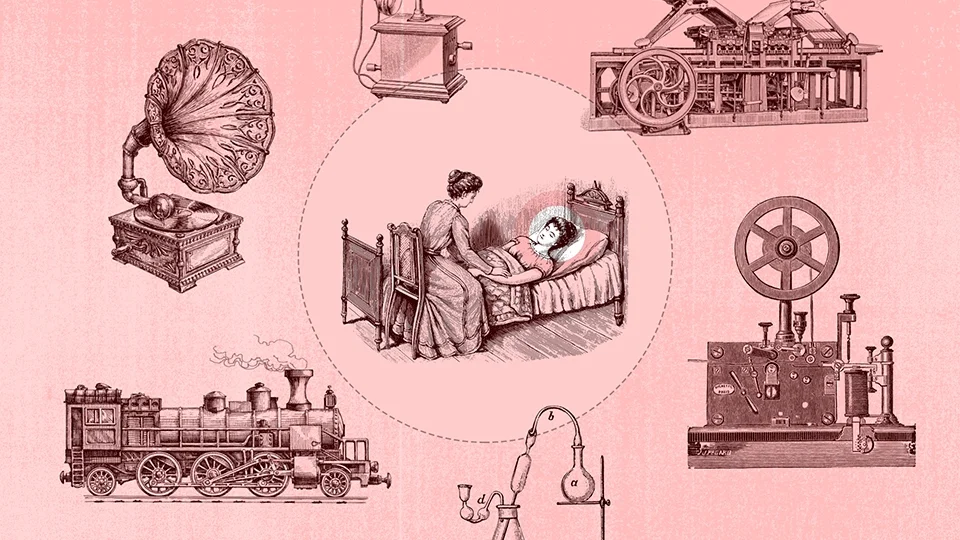
AVA Bitter / Hein Nouwens / ledokol.ua / Morphart Creation / Shutterstock / Kara Gordon / The Atlantic
AVA 苦味 / 海因·纽文斯 / ledokol.ua / Morphart 创作 / Shutterstock / 卡拉·戈登 / 大西洋
March 11, 2016 2016 年 3 月 11 日
In the decades after the Civil War, a lot of things were changing in the (re-)United States. The late 19th century and early 20th saw a huge increase in the country’s population (nearly 200 percent between 1860 and 1910) mostly due to immigration, and that population was becoming ever more urban as people moved to cities to seek their fortunes—including women, more of whom were getting college educations and jobs outside the home. Cars and planes were introduced to the public; telephones and telegraphs proliferated. Modern society was full of new wonders—or, seen differently, new things to be anxious about.
内战后的几十年里,美国(重新)统一后发生了许多变化。19 世纪末和 20 世纪初,该国人口急剧增长(1860 年至 1910 年间几乎增长了 200%),这主要归因于移民,而且随着人们涌入城市寻求财富——包括越来越多的女性,她们中的许多人正在接受大学教育并在家庭以外找到工作。汽车和飞机被引入公众视野;电话和电报迅速普及。现代社会充满了新的奇迹——或者,换个角度看,充满了令人担忧的新事物。
In his 1871 book Wear and Tear, or Hints for the Overworked, the physician S. Weir Mitchell fretted: “Have we lived too fast?”
在他的 1871 年著作《磨损与损耗,或对过度劳累者的建议》中,医生 S. Weir Mitchell 焦虑地问道:“我们是否生活得太快了?”
As you may have guessed from the book’s title, he answered that with a capital-Y Yes. He glorified earlier settlers who “lived sturdily by their own hands,” and who didn’t have “the thousand intricate problems … which perplex those who struggle to-day in our teeming city hives.”
如您从书名中猜到的,他回答道,这是一个大写的“是”。他赞扬了早期的定居者,他们“靠自己的双手坚韧地生活”,并且没有“那些使今天在我们拥挤的城市蜂巢中挣扎的人感到困惑的千头万绪的问题……”。
A prominent medical theory at the time was that the human body was like an electrical machine, powered by energy distributed through the nervous system. An unfortunate byproduct of the teeming cities and their attendant problems was that people spent too much of this “nervous energy” and when it was depleted, they got sick with a condition called neurasthenia. Both Mitchell and George Beard, a neurologist who coined the term in 1869, saw the disease as a direct consequence of modern life.
当时一个突出的医学理论是,人体就像一台电气机器,由通过神经系统分布的能量供电。繁华城市及其附带问题的一个不幸副作用是,人们消耗了过多的这种“神经能量”,当它耗尽时,他们会患上一种被称为神经衰弱症的疾病。米切尔和乔治·比尔德,这位在 1869 年创造了这个术语的神经学家,都将这种疾病视为现代生活的直接后果。
The nature of this sickness was vague and all-encompassing. In his book Neurasthenic Nation, David Schuster, an associate professor of history at Indiana University-Purdue University Fort Wayne, outlines some of the possible symptoms of neurasthenia: headaches, muscle pain, weight loss, irritability, anxiety, impotence, depression, “a lack of ambition,” and both insomnia and lethargy. It was a bit of a grab bag of a diagnosis, a catch-all for nearly any kind of discomfort or unhappiness.
这种疾病的性质模糊而全面。在《神经衰弱国家》一书中,印第安纳大学-普渡大学福坦瓦内的历史学副教授大卫·舒斯特概述了一些神经衰弱的可能症状:头痛、肌肉疼痛、体重减轻、易怒、焦虑、阳痿、抑郁、“缺乏抱负”,以及失眠和嗜睡。这是一种有点杂乱无章的诊断,几乎可以涵盖任何不适或不快乐。
This vagueness meant that the diagnosis was likely given to people suffering from a variety of mental and physical illnesses, as well as some people with no clinical conditions by modern standards, who were just dissatisfied or full of ennui. “It was really largely a quality-of-life issue,” Schuster says. “If you were feeling good and healthy, you were not neurasthenic, but if for some reason you were feeling run down, then you were neurasthenic.”
这种模糊性意味着诊断可能被给予患有各种精神和身体疾病的人,以及一些按照现代标准没有临床条件的人,他们只是不满意或充满厌倦。 “这实际上主要是生活质量问题,”舒斯特说。“如果你感觉良好且健康,你就不是神经衰弱,但如果你因为某种原因感到疲惫不堪,那么你就是神经衰弱。”
Neurasthenia then, took these age-old problems of happiness and comfort and medicalized them. Though older conditions like melancholia similarly treated happiness as a health issue, neurasthenia did it at the same time that modern medicine was emerging, giving it more scientific weight. Plus, Schuster writes, “neurasthenia commanded an intuitive legitimacy because it incorporated the anxieties that arose from [modern] changes into the way people thought of their health.”
神经衰弱当时,将这些古老的快乐和舒适问题医学化。尽管像忧郁症这样的老问题也将快乐视为健康问题,但神经衰弱是在现代医学兴起的同时进行的,给它赋予了更多的科学权重。此外,舒斯特写道:“神经衰弱因其将[现代]变化引起的焦虑纳入人们对健康的看法而具有直观的合法性。”
And it could only have happened in America. The condition had “a certain American flavor,” Schuster writes, so much so that the early psychologist William James (a neurasthenic himself) called it “Americanitis.” (The suffix “-itis” in medical parlance connotes inflammation; the inflamed things here, I suppose, were people’s relationships to society.)
并且这只能发生在美国。舒斯特写道,这种状况有一种“特有的美国风味”,以至于早期的心理学家威廉·詹姆斯(他自己也是神经衰弱患者)称之为“美国病”。(在医学术语中,“-itis”后缀表示炎症;我想这里的炎症是指人们对社会的关系的炎症。)
“Remember pursuit of happiness?” Schuster asks. “When Americans are not happy, we try to blame it on something.”
“还记得追求幸福吗?”舒斯特问道。“当美国人感到不幸福时,我们试图把它归咎于某件事。”
In this case, the accepted reason for Americans’ suffering was just how awesome they were. This widespread depletion of nervous energy was thought to be a side effect of progress: The U.S. had evolved beyond the rest of the world, and the demands on its citizens just proved to be too much sometimes.
在这种情况下,美国人痛苦被接受的理由只是他们有多么出色。这种普遍的神经能量耗竭被认为是一种进步的副作用:美国已经超越了世界上的其他国家,对公民的要求有时确实太过分了。
“Their intellectual superiority could be both a strength and a weakness,” says Anne Stiles, an associate professor of English at Saint Louis University. “Such a complex system was prone to breakdowns.”
他们的智力优势可能既是优点也是缺点,”圣路易斯大学英语系副教授安妮·斯蒂尔斯说。“这样一个复杂的系统容易崩溃。”
Neurasthenia, in other words, was a disease of culture as much as of the mind and body. Beard thought that people in earlier societies could not have been neurasthenic because they weren’t exposed to the modern things that depleted nervous energy, particularly “steam power, the periodical press, the telegraph, the sciences, and the mental activity of women.” Beard didn’t think they were bad; they just used up people’s time and energy and didn’t give them room to relax.
神经衰弱,换句话说,是一种文化和身心疾病。比尔德认为,在早期社会中的人不可能患有神经衰弱,因为他们没有接触到消耗神经能量的现代事物,尤其是“蒸汽动力、期刊、电报、科学以及女性的精神活动。”比尔德并不认为这些事物是坏的;它们只是消耗了人们的时间和精力,没有给他们放松的空间。
But in the land of the Protestant work ethic, relaxing’s for chumps, anyway. “Neurasthenia did not simply denote the presence of sickness,” Schuster writes, “Beard argued it indicated the presence of an active mind, a competitive character, a lover of liberty—in short, the quintessential American.” Many characters in fiction of the day were neurasthenic, and portrayed positively.
但在新教工作伦理的土地上,放松对笨蛋来说也行。“神经衰弱并不仅仅表示疾病的存在,”舒斯特写道,“比尔德认为它表示存在一个活跃的头脑,一个竞争的性格,一个热爱自由的人——简而言之,典型的美国人。”当时许多小说人物都是神经衰弱,并且被正面描绘。
This attitude made the diagnosis desirable and some patients sought it out. Because American medicine was still trying to establish itself as a respected profession, doctors were motivated to give the patients what they wanted. Medicine manufacturers also did a booming business selling bottled treatments of dubious composition directly to patients through newspapers and other periodicals, giving people the opportunity to self-diagnose—and, in the process, to assign themselves a label that said more about them than just their health. Tom Lutz, the author of American Nervousness: 1903*, *and a professor of creative writing at the University of California, Riverside, writes that people sometimes used “claims to sickness as claims to privilege.”
这种态度使得诊断变得令人向往,一些患者甚至主动寻求。由于美国医学仍在努力确立其作为受人尊敬的职业,医生们有动力满足患者的需求。制药商也通过报纸和其他期刊直接向患者销售成分可疑的瓶装治疗,给人们自我诊断的机会——在这个过程中,为自己贴上标签,这些标签所表达的内容比他们的健康状况更多。汤姆·卢茨(Tom Lutz),《1903 年美国神经质》的作者,同时也是加州大学河滨分校的创意写作教授,写道,人们有时会将“患病声明”视为“特权声明”。
And this was an illness of the privileged—the white, Protestant, Northern privileged, mostly. Mental activity was thought to use more energy than physical activity, a belief that allowed Beard to offer racist explanations for why blacks and Native Americans didn’t get neurasthenia—because they didn’t overuse their minds, he thought, or didn’t have the mental capacities to overuse in the first place. Catholics just did whatever the church told them, in Beard’s view, so that relieved some of their mental burden, and the South wasn’t as modernized as the North.
这曾是特权阶层的疾病——主要是白人、新教徒、北方的特权阶层。人们认为精神活动比体力活动消耗更多能量,这种信念使得比尔德能够提供种族主义解释,为什么黑人和印第安人不会患神经衰弱——他认为,因为他们没有过度使用他们的头脑,或者一开始就没有过度使用的心理能力。在比尔德看来,天主教徒只是做教会告诉他们的事情,因此减轻了一些他们的心理负担,而南方没有北方那样现代化。
It was thought that “if you were lower class, and you weren't educated and you weren’t Anglo Saxon, you wouldn’t get neurasthenic because you just didn't have what it took to be damaged by modernity,” Lutz says.
人们认为,“如果你是下层阶级,你没有受过教育,你不是盎格鲁-撒克逊人,你就不会得神经衰弱,因为你根本不具备被现代性伤害的条件,”卢茨说。
In reality, members of the upper and middle classes were the ones who could afford to see a neurologist and get the diagnosis in the first place. They could afford tonics from advertisements, and afford the expensive, time-consuming treatments. But even within this more well-off population, there was a sharp divide between how the disease was conceptualized and treated for men and for women.
实际上,上层和中产阶级的人才是能够负担得起去看神经科医生并首先得到诊断的人。他们可以负担得起从广告中看到的补药,以及昂贵的、耗时的治疗。但即使在更富裕的人群中,对于男女对待疾病的概念和治疗方式也存在明显的差异。
The underlying notion of neurasthenia—that nervous energy gets depleted because people’s bodies weren’t built for modern life—provided an easy way to reinforce traditional gender roles. When men spent too much time indoors, when they couldn’t keep up with the pace of their work, or had money problems, they were susceptible to neurasthenia. Women were susceptible when they were too socially active, or spent too much time outside the home.
神经衰弱的根本观念——因为人们的身体不是为现代生活而建造的,所以神经能量会耗尽——提供了一种强化传统性别角色的简单方法。当男性花费太多时间在室内,当他们无法跟上工作节奏,或者有金钱问题时,他们容易患上神经衰弱。女性在过于活跃于社交活动或在家外花费太多时间时容易受到影响。
For men, the frontier held the cure. Doctors would often send male neurasthenics westward to ride horses, rope cattle, do pushups, and slap each others’ butts until the sheer manliness of it all restored their nervous energy. None other than the 26th president of the United States, Teddy Roosevelt, received such a “West cure” for his neurasthenia. Before his cure, when he was a New York state legislator, Roosevelt had a reputation as a dandy, and people called him names like “Young Squirt” and “Punkin-Lily,” Lutz writes. Some called him an American Oscar Wilde. His neurasthenia was seen as an “effeminizing sickness” that the West cure got rid of, making him buff and tough enough to be elected president. Such were the times.
对于男性来说,边疆是治愈之地。医生们经常将男性神经衰弱患者送往西部骑马、套牛、做俯卧撑,互相拍打屁股,直到这种纯粹的男子气概恢复他们的神经能量。美国第 26 任总统西奥多·罗斯福也不例外,他因神经衰弱接受了这种“西部疗法”。卢茨写道,在治愈之前,当他还是纽约州立法议员时,罗斯福以花花公子著称,人们称他为“小喷壶”和“南瓜百合”,有些人甚至称他为“美国的奥斯卡·王尔德”。他的神经衰弱被认为是一种“女性化疾病”,而西部疗法则治愈了这种疾病,使他变得健壮而坚韧,足以当选总统。这就是那个时代的样子。
For women, the go-to was Mitchell’s “rest cure” which consisted of being confined to bed for four to six weeks, with every aspect of their lives controlled by physicians for that period. (Some men did the rest cure as well, just fewer.) They were spoon fed milk and soup, and not even allowed to read or move themselves—massages kept their muscles from atrophying. This treatment was made famous in Charlotte Perkins Gilman’s story “The Yellow Wallpaper,” in which a woman confined to an “atrocious nursery” slowly loses her mind. The story was inspired by Gilman’s own experience with the rest cure.
对于女性来说,首选的治疗方法是米切尔提出的“休息疗法”,这包括在床上躺四到六周,在此期间她们生活的方方面面都由医生控制。(一些男性也进行了休息疗法,但人数较少。)她们被喂食牛奶和汤,甚至不允许自己阅读或移动——按摩防止她们的肌肉萎缩。这种治疗方法在夏洛特·帕金斯·吉尔曼的故事《黄壁纸》中闻名,故事中一位被关在“可怕的育儿室”里的女性逐渐失去了理智。这个故事灵感来源于吉尔曼自己对休息疗法的亲身经历。
There were also some women, Gilman included, who used neurasthenia to challenge the status quo, rather than enforce it. They argued that traditional gender roles were causing women’s neurasthenia, and that housework was wasting their nervous energy. If they were allowed to do more useful work,they said, they’d be reinvesting and replenishing their energies, much as men were thought to do out in the wilderness.
也有一些女性,包括吉尔曼,她们利用神经衰弱来挑战现状,而不是维护它。她们认为传统性别角色导致了女性的神经衰弱,家务劳动浪费了她们的精神能量。如果允许她们做更多有益的工作,她们说,她们会重新投资和补充自己的能量,就像人们认为男人在野外做的那样。
Given the flexibility of neurasthenia, it makes sense that it could be used to argue two opposing points. The disease was both deeply cultural and deeply personal, and so provided a metaphorical framework for people to discuss how culture affected their lives and their health. “The appeal of neurasthenia as a disease was in part the way in which it allowed patients to reexplain the world to themselves,” Lutz writes.
鉴于神经衰弱的灵活性,用它来论证两个对立的观点是有道理的。这种疾病既深刻地体现了文化,又深刻地体现了个人,因此为人们提供了一个隐喻性的框架,让他们讨论文化如何影响他们的生活和健康。“神经衰弱作为一种疾病的吸引力部分在于它允许患者重新解释世界给自己,”Lutz 写道。
And neurasthenia, in turn, did a lot to reorder the world. The national parks were pretty much created to give neurasthenics places to retreat into nature and heal. Recess time was established in schools because of the fear that sitting in a classroom all day was bad for children’s nervous systems. Christian Science as a religion grew up alongside neurasthenia, and its “think yourself well” doctrine, dubious as it was, did provide relief for some people suffering from the condition. The growing popularity of activities like bike-riding, traveling for vacations, and sports leagues was buoyed by the fact that these things were thought to help stave off neurasthenia.
神经衰弱反过来在很大程度上重新安排了世界。国家公园的建立主要是为了给神经衰弱者提供退入自然和疗愈的地方。学校设立课间休息是因为担心整天坐在教室里对儿童神经系统有害。基督教科学作为一种宗教与神经衰弱一同成长,其“自我思考健康”的教义,尽管可疑,但确实为一些患有这种疾病的人提供了缓解。骑自行车、度假旅行和体育联赛等活动的日益流行得益于这些活动被认为有助于预防神经衰弱。
Neurasthenia shaped so many things, but its true legacy is in how people talk about health and happiness and lifestyles. The more I’ve learned about neurasthenia, the more I’ve felt like I can hear its echoes in all the self-help books that promise to tell you how to be happy, in the Westernized yoga classes offering inner peace, in everyone fretting over whether the Internet is alienating or if babies should look at screens or if Americans are working too much and burning out. People haven’t stopped worrying about what the trappings of modern life are doing to us.
神经衰弱塑造了许多事物,但其真正的遗产在于人们谈论健康、幸福和生活方式的方式。我对神经衰弱了解得越多,就越觉得我能在所有承诺告诉你如何快乐的自我帮助书中听到它的回声,在提供内心平静的西式瑜伽课程中,在每个人担心互联网是否使人疏远,婴儿是否应该看屏幕,或者美国人是否工作过度而疲惫不堪的时候。人们并没有停止担心现代生活的装饰对我们做了什么。
“How can Americans stay healthy while struggling with the demands of modern life?” This is the central question of Schuster’s book, and though he’s asking it about neurasthenia in the late 1800s, he could just as easily be asking it about stress today. (What is stress, anyway? Like, what is it? I went to the doctor recently with an ear problem and they told me it was probably stress. It was not illuminating.) Both neurasthenia and stress are vague concepts that make for easy scapegoats *because *they are so flexible. Both are grounded in reality but invoked in ways that exceed what is truly known about them.
美国人如何在应对现代生活的压力中保持健康?这是舒斯特书中探讨的核心问题,尽管他是在 19 世纪末关于神经衰弱时提出这个问题,但他同样可以用来询问今天的压力问题。(压力究竟是什么?比如,它是什么?我最近因为耳朵问题去看医生,他们告诉我可能是压力引起的。这并没有什么启发。)神经衰弱和压力都是模糊的概念,因为它们非常灵活,容易成为替罪羊。两者都基于现实,但被引用的方式超出了我们对它们的真正了解。
“These are real things and metaphorical things,” Lutz says.
“这些都是真实的事物和比喻事物,”卢茨说。
When health is tied to happiness, it takes on an almost spiritual, moral quality: This is the way you *should *live, to be happy. And you should value happiness, not only for its own sake, but because it is equivalent to healthiness. Mitchell, for one, characterized his writings about neurasthenia as “lay sermons.”
当健康与幸福相连时,它几乎具有一种精神上的、道德上的品质:这就是你应该的生活方式,为了快乐。你应该珍视快乐,不仅因为它本身的价值,还因为它等同于健康。例如,米切尔将他对神经衰弱的著作描述为“世俗布道”。
Health has long been tied to morality, from Christians who thought illness was a punishment for sin, to “debates about whether the use of drugs or alcoholism are moral failings or medical failings,” Lutz says. “We still confuse these things as a culture.” And for advice on how to live right, you can turn to any number of scientific experts with tips for how to relax, be more mindful, or be kinder.
健康长期以来与道德紧密相连,从认为疾病是罪恶惩罚的基督徒,到“关于使用药物或酗酒是否是道德败坏或医疗失败的争论”,Lutz 说。“我们仍然将这些事情混淆为一种文化。”至于如何正确生活的建议,你可以求助于众多科学专家,他们有放松、更加关注或更加仁慈的建议。
As for neurasthenia itself, it declined as a diagnosis in the 1920s. The nervous-energy theory never really panned out, and the rise of psychology meant medicine began to consider mind and body separately for a while. Truth in advertising laws meant companies couldn’t just bottle whatever and market it as a neurasthenia cure anymore. Neurasthenia is still included in the World Health Organization’s International Classification of Diseases and is still sometimes diagnosed in Japan and China, but in America, American-itis is now a relic.
至于神经衰弱本身,它在 20 世纪 20 年代作为一种诊断被淘汰。神经能量理论从未真正得到证实,心理学的兴起意味着医学开始暂时将身心分开考虑。广告真实性法律意味着公司不能再随便瓶装什么并作为神经衰弱的治疗方法进行市场推广。神经衰弱仍然被纳入世界卫生组织《国际疾病分类》,在日本和中国有时仍被诊断,但在美国,美国病现在已成为遗迹。
“We’ve basically divided neurasthenia up into a lot of different diagnoses—anxiety disorders, depression, OCD, eating disorders, or even something like chronic fatigue syndrome,” Stiles says. “Because the diagnosis is so broad, you can really see it in numerous aspects of American life now. What’s different is we seem to have made the diagnoses more specialized.”
我们基本上将神经衰弱划分为许多不同的诊断——焦虑障碍、抑郁症、强迫症、饮食障碍,甚至是像慢性疲劳综合症这样的东西。”斯蒂尔斯说。“因为诊断范围很广,你现在几乎可以在美国生活的各个方面看到它。不同的是,我们似乎使诊断变得更加专业化。”
Regardless, the idea of happiness as a predictor of health persists today—and is, as the case of neurasthenia shows, deeply entangled with cultural norms and developments. Technology can give happiness and comfort in some ways, and take it away in others. With wonders come anxieties. Have we lived too fast? No matter when the question is asked, the answer always seems to be yes.
无论如何,幸福作为健康预测因素的观点至今仍存在——正如神经衰弱案例所示,它与文化规范和发展紧密相连。技术在某些方面可以带来幸福和舒适,在另一些方面则可能夺走它们。奇迹带来焦虑。我们是否生活得太快了?无论何时提出这个问题,答案似乎总是肯定的。
Related Video 相关视频
Since 2006, Ryan Carson, the CEO of Treehouse, has maintained a four-day workweek for his employees.
自 2006 年以来,Treehouse 公司首席执行官 Ryan Carson 一直为其员工实行每周四天工作制。