Module 02 · Foundations心理学基础
Conditioning and Learning条件作用与学习
Basic principles of learning are always operating and always influencing human behavior. This module discusses the two most fundamental forms of learning -- classical (Pavlovian) and instrumental (operant) conditioning. Through them, we respectively learn to associate 1) stimuli in the environment, or 2) our own behaviors, with significant events, such as rewards and punishments. The two types of learning have been intensively studied because they have powerful effects on behavior, and because they provide methods that allow scientists to analyze learning processes rigorously. This module describes some of the most important things you need to know about classical and instrumental conditioning, and it illustrates some of the many ways they help us understand normal and disordered behavior in humans. The module concludes by introducing the concept of observational learning, which is a form of learning that is largely distinct from classical and operant conditioning.
学习的基本原则始终在起作用,始终影响着人类的行为。本模块讨论了两种最基本的学习形式--经典条件反射和工具性条件反射。通过它们,我们分别学会了将 1)环境中的刺激或 2)我们自己的行为与重要事件(如奖励和惩罚)相关联起来。这两种学习类型由于对行为产生强大影响并为科学家提供了分析学习过程的方法而被广泛研究。本模块描述了关于经典和工具性条件反射的一些重要知识,并且通过一些实例说明了它们在理解人类正常和异常行为方面的许多帮助。本模块最后介绍了观察性学习的概念,这是一种与经典和工具性条件反射大不相同的学习形式。
- Associative learning 关联学习
- Classical conditioning 经典条件反射
- Instrumental learning 工具性学习
- Learning theory 学习理论
- Operant conditioning 操作性条件化
- Pavlovian learning 巴甫洛夫学习
Learning Objectives 学习目标
- Distinguish between classical (Pavlovian) conditioning and instrumental (operant) conditioning.
区分古典(巴甫洛夫)条件作用和工具(操作性)条件作用。 - Understand some important facts about each that tell us how they work.
了解一些重要信息,告诉我们它们是如何起作用的。 - Understand how they work separately and together to influence human behavior in the world outside the laboratory.
理解它们如何分别和共同影响实验室之外的世界中的人类行为。 - Students will be able to list the four aspects of observational learning according to Social Learning Theory.
学生将能够根据社会学习理论列出观察学习的四个方面。
Two Types of Conditioning 两种类别的条件反射
Although Ivan Pavlov won a Nobel Prize for studying digestion, he is much more famous for something else: working with a dog, a bell, and a bowl of saliva. Many people are familiar with the classic study of “Pavlov’s dog,” but rarely do they understand the significance of its discovery. In fact, Pavlov’s work helps explain why some people get anxious just looking at a crowded bus, why the sound of a morning alarm is so hated, and even why we swear off certain foods we’ve only tried once. Classical (or Pavlovian) conditioning is one of the fundamental ways we learn about the world around us. But it is far more than just a theory of learning; it is also arguably a theory of identity. For, once you understand classical conditioning, you’ll recognize that your favorite music, clothes, even political candidate, might all be a result of the same process that makes a dog drool at the sound of bell.
尽管伊万·巴甫洛夫因研究消化而获得了诺贝尔奖,但他更为人所熟知的是因为另一件事情:与一只狗、一只铃和一碗唾液合作。很多人熟悉对“巴甫洛夫的狗”的经典研究,但很少有人理解其发现的重要性。事实上,巴甫洛夫的工作有助于解释为什么有些人只是看到拥挤的公交车就会感到焦虑,为什么早晨闹钟的声音那么令人讨厌,甚至解释了为什么我们会对只尝了一次的某些食物产生厌恶感。经典(或巴甫洛夫式)条件反射是我们学习周围世界的基本方式之一。但它远不仅仅是一种学习理论;它还可以说是一种身份理论。因为,一旦你理解了经典条件反射,你会意识到你最喜欢的音乐、服装,甚至政治候选人,都可能是同样的使狗一听到铃声就流口水的过程的结果。

The Pavlov in All of Us: Does your dog learn to beg for food because you reinforce her by feeding her from the table? [Image: David Mease, https://goo.gl/R9cQV7, CC BY-NC 2.0, https://goo.gl/FIlc2e[]](https://goo.gl/FIlc2e%5D)
我们每个人都是巴甫洛夫:你的狗是不是学会乞讨食物,因为你喂她吃餐桌上的食物?[图片:David Mease,https://goo.gl/R9cQV7,CC BY-NC 2.0,https://goo.gl/FIlc2e]
Around the turn of the 20th century, scientists who were interested in understanding the behavior of animals and humans began to appreciate the importance of two very basic forms of learning. One, which was first studied by the Russian physiologist Ivan Pavlov, is known as classical, or Pavlovian conditioning. In his famous experiment, Pavlov rang a bell and then gave a dog some food. After repeating this pairing multiple times, the dog eventually treated the bell as a signal for food, and began salivating in anticipation of the treat. This kind of result has been reproduced in the lab using a wide range of signals (e.g., tones, light, tastes, settings) paired with many different events besides food (e.g., drugs, shocks, illness; see below).
在 20 世纪之交,对动物和人类行为有兴趣的科学家开始认识到两种非常基本的学习形式的重要性。其中之一是由俄罗斯生理学家伊万·巴甫洛夫首次研究的,被称为经典或巴甫洛夫式条件作用。在他的著名实验中,巴甫洛夫用铃声并给狗一些食物。经过多次重复这个配对,狗最终把铃声当作食物的信号,并开始产生唾液以期待食物的到来。这种结果已经在实验室中使用广泛的信号(如声音、光、味道、环境等)与食物以外的不同事件(如药物、电击、疾病)进行配对而得到重现(见下文)。
We now believe that this same learning process is engaged, for example, when humans associate a drug they’ve taken with the environment in which they’ve taken it; when they associate a stimulus (e.g., a symbol for vacation, like a big beach towel) with an emotional event (like a burst of happiness); and when they associate the flavor of a food with getting food poisoning. Although classical conditioning may seem “old” or “too simple” a theory, it is still widely studied today for at least two reasons: First, it is a straightforward test of associative learning that can be used to study other, more complex behaviors. Second, because classical conditioning is always occurring in our lives, its effects on behavior have important implications for understanding normal and disordered behavior in humans.
现在我们相信,当人类把他们用药的环境与药物联系起来时,就会触发同样的学习过程;当他们把一个刺激(例如,象征度假的符号,比如一条大海滩毛巾)与一种情绪事件(如愉悦的爆发)联系起来时;当他们把一种食物的味道与食物中毒联系起来时。尽管经典条件反射可能看起来“老旧”或“过于简单”,但它今天仍然被广泛研究,至少有两个原因:首先,它是一种用于研究其他更复杂行为的简单的联想学习测试。其次,由于经典条件反射在我们的生活中始终存在,它对行为的影响对于理解人类的正常和异常行为具有重要意义。
In a general way, classical conditioning occurs whenever neutral stimuli are associated with psychologically significant events. With food poisoning, for example, although having fish for dinner may not normally be something to be concerned about (i.e., a “neutral stimuli”), if it causes you to get sick, you will now likely associate that neutral stimuli (the fish) with the psychologically significant event of getting sick. These paired events are often described using terms that can be applied to any situation.
一般来说,当中性刺激与心理上重要的事件相关联时,就会发生经典条件反射。以食物中毒为例,尽管晚餐吃鱼通常不会引起担忧(即“中性刺激”),但如果引起你生病,你现在很可能将这个中性刺激(鱼)与心理上重要的生病事件相关联。这些成对的事件通常用能适用于任何情况的术语来描述。
The dog food in Pavlov’s experiment is called the unconditioned stimulus (US) because it elicits an unconditioned response (UR). That is, without any kind of “training” or “teaching,” the stimulus produces a natural or instinctual reaction. In Pavlov’s case, the food (US) automatically makes the dog drool (UR). Other examples of unconditioned stimuli include loud noises (US) that startle us (UR), or a hot shower (US) that produces pleasure (UR).
在巴甫洛夫的实验中,狗粮被称为无条件刺激(US),因为它引起了一种无条件反应(UR)。也就是说,没有任何形式的“训练”或“教学”,刺激就能产生自然或本能的反应。在巴甫洛夫的实验中,食物(US)会自动使狗流口水(UR)。其他无条件刺激的例子包括大声的噪音(US)会使我们吃惊(UR),或者热水淋浴(US)会带来快乐(UR)。
On the other hand, a conditioned stimulus produces a conditioned response. A conditioned stimulus (CS) is a signal that has no importance to the organism until it is paired with something that does have importance. For example, in Pavlov’s experiment, the bell is the conditioned stimulus. Before the dog has learned to associate the bell (CS) with the presence of food (US), hearing the bell means nothing to the dog. However, after multiple pairings of the bell with the presentation of food, the dog starts to drool at the sound of the bell. This drooling in response to the bell is the conditioned response (CR). Although it can be confusing, the conditioned response is almost always the same as the unconditioned response. However, it is called the conditioned response because it is conditional on (or, depends on) being paired with the conditioned stimulus (e.g., the bell). To help make this clearer, consider becoming really hungry when you see the logo for a fast food restaurant. There’s a good chance you’ll start salivating. Although it is the actual eating of the food (US) that normally produces the salivation (UR), simply seeing the restaurant’s logo (CS) can trigger the same reaction (CR).
另一方面,一个条件刺激产生一个条件反应。一个条件刺激(CS)是一个信号,在它与某些重要的东西配对之前对有机体没有重要性。例如,在巴甫洛夫的实验中,铃声是条件刺激。在狗学会将铃声(CS)与食物(US)的存在联系起来之前,听到铃声对狗来说毫无意义。然而,在铃声多次与食物呈现配对之后,狗开始听到铃声而流口水。这种对铃声的流口水是条件反应(CR)。虽然可能会让人困惑,但条件反应几乎总是与无条件反应相同。然而,它被称为条件反应,因为它受条件刺激(例如铃声)的影响。为了更清楚地说明这一点,考虑当你看到快餐店的标志时变得非常饥饿。你很有可能开始流口水。 虽然通常是实际食用食物(US)会引起流口水(无条件反射),但仅仅看到餐厅的标志(有条件刺激)同样能触发相同的反应(有条件反射)。
Another example you are probably very familiar with involves your alarm clock. If you’re like most people, waking up early usually makes you unhappy. In this case, waking up early (US) produces a natural sensation of grumpiness (UR). Rather than waking up early on your own, though, you likely have an alarm clock that plays a tone to wake you. Before setting your alarm to that particular tone, let’s imagine you had neutral feelings about it (i.e., the tone had no prior meaning for you). However, now that you use it to wake up every morning, you psychologically “pair” that tone (CS) with your feelings of grumpiness in the morning (UR). After enough pairings, this tone (CS) will automatically produce your natural response of grumpiness (CR). Thus, this linkage between the unconditioned stimulus (US; waking up early) and the conditioned stimulus (CS; the tone) is so strong that the unconditioned response (UR; being grumpy) will become a conditioned response (CR; e.g., hearing the tone at any point in the day—whether waking up or walking down the street—will make you grumpy). Modern studies of classical conditioning use a very wide range of CSs and USs and measure a wide range of conditioned responses.
另一个例子,你可能非常熟悉,涉及到你的闹钟。如果你和大多数人一样,早起通常会让你不开心。在这种情况下,早起(US)会产生一种自然的烦躁感(UR)。不过,你可能有一个闹钟,会播放一个声音来叫醒你。在设置闹钟为那个特定的声音之前,让我们想象一下,你对它没有任何感觉(即,这个声音对你来说没有任何意义)。然而,现在你每天早上都用它来叫醒自己,你在早上的烦躁感(UR)与这个声音(CS)在心理上“配对”了。经过足够多的配对,这个声音(CS)会自动产生你自然的烦躁反应(CR)。因此,无条件刺激(US;早起)和条件刺激(CS;声音)之间的这种联系是如此强大,以至于无条件反应(UR;不开心)将变成一种条件反应(CR;例如,在一天的任何时间听到这个声音,无论是在醒来还是在街上行走,都会让你不开心)。 现代对经典条件反射的研究使用非常广泛的条件刺激和非条件刺激,并测量了广泛的条件反应。
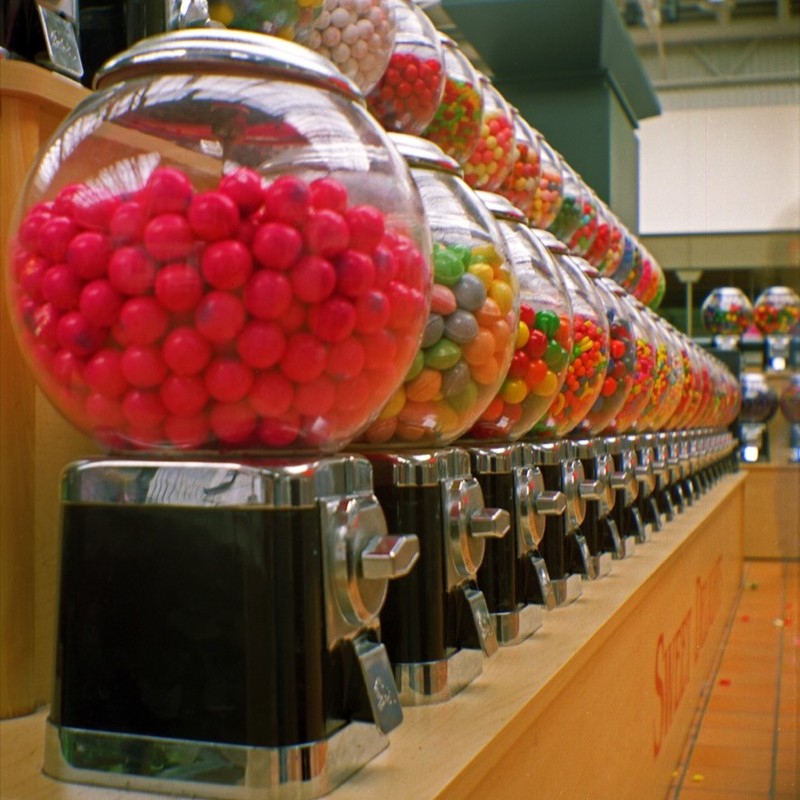
Receiving a reward can condition you toward certain behaviors. For example, when you were a child, your mother may have offered you this deal: "Don't make a fuss when we're in the supermarket and you'll get a treat on the way out." [Image: Oliver Hammond, https://goo.gl/xFKiZL, CC BY-NC-SA 2.0, https://goo.gl/Toc0ZF[]](https://goo.gl/Toc0ZF%5D)
接受奖励可以使您养成某些行为习惯。例如,当您还是个孩子时,您的母亲可能给您提出了这样的交易:“在超市里的时候不要闹,到出门的时候就能得到一份好吃的。”[图片:Oliver Hammond,https://goo.gl/xFKiZL,CC BY-NC-SA 2.0,https://goo.gl/Toc0ZF]
Although classical conditioning is a powerful explanation for how we learn many different things, there is a second form of conditioning that also helps explain how we learn. First studied by Edward Thorndike, and later extended by B. F. Skinner, this second type of conditioning is known as instrumental or operant conditioning. Operant conditioning occurs when a behavior (as opposed to a stimulus) is associated with the occurrence of a significant event. In the best-known example, a rat in a laboratory learns to press a lever in a cage (called a “Skinner box”) to receive food. Because the rat has no “natural” association between pressing a lever and getting food, the rat has to learn this connection. At first, the rat may simply explore its cage, climbing on top of things, burrowing under things, in search of food. Eventually while poking around its cage, the rat accidentally presses the lever, and a food pellet drops in. This voluntary behavior is called an operant behavior, because it “operates” on the environment (i.e., it is an action that the animal itself makes).
尽管经典条件反射是解释我们如何学习很多不同事物的一个强有力的理论,但还有第二种形式的条件反射能解释我们的学习方式。这个第二种形式的条件反射是由爱德华·桑代克(Eward Thorndike)首次研究,后来由 B·F·斯金纳(B. F. Skinner)扩展的,被称为工具性或操作性条件反射。当一个行为(与刺激相对)与某个重要事件的发生关联在一起时,就发生了操作性条件反射。在最著名的例子中,一个实验室的老鼠学会按下笼子里的杠杆(称为“斯金纳盒子”)以获得食物。因为老鼠在按下杠杆和得到食物之间没有“自然”的联系,所以老鼠必须学会这种关联。起初,老鼠可能只是在笼子里探索,爬上物体,钻下物体,寻找食物。最终,当老鼠在笼子里四处探索时,它意外地按下了杠杆,食物颗粒掉了下来。这种自愿行为被称为操作性行为,因为它“对环境产生了作用”(即,它是动物自己采取的行动)。
Now, once the rat recognizes that it receives a piece of food every time it presses the lever, the behavior of lever-pressing becomes reinforced. That is, the food pellets serve as reinforcers because they strengthen the rat’s desire to engage with the environment in this particular manner. In a parallel example, imagine that you’re playing a street-racing video game. As you drive through one city course multiple times, you try a number of different streets to get to the finish line. On one of these trials, you discover a shortcut that dramatically improves your overall time. You have learned this new path through operant conditioning. That is, by engaging with your environment (operant responses), you performed a sequence of behaviors that that was positively reinforced (i.e., you found the shortest distance to the finish line). And now that you’ve learned how to drive this course, you will perform that same sequence of driving behaviors (just as the rat presses on the lever) to receive your reward of a faster finish.
现在,一旦老鼠意识到每次按下杠杆都会得到一块食物,按杠杆的行为就会得到加强。也就是说,食物颗粒充当了强化剂,因为它们增强了老鼠以这种特定方式与环境互动的欲望。在一个平行的例子中,想象一下你正在玩一款街头赛车游戏。当你多次驾驶穿越同一个城市赛道时,你会尝试多条不同的街道去到达终点线。在其中的一次尝试中,你发现了一个极大改善了你整体时间的捷径。你通过操作性条件反射学习了这条新路径。也就是说,通过与你的环境互动(操作性反应),你执行了一系列行为,这些行为得到了正向强化(即你找到了最短的终点距离)。现在,你已经学会了如何驾驶这个赛道,你将执行同样的驾驶行为序列(就像老鼠按压杠杆一样),以获得更快的终点奖励。
Operant conditioning research studies how the effects of a behavior influence the probability that it will occur again. For example, the effects of the rat’s lever-pressing behavior (i.e., receiving a food pellet) influences the probability that it will keep pressing the lever. For, according to Thorndike’s law of effect, when a behavior has a positive (satisfying) effect or consequence, it is likely to be repeated in the future. However, when a behavior has a negative (painful/annoying) consequence, it is less likely to be repeated in the future. Effects that increase behaviors are referred to as reinforcers, and effects that decrease them are referred to as punishers.
操作条件作用研究的目的是了解行为的效果如何影响该行为再次发生的概率。例如,老鼠按压杆的行为的效果(即获得食物颗粒)会影响它继续按压杆的概率。根据桑代克的功效定律,当一种行为具有积极(令人满意)的效果或结果时,将来该行为很可能会重复发生。然而,当一种行为具有负面(痛苦/烦恼)的结果时,将来该行为很可能不会重复发生。增加行为的效果被称为强化剂,而减少行为的效果被称为惩罚剂。
An everyday example that helps to illustrate operant conditioning is striving for a good grade in class—which could be considered a reward for students (i.e., it produces a positive emotional response). In order to get that reward (similar to the rat learning to press the lever), the student needs to modify his/her behavior. For example, the student may learn that speaking up in class gets him/her participation points (a reinforcer), so the student speaks up repeatedly. However, the student also learns that s/he shouldn’t speak up about just anything; talking about topics unrelated to school actually costs points. Therefore, through the student’s freely chosen behaviors, s/he learns which behaviors are reinforced and which are punished.
每天的例子可以帮助说明操作性条件反射,例如争取好成绩(可以被视为对学生来说是一种奖励,会产生积极的情绪反应)。为了获得这个奖励(类似于老鼠学会按压杆子),学生需要改变自己的行为。例如,学生可能会发现,在课堂上发言可以获得参与积分(一种强化因素),所以学生会一再发言。然而,学生也会明白自己不应该随便发言;谈论与学校无关的话题实际上会扣分。因此,通过学生自由选择的行为,他/她会学到哪些行为是被强化的,哪些是受到惩罚的。
An important distinction of operant conditioning is that it provides a method for studying how consequences influence “voluntary” behavior. The rat’s decision to press the lever is voluntary, in the sense that the rat is free to make and repeat that response whenever it wants. Classical conditioning, on the other hand, is just the opposite—depending instead on “involuntary” behavior (e.g., the dog doesn’t choose to drool; it just does). So, whereas the rat must actively participate and perform some kind of behavior to attain its reward, the dog in Pavlov’s experiment is a passive participant. One of the lessons of operant conditioning research, then, is that voluntary behavior is strongly influenced by its consequences.
经典条件反射与主动条件反射的一个重要区别在于,它提供了研究后果如何影响“自愿”行为的方法。老鼠按动杠杆的决定是自愿的,意味着老鼠可以自由地选择并重复这种反应。而经典条件反射则恰恰相反,它依赖于“无意识”的行为(例如,狗不会选择流口水,它只是自然而然地流口水)。因此,老鼠必须积极参与并执行某种行为以获得奖励,而巴甫洛夫的实验中的狗则是被动参与者。主动条件反射研究的一个教训是自愿行为很大程度上受其后果的影响。
[Image courtesy of Bernard W. Balleine]
[贝纳德·巴利恩的图片提供]
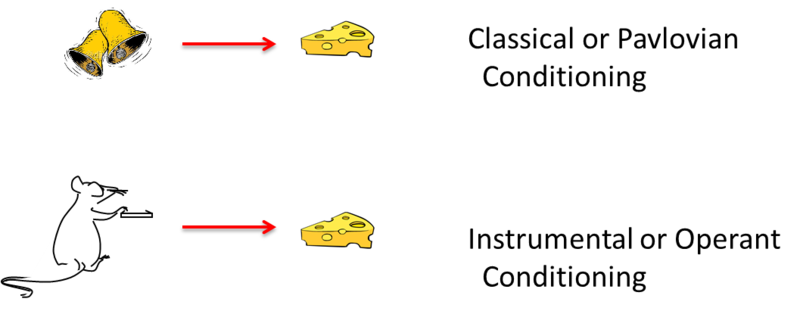
The illustration above summarizes the basic elements of classical and instrumental conditioning. The two types of learning differ in many ways. However, modern thinkers often emphasize the fact that they differ—as illustrated here—in *what *is learned. In classical conditioning, the animal behaves as if it has learned to associate a *stimulus *with a significant event. In operant conditioning, the animal behaves as if it has learned to associate a behavior with a significant event. Another difference is that the response in the classical situation (e.g., salivation) is *elicited *by a stimulus that comes before it, whereas the response in the operant case is not elicited by any particular stimulus. Instead, operant responses are said to be emitted. The word “emitted” further conveys the idea that operant behaviors are essentially voluntary in nature.
以上插图总结了经典条件反射和工具性条件反射的基本要素。这两种学习方式在很多方面存在差异。然而,现代思想家经常强调它们的差异,正如这里所示,差异体现在所学内容上。在经典条件反射中,动物的行为表现得好像它已经学会将刺激与重要事件相关联。在工具性条件反射中,动物的行为表现得好像它已经学会将行为与重要事件相关联。另一个区别在于,在经典条件反射中,响应(例如唾液分泌)是由先于它的刺激引发的,而在工具性条件反射中,响应并不是由特定的刺激引发的。相反,工具性反应被认为是有意发出的。词语“发出”进一步传达了工具性行为本质上是自愿的观念。
Understanding classical and operant conditioning provides psychologists with many tools for understanding learning and behavior in the world outside the lab. This is in part because the two types of learning occur continuously throughout our lives. It has been said that “much like the laws of gravity, the laws of learning are always in effect” (Spreat & Spreat, 1982).
了解经典和操作条件对心理学家在实验室外的学习和行为提供了许多工具。这部分是因为这两种学习类型在我们的生活中不断发生。有人曾说:“正如重力法则一样,学习法则始终有效”(Spreat&Spreat,1982 年)。
Useful Things to Know about Classical Conditioning 关于经典条件反射的有用知识
Classical Conditioning Has Many Effects on Behavior 经典条件反射对行为有许多效果
A classical CS (e.g., the bell) does not merely elicit a simple, unitary reflex. Pavlov emphasized salivation because that was the only response he measured. But his bell almost certainly elicited a whole system of responses that functioned to get the organism ready for the upcoming US (food) (see Timberlake, 2001). For example, in addition to salivation, CSs (such as the bell) that signal that food is near also elicit the secretion of gastric acid, pancreatic enzymes, and insulin (which gets blood glucose into cells). All of these responses prepare the body for digestion. Additionally, the CS elicits approach behavior and a state of excitement. And presenting a CS for food can also cause animals whose stomachs are full to eat more food if it is available. In fact, food CSs are so prevalent in modern society, humans are likewise inclined to eat or feel hungry in response to cues associated with food, such as the sound of a bag of potato chips opening, the sight of a well-known logo (e.g., Coca-Cola), or the feel of the couch in front of the television.
经典的 CS(例如钟声)并不仅仅引发简单的、单一的反射。巴甫洛夫之所以强调唾液分泌,是因为那是他所测量到的唯一反应。但他的钟声几乎肯定激发了一整套反应系统,这些反应系统的功能是让有机体为即将到来的食物做好准备(参见 Timberlake,2001)。例如,除唾液分泌外,还会引发胃酸、胰腺酶和胰岛素(将血糖引入细胞)的分泌。所有这些反应都为消化过程做好了准备。此外,CS 还会引发接近行为和兴奋状态。如果有食物可用,以食物为 CS 的动物即使胃已饱满,也会进食更多。事实上,在现代社会中,食物 CS 是如此普遍,人类也有类似的倾向,在接收到与食物相关的提示时产生进食或饥饿的感觉,比如听到一袋薯片袋子打开的声音,看到熟悉的商标(例如可口可乐)或感受到电视前沙发的触感。
Classical conditioning is also involved in other aspects of eating. Flavors associated with certain nutrients (such as sugar or fat) can become preferred without arousing any awareness of the pairing. For example, protein is a US that your body automatically craves more of once you start to consume it (UR): since proteins are highly concentrated in meat, the flavor of meat becomes a CS (or cue, that proteins are on the way), which perpetuates the cycle of craving for yet more meat (this automatic bodily reaction now a CR).
经典条件反射也参与了进食的其他方面。与特定营养素(如糖或脂肪)相关的味道可以在不引起任何配对意识的情况下变得更受偏爱。例如,一旦开始摄入蛋白质(UR),你的身体会自动渴望更多蛋白质:由于肉类中蛋白质含量较高,肉类的味道成为了一个提示(或暗示),表明蛋白质即将到来,从而加剧了对更多肉类的渴望的循环(这一自动的身体反应现在成为了一个条件反射)。
In a similar way, flavors associated with stomach pain or illness become avoided and disliked. For example, a person who gets sick after drinking too much tequila may acquire a profound dislike of the taste and odor of tequila—a phenomenon called taste aversion conditioning. The fact that flavors are often associated with so many consequences of eating is important for animals (including rats and humans) that are frequently exposed to new foods. And it is clinically relevant. For example, drugs used in chemotherapy often make cancer patients sick. As a consequence, patients often acquire aversions to foods eaten just before treatment, or even aversions to such things as the waiting room of the chemotherapy clinic itself (see Bernstein, 1991; Scalera & Bavieri, 2009).
以类似的方式,与胃痛或疾病有关的口味会变得避免和不受喜爱。例如,一个饮用过量龙舌兰后感到恶心的人可能会对龙舌兰的味道和气味产生深厌恶,这种现象被称为味觉避恶条件。口味往往与进食的许多后果相关,这对于经常接触新食物的动物(包括老鼠和人类)来说是很重要的。而且这在临床上也很相关。例如,化疗中使用的药物经常会使癌症患者感到恶心。因此,患者常常会对治疗前刚吃的食物产生厌恶,甚至对化疗诊所的候诊室本身产生厌恶(参见 Bernstein,1991; Scalera&Bavieri,2009)。
Classical conditioning occurs with a variety of significant events. If an experimenter sounds a tone just before applying a mild shock to a rat’s feet, the tone will elicit fear or anxiety after one or two pairings. Similar fear conditioning plays a role in creating many anxiety disorders in humans, such as phobias and panic disorders, where people associate cues (such as closed spaces, or a shopping mall) with panic or other emotional trauma (see Mineka & Zinbarg, 2006). Here, rather than a physical response (like drooling), the CS triggers an emotion.
经典条件作用发生于各种重要事件中。如果实验者在给老鼠的脚施加轻微的电击之前发出一个音调,那么这个音调在一两次配对后将引发恐惧或焦虑。类似的恐惧条件反射在人类中产生了许多焦虑症,比如恐惧症和恐慌症,人们将暗示物(比如封闭空间或购物中心)与恐慌或其他情绪创伤联系起来(见 Mineka&Zinbarg,2006 年)。在这里,与流口水等生理反应不同,条件刺激触发的是情绪。
Another interesting effect of classical conditioning can occur when we ingest drugs. That is, when a drug is taken, it can be associated with the cues that are present at the same time (e.g., rooms, odors, drug paraphernalia). In this regard, if someone associates a particular smell with the sensation induced by the drug, whenever that person smells the same odor afterward, it may cue responses (physical and/or emotional) related to taking the drug itself. But drug cues have an even more interesting property: They elicit responses that often “compensate” for the upcoming effect of the drug (see Siegel, 1989). For example, morphine itself suppresses pain; however, if someone is used to taking morphine, a cue that signals the “drug is coming soon” can actually make the person more sensitive to pain. Because the person knows a pain suppressant will soon be administered, the body becomes more sensitive, anticipating that “the drug will soon take care of it.” Remarkably, such conditioned compensatory responses in turn decrease the impact of the drug on the body—because the body has become more sensitive to pain.
经典条件反射的另一个有趣效应是在我们摄入药物时可能发生的。也就是说,当服用药物时,它可以与同时存在的线索(例如房间、气味、药物工具)相关联。在这方面,如果有人将某种气味与药物引起的感觉相关联,那么当该人事后闻到相同的气味时,它可能会引起与服用药物本身有关的反应(身体和/或情绪)。但药物线索具有更有趣的特性:它们常常引发“补偿”作用以对抗即将出现的药物效应(参见 Siegel,1989)。例如,吗啡本身具有镇痛作用;然而,如果有人习惯于服用吗啡,一个信号“药物即将出现”可以使这个人对疼痛更加敏感。因为人们知道很快就会给予镇痛药物,身体会变得更敏感,预计“药物很快就会照顾好它”。值得注意的是,这种有条件的补偿性反应反过来减弱了药物对身体的影响-因为身体对疼痛更加敏感。
This conditioned compensatory response has many implications. For instance, a drug user will be most “tolerant” to the drug in the presence of cues that have been associated with it (because such cues elicit compensatory responses). As a result, overdose is usually not due to an increase in dosage, but to taking the drug in a new place without the familiar cues—which would have otherwise allowed the user to tolerate the drug (see Siegel, Hinson, Krank, & McCully, 1982). Conditioned compensatory responses (which include heightened pain sensitivity and decreased body temperature, among others) might also cause discomfort, thus motivating the drug user to continue usage of the drug to reduce them. This is one of several ways classical conditioning might be a factor in drug addiction and dependence.
这种有条件的补偿反应有很多含义。例如,一个吸毒者在与其相关联的线索存在时对药物的“耐受性”最高(因为这些线索会引发补偿反应)。因此,药物过量通常不是由于剂量增加,而是由于在一个没有熟悉线索的新地方使用药物——否则用户将能够耐受药物(参见 Siegel,Hinson,Krank 和 McCully,1982 年)。有条件的补偿反应(包括疼痛敏感度增加和体温降低等)还可能引起不适,从而促使吸毒者继续使用药物来减轻这些不适。这是古典条件作用可能在药物成瘾和依赖中发挥作用的几种方式之一。
A final effect of classical cues is that they motivate ongoing operant behavior (see Balleine, 2005). For example, if a rat has learned via operant conditioning that pressing a lever will give it a drug, in the presence of cues that signal the “drug is coming soon” (like the sound of the lever squeaking), the rat will work harder to press the lever than if those cues weren’t present (i.e., there is no squeaking lever sound). Similarly, in the presence of food-associated cues (e.g., smells), a rat (or an overeater) will work harder for food. And finally, even in the presence of negative cues (like something that signals fear), a rat, a human, or any other organism will work harder to avoid those situations that might lead to trauma. Classical CSs thus have many effects that can contribute to significant behavioral phenomena.
古典提示的最终效果是激励持续的操作行为(参见 Balleine,2005)。例如,如果一只大鼠通过操作条件作用学习到按动杠杆会得到药物,在信号“药物即将到来”的提示(例如杠杆发出的声音)存在时,大鼠将比在没有这些提示的情况下更加努力地按动杠杆(即没有 squeaking lever sound)。同样,在食物相关的提示(例如气味)存在的情况下,大鼠(或者一个暴饮暴食者)将更加努力地为食物而工作。最后,即使在存在负面提示(例如一些表明恐惧的事物)的情况下,大鼠、人类或任何其他生物都会更加努力地避免可能导致创伤的情况。因此,古典条件刺激(CS)有许多效应,可以促成重要的行为现象。
[Image courtesy of Bernard W. Balleine]
[贝纳德·巴利恩的图片提供]
The Learning Process 学习过程
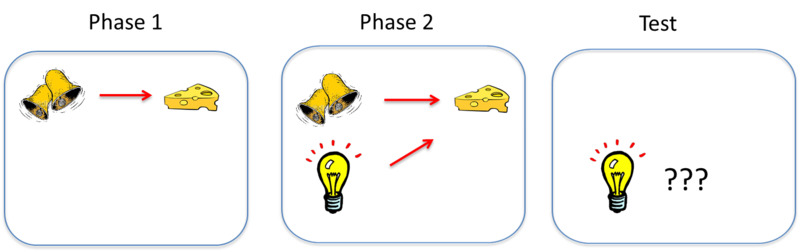
As mentioned earlier, classical conditioning provides a method for studying basic learning processes. Somewhat counterintuitively, though, studies show that pairing a CS and a US together is not sufficient for an association to be learned between them. Consider an effect called blocking (see Kamin, 1969). In this effect, an animal first learns to associate one CS—call it stimulus A—with a US. In the illustration above, the sound of a bell (stimulus A) is paired with the presentation of food. Once this association is learned, in a second phase, a second stimulus—stimulus B—is presented alongside stimulus A, such that the two stimuli are paired with the US together. In the illustration, a light is added and turned on at the same time the bell is rung. However, because the animal has already learned the association between stimulus A (the bell) and the food, the animal doesn’t learn an association between stimulus B (the light) and the food. That is, the conditioned response only occurs during the presentation of stimulus A, because the earlier conditioning of A “blocks” the conditioning of B when B is added to A. The reason? Stimulus A already predicts the US, so the US is not surprising when it occurs with Stimulus B.
正如前面提到的,经典条件反射提供了研究基本学习过程的方法。然而,一项研究表明,仅仅将条件刺激(CS)和无条件刺激(US)配对在一起并不足以使它们之间建立起关联。考虑到一种称为阻塞效应的现象(见 Kamin,1969 年),这个现象中,动物首先学会将一个条件刺激 A 与一个无条件刺激关联起来。在上面的示例中,一个铃的声音(刺激 A)与食物的呈现配对。一旦学会了这个关联,第二阶段,在刺激 A 的旁边同时呈现第二个刺激——刺激 B,以便这两个刺激与无条件刺激同时配对。在示例中,一盏灯被加入并在铃声响起的同时打开。然而,因为动物已经学会了刺激 A(铃声)与食物的关联,所以动物并不会学会刺激 B(灯光)与食物的关联。也就是说,条件反射只在刺激 A 呈现时发生,因为先前对 A 的条件反射“阻塞”了在 A 中加入 B 的条件反射。原因是什么呢? 刺激 A 已经预测到了 US,因此当刺激 B 和 US 同时发生时,并不令人惊讶。
Learning depends on such a surprise, or a discrepancy between what occurs on a conditioning trial and what is already predicted by cues that are present on the trial. To learn something through classical conditioning, there must first be some prediction error, or the chance that a conditioned stimulus won’t lead to the expected outcome. With the example of the bell and the light, because the bell always leads to the reward of food, there’s no “prediction error” that the addition of the light helps to correct. However, if the researcher suddenly requires that the bell and the light both occur in order to receive the food, the bell alone will produce a prediction error that the animal has to learn.
学习依赖于如此之大的惊喜,或者是在一次条件试验中发生的情况与试验中已经存在的线索所预测的情况之间的差异。要通过经典条件反射学习某样东西,首先必须存在一些预测错误,或者说有一定的机会,一个条件刺激不会导致预期的结果。以铃和灯为例,因为铃总是会导致获得食物的奖励,所以没有“预测错误”,灯的加入并不起到纠正作用。然而,如果研究人员突然要求铃和灯同时出现才能获得食物,仅有铃的情况就会产生一个预测错误,动物必须学会适应。
Blocking and other related effects indicate that the learning process tends to take in the most valid predictors of significant events and ignore the less useful ones. This is common in the real world. For example, imagine that your supermarket puts big star-shaped stickers on products that are on sale. Quickly, you learn that items with the big star-shaped stickers are cheaper. However, imagine you go into a similar supermarket that not only uses these stickers, but also uses bright orange price tags to denote a discount. Because of blocking (i.e., you already know that the star-shaped stickers indicate a discount), you don’t have to learn the color system, too. The star-shaped stickers tell you everything you need to know (i.e. there’s no prediction error for the discount), and thus the color system is irrelevant.
阻塞和其他相关影响表明学习过程倾向于接纳最有效的显著事件预测因素,而忽视较不实用的因素。这在现实世界中很常见。例如,想象一下,你的超市在促销产品上贴上了大星星形状的贴纸。很快,你就会知道带有大星星形状贴纸的物品更便宜。然而,假设你进了一家类似的超市,它不仅使用这些贴纸,还使用明亮的橙色价签来表示折扣。由于阻塞效应(即你已经知道星星形状贴纸表示折扣),你不需要学习颜色系统。星星形状贴纸告诉你一切你需要知道的(即折扣不会有预测错误),因此颜色系统是无关紧要的。
Classical conditioning is strongest if the CS and US are intense or salient. It is also best if the CS and US are relatively new and the organism hasn’t been frequently exposed to them before. And it is especially strong if the organism’s biology has prepared it to associate a particular CS and US. For example, rats and humans are naturally inclined to associate an illness with a flavor, rather than with a light or tone. Because foods are most commonly experienced by taste, if there is a particular food that makes us ill, associating the flavor (rather than the appearance—which may be similar to other foods) with the illness will more greatly ensure we avoid that food in the future, and thus avoid getting sick. This sorting tendency, which is set up by evolution, is called preparedness.
经典条件反射在条件刺激(CS)和无条件刺激(US)强烈或显著时最为强烈。如果 CS 和 US 相对较新,且生物之前没有经常接触它们,那么效果会更好。如果生物的生物学准备好了将特定的 CS 和 US 关联起来,那么效果尤为明显。例如,老鼠和人类天生倾向于将疾病与味道相关联,而不是与光线或音调相关联。由于食物通常通过味觉体验,如果有一种特定的食物让我们生病,将味道(而不是外观,可能与其他食物相似)与疾病关联起来,能更好地确保我们将来避免食用那种食物,从而避免生病。这种通过进化而建立起来的分类倾向被称为准备性。
There are many factors that affect the strength of classical conditioning, and these have been the subject of much research and theory (see Rescorla & Wagner, 1972; Pearce & Bouton, 2001). Behavioral neuroscientists have also used classical conditioning to investigate many of the basic brain processes that are involved in learning (see Fanselow & Poulos, 2005; Thompson & Steinmetz, 2009).
有很多因素会影响经典条件反射的强度,这些因素已经成为许多研究和理论的主题(参见 Rescorla&Wagner,1972 年; Pearce&Bouton,2001 年)。行为神经科学家还使用经典条件反射研究了参与学习的许多基本脑过程(参见 Fanselow&Poulos,2005 年; Thompson&Steinmetz,2009 年)。
Erasing Classical Learning 擦除经典学习
After conditioning, the response to the CS can be eliminated if the CS is presented repeatedly without the US. This effect is called extinction, and the response is said to become “extinguished.” For example, if Pavlov kept ringing the bell but never gave the dog any food afterward, eventually the dog’s CR (drooling) would no longer happen when it heard the CS (the bell), because the bell would no longer be a predictor of food. Extinction is important for many reasons. For one thing, it is the basis for many therapies that clinical psychologists use to eliminate maladaptive and unwanted behaviors. Take the example of a person who has a debilitating fear of spiders: one approach might include systematic exposure to spiders. Whereas, initially the person has a CR (e.g., extreme fear) every time s/he sees the CS (e.g., the spider), after repeatedly being shown pictures of spiders in neutral conditions, pretty soon the CS no longer predicts the CR (i.e., the person doesn’t have the fear reaction when seeing spiders, having learned that spiders no longer serve as a “cue” for that fear). Here, repeated exposure to spiders without an aversive consequence causes extinction.
在经过调节后,如果反复呈现条件刺激(CS)而没有无条件刺激(US),则可以消除对 CS 的反应。这种效应被称为消退,反应被称为“消失”。例如,如果巴甫洛夫一直敲铃,但之后从未给狗任何食物,最终当狗听到 CS(铃声)时,它的 CR(流口水)不再发生,因为铃声不再是食物的预测器。消退对于许多原因都很重要。首先,它是临床心理学家用来消除不适应和不希望的行为的许多治疗方法的基础。以一个人对蜘蛛有严重恐惧的情况为例:一种方法可能包括对蜘蛛进行系统暴露。最开始,每当他/她看到 CS(蜘蛛)时,该人可能有一个 CR(例如,极度恐惧),但在反复在中性条件下展示蜘蛛图片后,很快 CS 不再预测 CR(即在看到蜘蛛时,该人不会产生恐惧反应,从而学到蜘蛛不再作为恐惧的“暗示”)。在这里,反复面对没有刺激性后果的蜘蛛暴露引起了消退。
Psychologists must accept one important fact about extinction, however: it does not necessarily destroy the original learning (see Bouton, 2004). For example, imagine you strongly associate the smell of chalkboards with the agony of middle school detention. Now imagine that, after years of encountering chalkboards, the smell of them no longer recalls the agony of detention (an example of extinction). However, one day, after entering a new building for the first time, you suddenly catch a whiff of a chalkboard and WHAM!, the agony of detention returns. This is called spontaneous recovery: following a lapse in exposure to the CS after extinction has occurred, sometimes re-exposure to the CS (e.g., the smell of chalkboards) can evoke the CR again (e.g., the agony of detention).
心理学家必须接受有关消退的一个重要事实, 然而:它并不一定摧毁原始学习(参见 Bouton, 2004 年)。 例如, 想象一下,您强烈地将黑板的气味与中学停堂留课的痛苦联系在一起。 现在想象一下,经过多年与黑板的碰面,它们的气味再也不会让您回想起停堂留课的痛苦(这是消退的一个例子)。 然而,有一天,当您第一次进入一座新建筑时,突然闻到黑板的气味, 痛苦立刻回来了。 这就是所谓的自发恢复:在消退发生后暴露于刺激之前的时间间隔后,有时再次接触刺激(例如, 黑板的气味)可以再次引发相应反应(例如,停堂留课的痛苦)。
Another related phenomenon is the renewal effect: After extinction, if the CS is tested in a new context, such as a different room or location, the CR can also return. In the chalkboard example, the action of entering a new building—where you don’t expect to smell chalkboards—suddenly renews the sensations associated with detention. These effects have been interpreted to suggest that extinction inhibits rather than erases the learned behavior, and this inhibition is mainly expressed in the context in which it is learned (see “context” in the Key Vocabulary section below).
另一个相关的现象是更新效应:在消退后,如果在一个新的环境中测试条件刺激(如不同的房间或位置),条件反射也可能会恢复。在这个例子中,进入一个新建筑的动作——你不会期望闻到粉笔板的地方——突然恢复了与停堂留课相关的感觉。这些效应被解释为消退不是将学到的行为抹除,而是抑制,而这种抑制主要在其被学习的背景中表现出来(请参见下面“关键词汇”部分中的“背景”)。
This does not mean that extinction is a bad treatment for behavior disorders. Instead, clinicians can increase its effectiveness by using basic research on learning to help defeat these relapse effects (see Craske et al., 2008). For example, conducting extinction therapies in contexts where patients might be most vulnerable to relapsing (e.g., at work), might be a good strategy for enhancing the therapy’s success.
这并不意味着消退是一种不良的行为障碍治疗方法。相反,临床医生可以通过利用学习的基础研究帮助克服这些复发效应(参见 Craske 等人,2008 年),从而增加其有效性。例如,在患者可能最容易复发的情境(如工作场所)进行消退疗法可能是提高疗效的一个好策略。
Useful Things to Know about Instrumental Conditioning 工具性条件反射的有用知识
Most of the things that affect the strength of classical conditioning also affect the strength of instrumental learning—whereby we learn to associate our actions with their outcomes. As noted earlier, the “bigger” the reinforcer (or punisher), the stronger the learning. And, if an instrumental behavior is no longer reinforced, it will also be extinguished. Most of the rules of associative learning that apply to classical conditioning also apply to instrumental learning, but other facts about instrumental learning are also worth knowing.
大多数影响经典条件反射强度的因素也会影响工具性学习的强度——通过工具性学习我们学会将我们的行为与它们的结果联系起来。正如前面所提到的,“更大”的强化物(或惩罚物)会导致更强的学习效果。如果一个工具性行为不再得到强化,它也会被消退。适用于经典条件反射的大部分关联学习规则同样适用于工具性学习,但还有其他关于工具性学习值得知道的事实。
Instrumental Responses Come Under Stimulus Control 工具性反应受刺激控制
As you know, the classic operant response in the laboratory is lever-pressing in rats, reinforced by food. However, things can be arranged so that lever-pressing only produces pellets when a particular stimulus is present. For example, lever-pressing can be reinforced only when a light in the Skinner box is turned on; when the light is off, no food is released from lever-pressing. The rat soon learns to discriminate between the light-on and light-off conditions, and presses the lever only in the presence of the light (responses in light-off are extinguished). In everyday life, think about waiting in the turn lane at a traffic light. Although you know that green means go, only when you have the green arrow do you turn. In this regard, the operant behavior is now said to be under stimulus control. And, as is the case with the traffic light, in the real world, stimulus control is probably the rule.
如您所知,实验室中经典的操作性反应是老鼠按压杠杆,并通过食物进行强化。然而,可以安排这样一种情况,即只有在特定刺激存在时按压杠杆才会产生食物颗粒。例如,只有当 Skinner 盒子中的灯亮时,按压杠杆才会受到强化;当灯灭时,按压杠杆不会释放食物。老鼠很快学会区分亮灯和灭灯的情况,并只在有灯亮时按压杠杆(灭灯响应被熄灭)。在日常生活中,想象一下在交通信号灯的转弯车道等待。虽然您知道绿灯意味着行进,但只有在有绿色箭头时您才转弯。在这方面,现在说操作行为受到刺激控制。而且,在现实世界中,刺激控制可能是一种规律。
The stimulus controlling the operant response is called a discriminative stimulus. It can be associated directly with the response, or the reinforcer (see below). However, it usually does not elicit the response the way a classical CS does. Instead, it is said to “set the occasion for” the operant response. For example, a canvas put in front of an artist does not elicit painting behavior or compel her to paint. It allows, or sets the occasion for, painting to occur.
控制操作性反应的刺激称为区别性刺激。它可以直接与反应或强化剂(见下文)相关联。然而,通常情况下它不像经典条件刺激一样引发反应。相反,它被认为是“为操作性反应设定机会”。例如,一个画布放在艺术家面前并不引起绘画行为或强迫她绘画。它只是允许或为绘画创造机会。
Stimulus-control techniques are widely used in the laboratory to study perception and other psychological processes in animals. For example, the rat would not be able to respond appropriately to light-on and light-off conditions if it could not see the light. Following this logic, experiments using stimulus-control methods have tested how well animals see colors, hear ultrasounds, and detect magnetic fields. That is, researchers pair these discriminative stimuli with those they know the animals already understand (such as pressing the lever). In this way, the researchers can test if the animals can learn to press the lever only when an ultrasound is played, for example.
刺激控制技术广泛应用于实验室中,用于研究动物的知觉和其他心理过程。例如,如果老鼠看不见光线,它将无法适当地对光亮和光暗条件作出反应。基于这种逻辑,使用刺激控制方法的实验已经测试了动物对颜色的视觉能力、对超声波的听觉能力以及对磁场的探测能力。也就是说,研究人员将这些差异刺激与其已经知道的动物已经了解的信号(例如按下杆子)配对。通过这种方式,研究人员可以测试动物是否能够学会只有在播放超声波时才按下杆子。
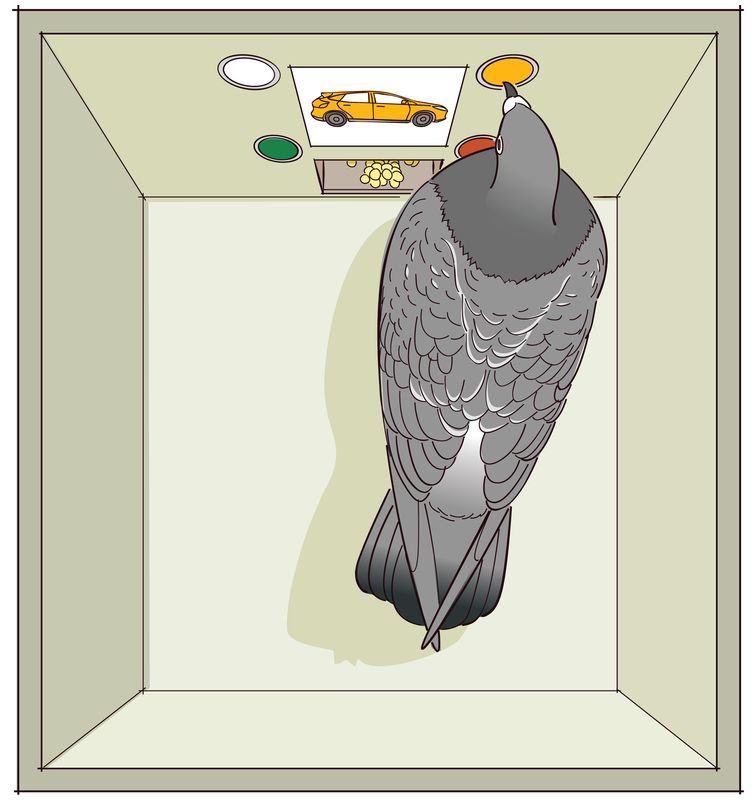
These methods can also be used to study “higher” cognitive processes. For example, pigeons can learn to peck at different buttons in a Skinner box when pictures of flowers, cars, chairs, or people are shown on a miniature TV screen (see Wasserman, 1995). Pecking button 1 (and no other) is reinforced in the presence of a flower image, button 2 in the presence of a chair image, and so on. Pigeons can learn the discrimination readily, and, under the right conditions, will even peck the correct buttons associated with pictures of new flowers, cars, chairs, and people they have never seen before. The birds have learned to categorize the sets of stimuli. Stimulus-control methods can be used to study how such categorization is learned.
这些方法也可以用来研究“更高级”的认知过程。例如,鸽子可以学会在一个斯金纳箱中对不同的按钮进行啄击,当显现出小型电视屏幕上的花朵、汽车、椅子或人的图片时(见 Wasserman,1995)。在花朵图片的前提下,不会补强除了按钮 1 之外的任何按钮;在椅子图片的前提下,会补强按钮 2 等等。鸽子可以容易地学会这种辨别,而且在合适的条件下,它们甚至可以啄击与之前从未见过的花朵、汽车、椅子和人的图片相关联的正确按钮。这些鸟儿已经学会对这些刺激集进行分类。可以使用刺激控制方法来研究这种分类是如何学习的。
Operant Conditioning Involves Choice 操作条件化涉及选择
Another thing to know about operant conditioning is that the response always requires choosing one behavior over others. The student who goes to the bar on Thursday night chooses to drink instead of staying at home and studying. The rat chooses to press the lever instead of sleeping or scratching its ear in the back of the box. The alternative behaviors are each associated with their own reinforcers. And the tendency to perform a particular action depends on both the reinforcers earned for it and the reinforcers earned for its alternatives.
关于操作条件反射的另一件需要了解的事情是,响应始终需要在其他行为中做出选择。在星期四晚上去酒吧的学生选择喝酒而不是呆在家里学习。老鼠选择按动杆而不是在盒子后面睡觉或挠耳朵。每种可替代的行为都与它们自己的强化物相联系。执行特定行为的倾向取决于为其赢得的强化物以及为其替代行为赢得的强化物。
To investigate this idea, choice has been studied in the Skinner box by making two levers available for the rat (or two buttons available for the pigeon), each of which has its own reinforcement or payoff rate. A thorough study of choice in situations like this has led to a rule called the quantitative law of effect (see Herrnstein, 1970), which can be understood without going into quantitative detail: The law acknowledges the fact that the effects of reinforcing one behavior depend crucially on how much reinforcement is earned for the behavior’s alternatives. For example, if a pigeon learns that pecking one light will reward two food pellets, whereas the other light only rewards one, the pigeon will only peck the first light. However, what happens if the first light is more strenuous to reach than the second one? Will the cost of energy outweigh the bonus of food? Or will the extra food be worth the work? In general, a given reinforcer will be less reinforcing if there are many alternative reinforcers in the environment. For this reason, alcohol, sex, or drugs may be less powerful reinforcers if the person’s environment is full of other sources of reinforcement, such as achievement at work or love from family members.
为了调查这个想法,人们在斯金纳盒中研究了选择问题,通过为老鼠提供两个杠杆(或为鸽子提供两个按钮),每个杠杆(或按钮)都有自己的强化或报酬率。对于这种情况下的选择进行了彻底的研究,得出了一条称为数量增强定律的规则(见 Herrnstein,1970),不需要进一步探讨就能理解:这条定律承认了一个事实,那就是强化某种行为的效果极大程度上取决于该行为的替代方案能够获得多少强化。例如,如果鸽子学会了只有轻敲一个灯会奖励两个食物颗粒,而另一个灯只奖励一个,那么鸽子只会轻敲第一个灯。然而,如果第一个灯比第二个灯更难到达,能量成本是否会超过食物奖励?或者额外的食物是否值得努力?总的来说,在环境中存在许多替代的强化物品时,给定的强化物品的强化效果会较弱。 因此,如果个人的环境充满了其他的强化源,如工作上的成就或家人的爱,那么酒精、性或药物可能会成为较弱的强化剂。
Cognition in Instrumental Learning 工具性学习中的认知
Modern research also indicates that reinforcers do more than merely strengthen or “stamp in” the behaviors they are a consequence of, as was Thorndike’s original view. Instead, animals learn about the specific consequences of each behavior, and will perform a behavior depending on how much they currently want—or “value”—its consequence.
现代研究还表明,强化物不仅仅是增强或“固化”它们作为结果的行为,这是索恩迪克最初的观点。相反,动物会了解每个行为的具体后果,并根据它们目前的欲望程度或“价值”来执行行为。
[Image courtesy of Bernard W. Balleine]
[贝纳德·巴利恩的图片提供]
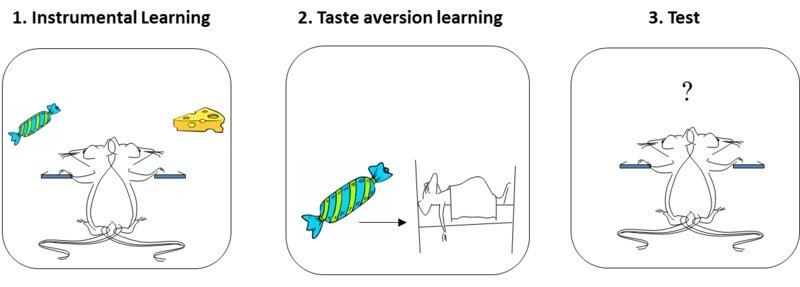
This idea is best illustrated by a phenomenon called the reinforcer devaluation effect (see Colwill & Rescorla, 1986). A rat is first trained to perform two instrumental actions (e.g., pressing a lever on the left, and on the right), each paired with a different reinforcer (e.g., a sweet sucrose solution, and a food pellet). At the end of this training, the rat tends to press both levers, alternating between the sucrose solution and the food pellet. In a second phase, one of the reinforcers (e.g., the sucrose) is then separately paired with illness. This conditions a taste aversion to the sucrose. In a final test, the rat is returned to the Skinner box and allowed to press either lever freely. No reinforcers are presented during this test (i.e., no sucrose or food comes from pressing the levers), so behavior during testing can only result from the rat’s memory of what it has learned earlier. Importantly here, the rat chooses *not *to perform the response that once produced the reinforcer that it now has an aversion to (e.g., it won’t press the sucrose lever). This means that the rat has learned and remembered the reinforcer associated with each response, and can combine that knowledge with the knowledge that the reinforcer is now “bad.” Reinforcers do not merely stamp in responses; the animal learns much more than that. The behavior is said to be “goal-directed” (see Dickinson & Balleine, 1994), because it is influenced by the current value of its associated goal (i.e., how much the rat wants/doesn’t want the reinforcer).
这个想法最好的例证是一个被称为强化削弱效应的现象(参见 Colwill&Rescorla,1986)。首先训练一只老鼠执行两个工具性动作(例如,按下左边的杠杆和右边的杠杆),每个动作都与不同的强化物(例如,甜蔗糖溶液和食物颗粒)配对。在这个训练结束时,老鼠倾向于同时按下两个杠杆,交替使用蔗糖溶液和食物颗粒。在第二阶段,其中一个强化物(例如,蔗糖)与疾病分开配对。这会让蔗糖引起味觉厌恶。在最后的测试中,将老鼠放回 Skinner box,并允许其自由选择按下哪个杠杆。在测试期间没有呈现任何强化物(即不通过按下杠杆获得蔗糖或食物),所以测试期间的行为只能来自老鼠对之前学到的记忆。在这里要注意的是,老鼠选择不执行曾经产生引起厌恶的强化物的反应(例如,它不会按下蔗糖杠杆)。 这意味着老鼠已经学习并记住了与每个回应相关的强化物,它可以将这一知识与强化物“变坏”的知识相结合。强化物不仅仅能够刻印回应,动物从中学到的不仅仅是那些。行为被称为“目标导向”(参见 Dickinson&Balleine,1994),因为它受其关联目标的当前价值的影响(即,老鼠对强化物的想要程度/不想要程度)。
Things can get more complicated, however, if the rat performs the instrumental actions frequently and repeatedly. That is, if the rat has spent many months learning the value of pressing each of the levers, the act of pressing them becomes automatic and routine. And here, this once goal-directed action (i.e., the rat pressing the lever for the goal of getting sucrose/food) can become a habit. Thus, if a rat spends many months performing the lever-pressing behavior (turning such behavior into a habit), even when sucrose is again paired with illness, the rat will continue to press that lever (see Holland, 2004). After all the practice, the instrumental response (pressing the lever) is no longer sensitive to reinforcer devaluation. The rat continues to respond automatically, regardless of the fact that the sucrose from this lever makes it sick.
事情可能变得更复杂,如果老鼠频繁地并且反复地执行工具性动作的话。也就是说,如果老鼠花费了几个月的时间学习按下每一个杠杆的价值,那么按下它们的行为就变成了自动和常规的。而在这里,这个曾经以目标为导向的行为(即老鼠按下杠杆以获取蔗糖/食物的目标)可能会变成一种习惯。因此,如果一只老鼠花费了几个月来执行按压杠杆的行为(将这种行为变成习惯),即使蔗糖再次与疾病相结合,老鼠仍然会继续按下那个杠杆(参见 Holland,2004 年)。经过所有的练习,工具性反应(按压杠杆)不再对奖赏品折价敏感。老鼠会继续自动地做出反应,无论来自这个杠杆的蔗糖是否让它生病。
Habits are very common in human experience, and can be useful. You do not need to relearn each day how to make your coffee in the morning or how to brush your teeth. Instrumental behaviors can eventually become habitual, letting us get the job done while being free to think about other things.
习惯在人类的经验中非常常见,并且可以很有用。你不需要每天早上重新学习如何冲咖啡或者刷牙。工具性行为最终可以变成习惯,让我们可以在完成工作的同时自由地思考其他事情。
Putting Classical and Instrumental Conditioning Together 将古典条件和工具性条件结合起来
Classical and operant conditioning are usually studied separately. But outside of the laboratory they almost always occur at the same time. For example, a person who is reinforced for drinking alcohol or eating excessively learns these behaviors in the presence of certain stimuli—a pub, a set of friends, a restaurant, or possibly the couch in front of the TV. These stimuli are also available for association with the reinforcer. In this way, classical and operant conditioning are always intertwined.
古典和操作性条件反射通常被分开研究。但在实验室之外,它们几乎总是同时发生。例如,一个因喝酒或过度进食而得到强化的人会在特定的刺激物存在下学会这些行为——酒吧、一群朋友、一家餐厅,或者可能是电视前的沙发。这些刺激物也可以与强化物进行关联。以这种方式,古典和操作性条件反射总是相互交织的。
The figure below summarizes this idea, and helps review what we have discussed in this module. Generally speaking, any reinforced or punished operant response (R) is paired with an outcome (O) in the presence of some stimulus or set of stimuli (S).
下图总结了这个思想,并帮助回顾我们在这个模块中讨论的内容。一般来说,在某个刺激或一组刺激(S)的存在下,任何被加强或被惩罚的操作性反应(R)都会与一个结果(O)配对。
The figure illustrates the types of associations that can be learned in this very general scenario. For one thing, the organism will learn to associate the response and the outcome (R – O). This is instrumental conditioning. The learning process here is probably similar to classical conditioning, with all its emphasis on surprise and prediction error. And, as we discussed while considering the reinforcer devaluation effect, once R – O is learned, the organism will be ready to perform the response if the outcome is desired or valued. The value of the reinforcer can also be influenced by other reinforcers earned for other behaviors in the situation. These factors are at the heart of instrumental learning.
该图示了在这个非常普遍的情境中可以学习到的联想类型。首先,有机体将学习将响应与结果关联起来(R - O)。这是一种工具性条件反射。在这里,学习过程可能类似于经典条件反射,重点是对意外和预测误差的强调。而且,正如我们在考虑强化削弱效应时所讨论的那样,一旦学习了 R - O,如果期望或重视结果,有机体将准备好执行响应。强化剂的价值也可能受到在该情境中为其他行为而获得的其他强化剂的影响。这些因素是工具性学习的核心。
Second, the organism can also learn to associate the stimulus with the reinforcing outcome (S – O). This is the classical conditioning component, and as we have seen, it can have many consequences on behavior. For one thing, the stimulus will come to evoke a system of responses that help the organism prepare for the reinforcer (not shown in the figure): The drinker may undergo changes in body temperature; the eater may salivate and have an increase in insulin secretion. In addition, the stimulus will evoke approach (if the outcome is positive) or retreat (if the outcome is negative). Presenting the stimulus will also prompt the instrumental response.
其次,生物体还可以学会将刺激与强化结果(S - O)关联起来。这是经典条件作用的组成部分,正如我们所看到的,它对行为有许多影响。首先,刺激将引起一系列帮助生物体为强化物做好准备的反应(在图中未显示):喝水者可能会发生体温变化;吃东西者可能会分泌唾液并增加胰岛素分泌。此外,刺激还会引起靠近(如果结果是积极的)或远离(如果结果是消极的)的反应。呈现刺激还会引发工具性反应。
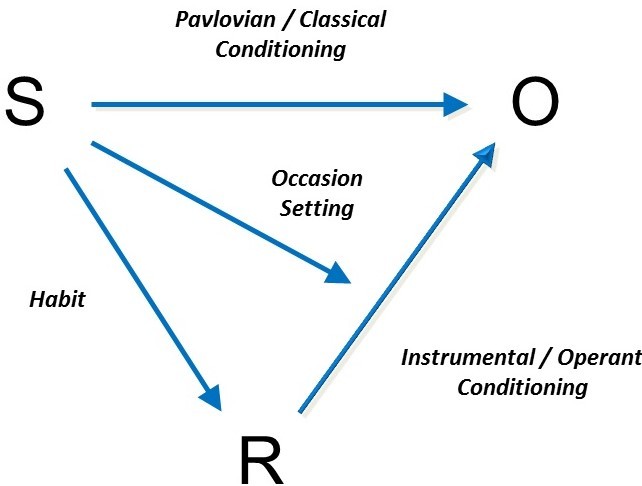
The third association in the diagram is the one between the stimulus and the response (S – R). As discussed earlier, after a lot of practice, the stimulus may begin to elicit the response directly. This is habit learning, whereby the response occurs relatively automatically, without much mental processing of the relation between the action and the outcome and the outcome’s current value.
图示中的第三个关联是刺激和反应之间的关联(S-R)。正如之前讨论的,经过大量练习后,刺激可能开始直接引发反应。这是习惯性学习,即反应相对自动地发生,不需要太多关于行动和结果以及结果当前价值之间关系的思考。
The final link in the figure is between the stimulus and the response-outcome association [S – (R – O)]. More than just entering into a simple association with the R or the O, the stimulus can signal that the R – O relationship is now in effect. This is what we mean when we say that the stimulus can “set the occasion” for the operant response: It sets the occasion for the response-reinforcer relationship. Through this mechanism, the painter might begin to paint when given the right tools and the opportunity enabled by the canvas. The canvas theoretically signals that the behavior of painting will now be reinforced by positive consequences.
图中的最后一个连接是刺激和反应-结果关联之间的 [S - (R - O)]. 不仅仅是与 R 或 O 建立一个简单的关联,刺激还可以表明 R - O 的关系已经生效。当我们说刺激可以"创造条件"来进行一种操作性反应时,我们指的是它为响应 - 强化物的关系创造了条件。通过这种机制,画家可以在给定正确的工具和画布的机会下开始绘画。理论上,画布信号表明绘画行为现在将通过积极的结果加以强化。
The figure provides a framework that you can use to understand almost any learned behavior you observe in yourself, your family, or your friends. If you would like to understand it more deeply, consider taking a course on learning in the future, which will give you a fuller appreciation of how classical learning, instrumental learning, habit learning, and occasion setting actually work and interact.
该图示提供了一个框架,您可以用来理解自己、家人或朋友所观察到的几乎所有学习行为。如果您想更深入地了解它,考虑未来参加一门关于学习的课程,这将使您更全面地欣赏经典学习、工具性学习、习惯性学习和场境设置是如何实际运作和相互作用的。
Observational Learning 观察性学习
Not all forms of learning are accounted for entirely by classical and operant conditioning. Imagine a child walking up to a group of children playing a game on the playground. The game looks fun, but it is new and unfamiliar. Rather than joining the game immediately, the child opts to sit back and watch the other children play a round or two. Observing the others, the child takes note of the ways in which they behave while playing the game. By watching the behavior of the other kids, the child can figure out the rules of the game and even some strategies for doing well at the game. This is called observational learning.
并非所有的学习形式都完全由经典条件和操作条件解释得到。想象一下,一个孩子走到操场上一群正在玩游戏的孩子旁边。游戏看起来很有趣,但它是新的和陌生的。孩子没有立即加入游戏,而是选择坐下来观察其他孩子玩一两局。通过观察其他人,孩子注意到他们在游戏中的行为方式。通过观察其他孩子的行为,孩子可以找出游戏的规则,甚至一些在游戏中做得好的策略。这被称为观察学习。
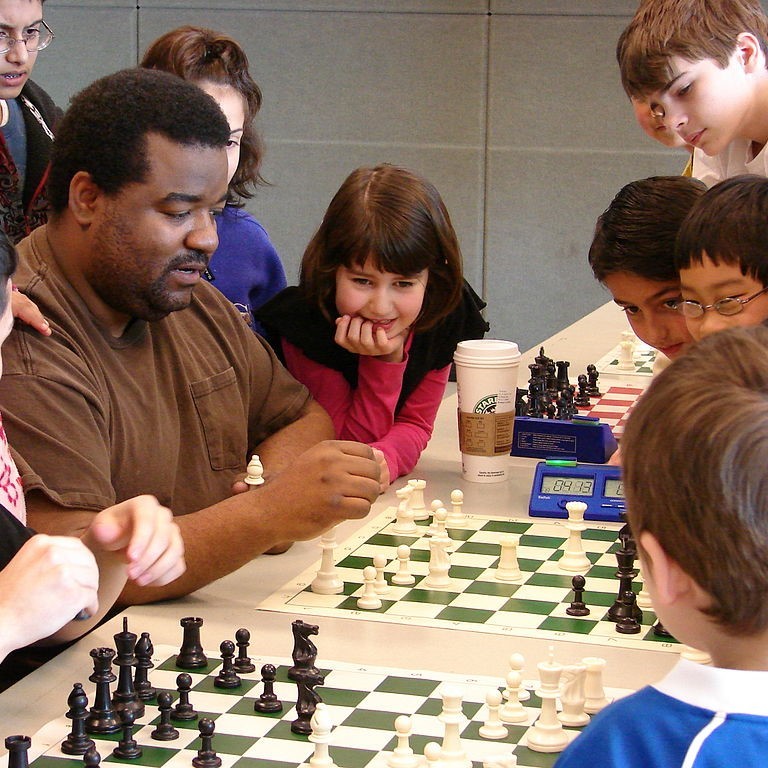
Children observing a social model (an experienced chess player) to learn the rules and strategies of the game of chess. [Image: David R. Tribble, https://goo.gl/nWsgxI, CC BY-SA 3.0, https://goo.gl/uhHola]
观察社会榜样(一位经验丰富的国际象棋选手)的孩子们,以学习国际象棋的规则和策略。 [图片:David R. Tribble,https://goo.gl/nWsgxI,CC BY-SA 3.0,https://goo.gl/uhHola]
Observational learning is a component of Albert Bandura’s Social Learning Theory (Bandura, 1977), which posits that individuals can learn novel responses via observation of key others’ behaviors. Observational learning does not necessarily require reinforcement, but instead hinges on the presence of others, referred to as social models. Social models are typically of higher status or authority compared to the observer, examples of which include parents, teachers, and police officers. In the example above, the children who already know how to play the game could be thought of as being authorities—and are therefore social models—even though they are the same age as the observer. By observing how the social models behave, an individual is able to learn how to act in a certain situation. Other examples of observational learning might include a child learning to place her napkin in her lap by watching her parents at the dinner table, or a customer learning where to find the ketchup and mustard after observing other customers at a hot dog stand.
观察学习是阿尔伯特·班杜拉(Bandura, 1977)的社会学习理论的一个组成部分,该理论认为个体可以通过观察他人行为来学习新的反应。观察学习不一定需要强化,而是依赖于他人的存在,被称为社会榜样。社会榜样通常具有较高的地位或权威,与观察者相比,例如父母、教师和警察等。在上面的例子中,已经知道如何玩游戏的孩子可以被看作是权威人物,因此他们是社会榜样,即使他们与观察者同岁。通过观察社会榜样的行为,个体能够学习如何在特定情境下行动。其他观察学习的例子可能包括通过观察父母在餐桌上的行为学会将餐巾放在膝盖上的孩子,或者通过观察热狗摊前的其他顾客学会在哪里找到番茄酱和芥末。
Bandura theorizes that the observational learning process consists of four parts. The first is attention—as, quite simply, one must pay attention to what s/he is observing in order to learn. The second part is retention: to learn one must be able to retain the behavior s/he is observing in memory.The third part of observational learning, initiation, acknowledges that the learner must be able to execute (or initiate) the learned behavior. Lastly, the observer must possess the motivation to engage in observational learning. In our vignette, the child must want to learn how to play the game in order to properly engage in observational learning.
班杜拉理论认为,观察学习过程由四个部分组成。第一个是注意力 - 简单地说,人们必须注意观察到的内容才能学习。第二部分是记忆:学习者必须能够将观察到的行为保留在记忆中。观察学习的第三部分,启动,承认学习者必须能够执行(或启动)所学的行为。最后,观察者必须具备参与观察学习的动机。在我们的例子中,孩子必须希望学习如何玩游戏,才能正确地进行观察学习。
Researchers have conducted countless experiments designed to explore observational learning, the most famous of which is Albert Bandura’s “Bobo doll experiment.”
研究人员进行了无数实验来探索观察学习,其中最著名的是艾伯特·班杜拉的“波波娃娃实验”。

Bobo [Image: © Sémhur / Wikimedia Commons / CC-BY-SA-3.0 (or Free Art License), https://goo.gl/uhHola]
In this experiment (Bandura, Ross & Ross 1961), Bandura had children individually observe an adult social model interact with a clown doll (“Bobo”). For one group of children, the adult interacted aggressively with Bobo: punching it, kicking it, throwing it, and even hitting it in the face with a toy mallet. Another group of children watched the adult interact with other toys, displaying no aggression toward Bobo. In both instances the adult left and the children were allowed to interact with Bobo on their own. Bandura found that children exposed to the aggressive social model were significantly more likely to behave aggressively toward Bobo, hitting and kicking him, compared to those exposed to the non-aggressive model. The researchers concluded that the children in the aggressive group used their observations of the adult social model’s behavior to determine that aggressive behavior toward Bobo was acceptable.
在这个实验中(班杜拉、罗斯和罗斯 1961 年),班杜拉让孩子们个别观察一个成年社会角色与一个小丑娃娃(“波波”)互动。对于其中一组孩子,成年人对波波表现出攻击性:拳打它、踢它、甩它,甚至用玩具锤子打在它的脸上。另一组孩子观察到成年人与其他玩具互动,对波波没有任何攻击行为。在两种情况下,成年人离开后,孩子们可以自己与波波互动。班杜拉发现,观察到暴力社会角色的孩子明显更有可能对波波表现出攻击性,打和踢它,相比于那些观察到非攻击性社会角色的孩子。研究人员得出结论,攻击组的孩子利用他们观察到的成年社会角色的行为来确定对波波采取攻击行为是可以接受的。
While reinforcement was not required to elicit the children’s behavior in Bandura’s first experiment, it is important to acknowledge that consequences do play a role within observational learning. A future adaptation of this study (Bandura, Ross, & Ross, 1963) demonstrated that children in the aggression group showed less aggressive behavior if they witnessed the adult model receive punishment for aggressing against Bobo. Bandura referred to this process as vicarious reinforcement, as the children did not experience the reinforcement or punishment directly, yet were still influenced by observing it.
虽然在班杜拉的第一个实验中不需要强化来引发儿童的行为,但要承认,后果在观察学习中确实发挥了作用。该研究后来的一个改编版本(班杜拉、罗斯和罗斯,1963 年)证明,如果孩子们目睹成人榜样因攻击波波(Bobo)而受到惩罚,那么攻击组的孩子表现出较少的攻击行为。班杜拉称这个过程为观摩性强化,因为这些孩子并没有直接经历到强化或惩罚的效果,但他们仍然受到观察的影响。
Conclusion 结论
We have covered three primary explanations for how we learn to behave and interact with the world around us. Considering your own experiences, how well do these theories apply to you? Maybe when reflecting on your personal sense of fashion, you realize that you tend to select clothes others have complimented you on (operant conditioning). Or maybe, thinking back on a new restaurant you tried recently, you realize you chose it because its commercials play happy music (classical conditioning). Or maybe you are now always on time with your assignments, because you saw how others were punished when they were late (observational learning). Regardless of the activity, behavior, or response, there’s a good chance your “decision” to do it can be explained based on one of the theories presented in this module.
我们已经讨论了我们学习如何行为和与周围世界互动的三个主要解释。考虑到你自己的经验,这些理论对你适用吗?也许当你反思自己的个人时尚感时,你意识到你倾向于选择别人称赞过的衣服(操作性条件作用)。或者说,回想起你最近尝试的一家新餐馆,你意识到你选择它是因为它的广告播放快乐的音乐(经典条件作用)。或者说,你现在总是按时完成作业,因为你看到别人迟交作业时受到了惩罚(观察性学习)。无论是活动、行为还是反应,很有可能你对它的“决定”可以基于本单元中所提出的理论来解释。
Outside Resources 外部资源
Article: Rescorla, R. A. (1988). Pavlovian conditioning: It’s not what you think it is. American Psychologist, 43, 151–160.
文章:Rescorla,R. A.(1988 年)。巴甫洛夫条件反射:它不是你想的那样。美国心理学家,43,151-160。
Book: Bouton, M. E. (2007). Learning and behavior: A contemporary synthesis. Sunderland, MA: Sinauer Associates.
书籍:Bouton,M. E.(2007 年)。学习与行为:当代综合。Sunderland, MA: Sinauer Associates。
Book: Bouton, M. E. (2009). Learning theory. In B. J. Sadock, V. A. Sadock, & P. Ruiz (Eds.), Kaplan & Sadock’s comprehensive textbook of psychiatry (9th ed., Vol. 1, pp. 647–658). New York, NY: Lippincott Williams & Wilkins.
书籍:Bouton,M. E.(2009 年)。学习理论。In B. J. Sadock, V. A. Sadock, & P. Ruiz(Eds.),Kaplan & Sadock's comprehensive textbook of psychiatry(第 9 版,第 1 卷,第 647-658 页)。纽约,NY: Lippincott Williams & Wilkins。
Book: Domjan, M. (2010). The principles of learning and behavior (6th ed.). Belmont, CA: Wadsworth.
书籍:Domjan, M. (2010). The principles of learning and behavior (6th ed.). Belmont, CA: Wadsworth.
Video: Albert Bandura discusses the Bobo Doll Experiment.
视频:阿尔伯特·班杜拉讨论波波娃娃实验。
Discussion Questions 讨论问题
- Describe three examples of Pavlovian (classical) conditioning that you have seen in your own behavior, or that of your friends or family, in the past few days.
描述你自己或者你的朋友或家人在过去几天中在行为上看到的三个巴甫洛夫(经典)条件反射的例子。 - Describe three examples of instrumental (operant) conditioning that you have seen in your own behavior, or that of your friends or family, in the past few days.
描述你自己或者你的朋友或家人在过去几天中在行为上看到的三个工具性(操作性)条件反射的例子。 - Drugs can be potent reinforcers. Discuss how Pavlovian conditioning and instrumental conditioning can work together to influence drug taking.
药物可以是强力的强化剂。讨论巴甫洛夫条件反射和工具性条件反射如何共同影响服药。 - In the modern world, processed foods are highly available and have been engineered to be highly palatable and reinforcing. Discuss how Pavlovian and instrumental conditioning can work together to explain why people often eat too much.
在现代社会中,加工食品的供应充足,并且被调整以具有极高的可口性和强化效果。讨论经典条件反射和工具性条件反射如何共同解释为什么人们常常吃得太多。 - How does blocking challenge the idea that pairings of a CS and US are sufficient to cause Pavlovian conditioning? What is important in creating Pavlovian learning?
阻滞是如何挑战将条件刺激和无条件刺激配对足以引起经典条件反射的观念?在创建经典学习过程中,什么是重要的? - How does the reinforcer devaluation effect challenge the idea that reinforcers merely “stamp in” the operant response? What does the effect tell us that animals actually learn in operant conditioning?
强化剂贬值效应如何挑战强化剂仅是“铭记”操作反应的观点?这种效应告诉我们在工具性条件反射中动物到底学到了什么? - With regards to social learning do you think people learn violence from observing violence in movies? Why or why not?
- What do you think you have learned through social learning? Who are your social models?
Source: https://nobaproject.com/modules/conditioning-and-learning